 Ian Egan
Table of Contents
Founder and CEO Wayne Skipper of Concentric Sky leads the way
Wayne Skipper is the Founder and CEO of Concentric Sky and leads a team of professionals who design and build a wide range of software products – from focused, individualized K-6 software to large-scale analytics systems that quantify the activity of user populations. Wayne is somewhat of a maverick, a veteran of the US Navy, Texas Instruments and Dell who is now creating the future of credentialing in education.
Education is at a turning point. The hundreds-year-old system of non-specific diplomas and degrees quickly gives way to a system that identifies skill sets and competencies. K-12, community colleges, traditional higher ed and even post-graduate education are all redefining their value in the global marketplace. Learners will not only need to define their competencies, but they will need to display and share those competencies with employers.
We are moving towards a digital landscape where a common, shared language will allow learning achievements to be recognized, and skills will become transferable to any applicable working situation. It is not only the future of education; it is a future that is arriving at breakneck speed. There are a handful of companies and organizations that are making this happen. Fewer still are the companies that have the technical ability and the vision to get us there.
 Wayne Skipper and Concentric Sky are very well-known within technology circles. Still, most educators and the general public have little knowledge of how the technical transformation in education is taking place. In twenty years, education at all levels will look very different. Learners will have a public persona, and their achievements will be documented and searchable, much the way we search for consumer products on the Internet today.
Companies will hire their employees globally, relying on provable skillsets to find and hire their remote workforces. It will all be made possible by an open system of credentials that industry and education institutions use and agree on. Skipper’s company, Concentric Sky, has been instrumental in helping to create this change in our educational system.
The Growing Impact of Open Badges and Open Technology Standards
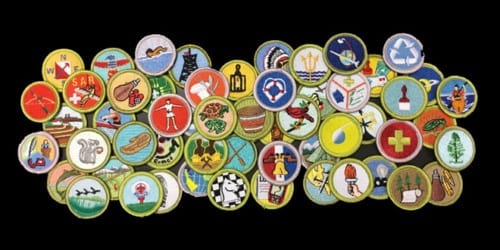
Nearly 15 million Open Badges have been issued in the last few years in the US alone. Skipper was among many who saw a need for a digital version of the badge system. Concentric Sky’s leadership in the development of Open Badges and Open Pathways not only answered that need but revolutionized the utility of badges for users.
“Concentric Sky has led the development of open badges since 2015,” said Skipper. “Under the auspices of the MacArthur Foundation, we developed the 2.0 specification and wrote the developers’ tools, developers’ guide, as well as the open source badge validation tools which are currently used throughout the ecosystem to validate badges. If you’re working with badges, you are most likely using our tech at some level.”
Concentric Sky’s work with open badges led MacArthur Foundation spin-off Collective Shift to approach them in 2015 to take over stewardship of the Badge Alliance, which they held until January of 2017 when they passed it over to IMS Global Learning Consortium, a member-driven global standards body.
 “Open Badges is a technology standard that allows you to take any learning achievement, whether formal or informal and recognize it with a portable micro-credential,” said Skipper. “In the past, we’ve had formal achievements signaled by a degree and informal achievements like Scout badges signaled by other means. Open Badges allows both kinds of learning achievements to be signaled in the same way, along with a host of other kinds of achievements – think certifications issued by trade organizations, professional development credentials, and such. Open standards allow us to put all these types of learning activities on the same playing field and describe them all in the same language.”
Making Badges Better
In order for a badge to have meaning, said Skipper, it has to be part of a system of meaning that relates to other credentials. It needs context. “Using Open Pathways, we can describe badges in terms of the badges around them. We can take badges issued by any platform, and arrange them together – stack them – to give them rich context. It’s a revolutionary new way to think of credentials. It allows organizations to leverage credentials that they themselves did not originate.”
As an example, Skipper said, “Let’s say your organization doesn’t teach computer fundamentals, yet those skills are a prerequisite for your coursework. Badgr allows you to pull in badges from programs that do teach those skills and make them prerequisites for your own program. This gives learners the opportunity to utilize the competencies they’ve developed elsewhere without you having to teach it all yourself. And the same is true of your credentials – others can stack them. This enables organizations to create what we call cross-institutional learning pathways, or pathways that start in one context, say high school – pass through another context such as community college – and then link together with pathways in higher education and workforce training.”
Badgr’s Pathways system provides value to three primary groups: students or badge earners, badge issuing institutions, and employers.
 “Pathways in Badgr allow students to discover new learning pathways upon which their badges may fall,” said Skipper. “We can look at all the badges a student has and show them pathways that they have already partially completed. For instance, if I’ve earned a certification in Maine, without something like Pathways, I wouldn’t have any way of knowing that it is accepted for credit as part of a Master’s degree in Georgia.”
For institutions, this technology creates a feedback loop that doesn’t currently exist: ‘how’ are people actually using your credentials. When an institution’s credentials are added to Pathways, and when students actually present them, we can report back to the issuing institution. This is so much more valuable than just counting Facebook likes, which is the best you can get from most badging platforms.
Pathways also have major benefits for hiring and workforce development. Employers can understand not just what qualifications applicants have today based on a snapshot of their achievements, but what skills an applicant is likely to acquire based on their existing learning achievements. It’s a way of forecasting skills achievement based on the performance of other learners travelling similar pathways. With professional skillsets becoming more and more specialized, the unique profile each person can develop through open badges is a clear way to demonstrate who is right for a given position. Open Pathways supplies the standards and technology that makes this key intelligence available.
Badgr as a Tool Kit
 “There are over a thousand different products in the world that will issue an Open Badge to you,” said Skipper. “What makes Badgr different is that it is a complete open source toolkit. Our goal is to give developers a tool that handles all of the heavy lifting around Open Badges and demonstrates industry best practices. Badgr was originally designed to serve as the official reference implementation of the Open Badges standard, and for that reason, great care has been put into its implementation.”
Solving the Skills Gap
We all understand the need for better outcomes for students today. Too many suffer from a skills gap – the gap between the skills they leave school with and what they actually need to get a job in today’s workforce. Badgr and Pathways are tools that allow educators to analyze those outcomes and improve them. Concentric Sky’s focus on building open standards allows for interoperability and for EdTech products from multiple companies to work together in the ways that the educators and students need them to work.
Now educators can address students’ skills gaps, whether 21st-century skills or soft skills. With Badges and Pathways, educators can add those skills into a program based on badges from third parties.
For instance, Concentric Sky’s partner in California Community Colleges’ New World of Work has an excellent rubric of 21st-century skills. Those badges can be required on your pathway, solving the skills gap for your students with material backed by strong pedagogy taught by another organization – all in a way that is digitally verifiable.
Thinking Globally
 Concentric Sky has long-standing partnerships with a wide number of prominent international organizations including The World Bank, United Nations, NASA, the National Science Foundation, National Geographic, Encyclopedia Britannica, and Cengage Learning. There are several thousand organizations using Badgr, including over seven hundred of the world’s leading academic institutions.
The company is internationally active with a strong presence in several regions. Concentric Sky was recently chosen to pilot a national digital credential infrastructure for the Netherlands based on their system of badging and pathways.
According to Skipper, “I’m motivated to the make the world a better place, which is one of the things that differentiates us as a company. Concentric Sky is a unique player in the technology space because we’re not a single product company, nor are we externally funded. I’m the only shareholder, and with no investors to please, I can decide to spend millions of dollars writing an open source project like Badgr and give it away.”
Author
Connie Bosley is a retired K12 teacher with over 30 years’ experience in the classroom. She has served on multiple school and district curriculum and tech committees as well as on the local newspaper education board.
She continues to study and write about the K-12 Districts’ issues with tech purchase, as well as the problems Ed Tech companies have in understanding and working with educators. Connie is currently working as a freelance business-to-business writer for the Education industry.
You can follow her on Twitter. For more information, visit
- Forbes – Taming The Wild West Of Digital Badges And Credentials
- PR Web – Concentric Sky and SURFnet announce collaboration
- Cision – Partnership Announced to Advance New Ecosystems for Learning