
 EdCircuit Staff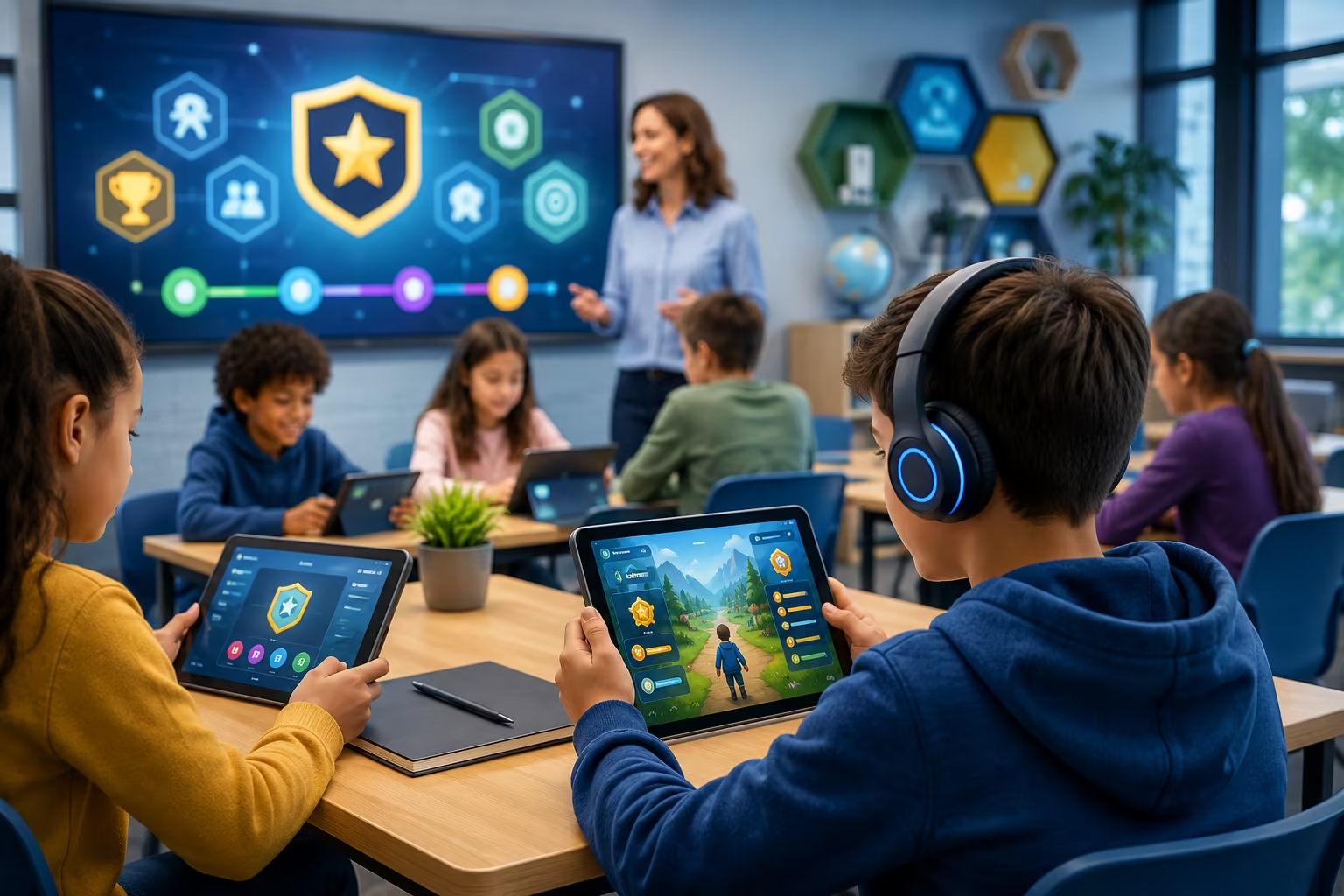
Table of Contents
Gamification in modern classrooms is no longer simply about points, badges, and leaderboards. What started as a creative way to motivate students has evolved into one of the most sophisticated instructional strategies in education, blending psychology, technology, personalized learning, and artificial intelligence to create engaging learning experiences that mirror the digital world students encounter every day.
Walk into many classrooms today and you may find students solving digital escape rooms, participating in mission-based science investigations, earning micro-credentials for demonstrating mastery, collaborating on team challenges, or progressing through personalized learning pathways designed specifically for their needs. In many cases, students may not even realize they are participating in a gamified experience because the focus has shifted away from rewards and toward meaningful engagement.
As educators continue searching for ways to capture student attention in an increasingly digital world, gamification is proving to be more than a trend. It is becoming a powerful instructional framework that helps schools address some of education’s most persistent challenges: engagement, motivation, personalization, and achievement.
At the same time, artificial intelligence is accelerating the evolution of gamification, creating learning experiences that would have been impossible just a few years ago.
The result is a new generation of gamified learning that looks very different from the systems educators first experimented with twenty years ago.
Gamification Has Been Around Longer Than Many Realize
While gamification often feels like a modern concept, educators have been using gamified principles for decades.
Long before laptops and tablets entered classrooms, teachers created systems that motivated students through achievement and progression.
Examples include:
- Reading challenges
- Classroom economies
- Accelerated Reader programs
- Spelling bees
- Science fairs
- Attendance incentives
- Math fact competitions
- Student leadership programs
These activities tapped into many of the same motivational principles found in modern gamification.
Students worked toward goals.
They received recognition.
They experienced progression.
They developed a sense of accomplishment.
Technology did not invent gamification. Technology expanded its possibilities.
As digital tools became more sophisticated, educators gained the ability to provide instant feedback, personalized learning paths, adaptive challenges, and immersive experiences that could engage students at entirely new levels.
Why Gamification Continues to Work
The continued success of gamification is rooted in human psychology.
Games are designed to keep participants engaged through a combination of challenge, achievement, feedback, and progression.
The same principles can be applied to learning.
Students are more likely to remain engaged when they understand:
- What they are working toward
- How they are progressing
- What success looks like
- How to improve
- Why their work matters
Traditional educational models often struggle in these areas.
Students may complete an assignment and wait days before receiving feedback. They may not understand how a lesson connects to larger goals. They may not recognize their progress until the end of a grading period.
Gamified learning environments address these challenges by making progress visible and learning more interactive.
Rather than asking students to simply complete assignments, gamification encourages them to participate in a journey.
The difference may seem subtle, but its impact can be significant.
Today’s Students Already Live in Gamified Environments
One reason gamification continues to evolve is because students themselves are changing.
Today’s learners have grown up in environments built around engagement systems.
They earn achievements in video games.
They maintain streaks on apps.
They unlock levels.
They collect digital rewards.
They receive immediate feedback from nearly every platform they use.
Popular platforms such as Duolingo, Minecraft, and Roblox have helped shape student expectations around interaction and engagement.
Students have become accustomed to environments that provide:
- Immediate feedback
- Clear goals
- Personal progression
- Customization
- Achievement recognition
- Continuous challenges
When students enter a classroom that relies exclusively on passive instruction, educators may find themselves competing against experiences that are significantly more interactive.
Gamification helps bridge that gap by incorporating elements that students already find motivating while maintaining academic rigor and educational purpose.
How AI Is Reinventing Classroom Gamification
Artificial intelligence may be the most significant advancement in gamification since the arrival of educational technology platforms.
Traditional gamification systems often treated every student the same.
AI changes that.
Modern AI-powered learning platforms can analyze student performance in real time and create personalized experiences that adapt as students learn.
Imagine a middle school science classroom.
A student is working through a gamified unit on ecosystems.
Instead of progressing through identical content as every other student, an AI system can:
- Identify misconceptions
- Adjust challenge difficulty
- Recommend additional resources
- Generate personalized review activities
- Offer enrichment opportunities
- Predict potential learning gaps
The experience becomes dynamic rather than static.
Each student receives a customized pathway designed to maximize success.
This level of personalization was once impossible for even the most skilled educator managing a classroom of 25 or 30 students.
Today, AI is making it increasingly achievable.
Real-World Examples of Modern Gamification
The most effective gamification strategies are often the simplest.
Across the country, teachers are finding creative ways to transform learning experiences.
The Science Escape Room
A middle school science teacher may transform a unit assessment into a digital escape room.
Students must solve scientific problems, analyze data, and apply concepts to unlock clues and advance through challenges.
Rather than viewing the assessment as a test, students view it as a mission.
The learning objectives remain the same.
The experience changes completely.
Mission-Based History Learning
In social studies classrooms, students may assume the role of historians investigating primary source documents.
Each completed challenge unlocks additional evidence, moving students closer to solving a historical mystery.
Students become active participants rather than passive recipients of information.
Cybersecurity Simulations
As cybersecurity education becomes more important, many schools are implementing gamified simulations.
Students identify phishing attempts, investigate security incidents, and respond to digital threats through scenario-based challenges.
The activities build critical thinking while preparing students for real-world situations.
Mathematics Quest Systems
Some teachers organize mathematics instruction into quest-based learning pathways.
Students complete challenges, unlock advanced levels, and demonstrate mastery before progressing.
The system encourages persistence while allowing learners to move at their own pace.
Collaboration Is Replacing Competition
One of the biggest shifts in gamification involves the movement away from competition.
Early implementations frequently emphasized leaderboards and rankings.
While competition can motivate some students, it can discourage others.
Modern gamification increasingly focuses on collaboration.
Students work together to:
- Solve complex problems
- Complete missions
- Earn group achievements
- Investigate real-world challenges
- Support team success
This shift reflects broader educational goals.
Today’s employers consistently emphasize communication, teamwork, creativity, and problem-solving.
Collaborative gamification helps students develop these essential skills while improving engagement.
Success becomes something shared rather than something won.
The Rise of Micro-Credentials and Digital Badges
Another emerging trend is the use of micro-credentials.
Instead of relying solely on grades, schools are beginning to recognize specific competencies and skills.
Students may earn digital badges for:
- Cybersecurity awareness
- Coding proficiency
- STEM skills
- Leadership
- Communication
- Problem-solving
- Digital citizenship
These credentials create visible evidence of learning and can help students build portfolios that showcase accomplishments beyond traditional report cards.
As workforce expectations continue evolving, micro-credentials may become increasingly valuable indicators of student readiness.
Immersive Technology Is Expanding Possibilities
Virtual reality, augmented reality, and mixed reality technologies are creating new opportunities for gamified learning.
Students can now:
- Explore ancient civilizations
- Visit distant ecosystems
- Conduct virtual laboratory experiments
- Practice technical skills
- Investigate historical events
Gamification enhances these experiences by introducing missions, objectives, achievements, and challenges.
Instead of reading about a concept, students actively engage with it.
The combination of immersive technology and gamification creates powerful opportunities for experiential learning.
As equipment becomes more affordable, these experiences are likely to become increasingly common in K–12 classrooms.
What School Leaders Need to Know
As gamification continues evolving, district leaders face important decisions about implementation.
The goal should never be to make every classroom feel like a video game.
Instead, leaders should focus on how gamification supports educational outcomes.
Several factors deserve consideration.
Professional Development Matters
Effective gamification requires thoughtful instructional design.
Teachers need training not only on technology platforms but also on motivational theory, student engagement, and learning design principles.
Equity Must Remain a Priority
Schools must ensure all students have access to gamified learning opportunities.
Technology access, device availability, and internet connectivity remain important considerations.
Data Privacy Cannot Be Ignored
Many gamified platforms collect student data.
District leaders should carefully evaluate privacy policies, cybersecurity protections, and compliance requirements before implementation.
Measure More Than Engagement
While student engagement is important, schools should also evaluate:
- Academic performance
- Knowledge retention
- Attendance
- Participation
- Student confidence
- Collaboration skills
Successful gamification should improve both engagement and learning outcomes.
The Future of Gamification
The future of gamification may look dramatically different from what exists today.
Artificial intelligence is likely to drive the next generation of learning experiences.
Future systems may create:
- AI-generated quests
- Personalized learning adventures
- Real-time adaptive challenges
- Intelligent tutoring systems
- Career simulation experiences
- Cross-curricular learning missions
Students may move through educational experiences that continuously adapt to their interests, abilities, and goals.
Learning could become increasingly individualized while still maintaining opportunities for collaboration and community.
The technology is advancing rapidly.
The instructional possibilities are expanding just as quickly.
More Than a Trend
Gamification has survived long enough to prove it is not a passing educational fad.
What began as a collection of points, badges, and rewards has matured into a comprehensive instructional strategy capable of supporting engagement, personalization, collaboration, and achievement.
Its continued evolution reflects a broader shift occurring throughout education.
Students increasingly expect interactive experiences.
Teachers need tools that support differentiation.
School leaders are searching for strategies that improve outcomes while preparing students for a rapidly changing future.
Gamification sits at the intersection of all three.
The future classroom may not resemble a video game, but it will likely borrow many of the principles that make games so powerful: immediate feedback, meaningful challenges, visible progress, collaboration, personalization, and continuous growth.
In an era increasingly shaped by artificial intelligence and digital learning, those principles may become some of the most important drivers of student success. As gamification continues to evolve, schools that embrace its potential thoughtfully and strategically will be better positioned to engage learners, support achievement, and prepare students for the world that awaits them beyond graduation.
Subscribe to edCircuit to stay up to date on all of our shows, podcasts, news, and thought leadership articles.