 EdCircuit Staff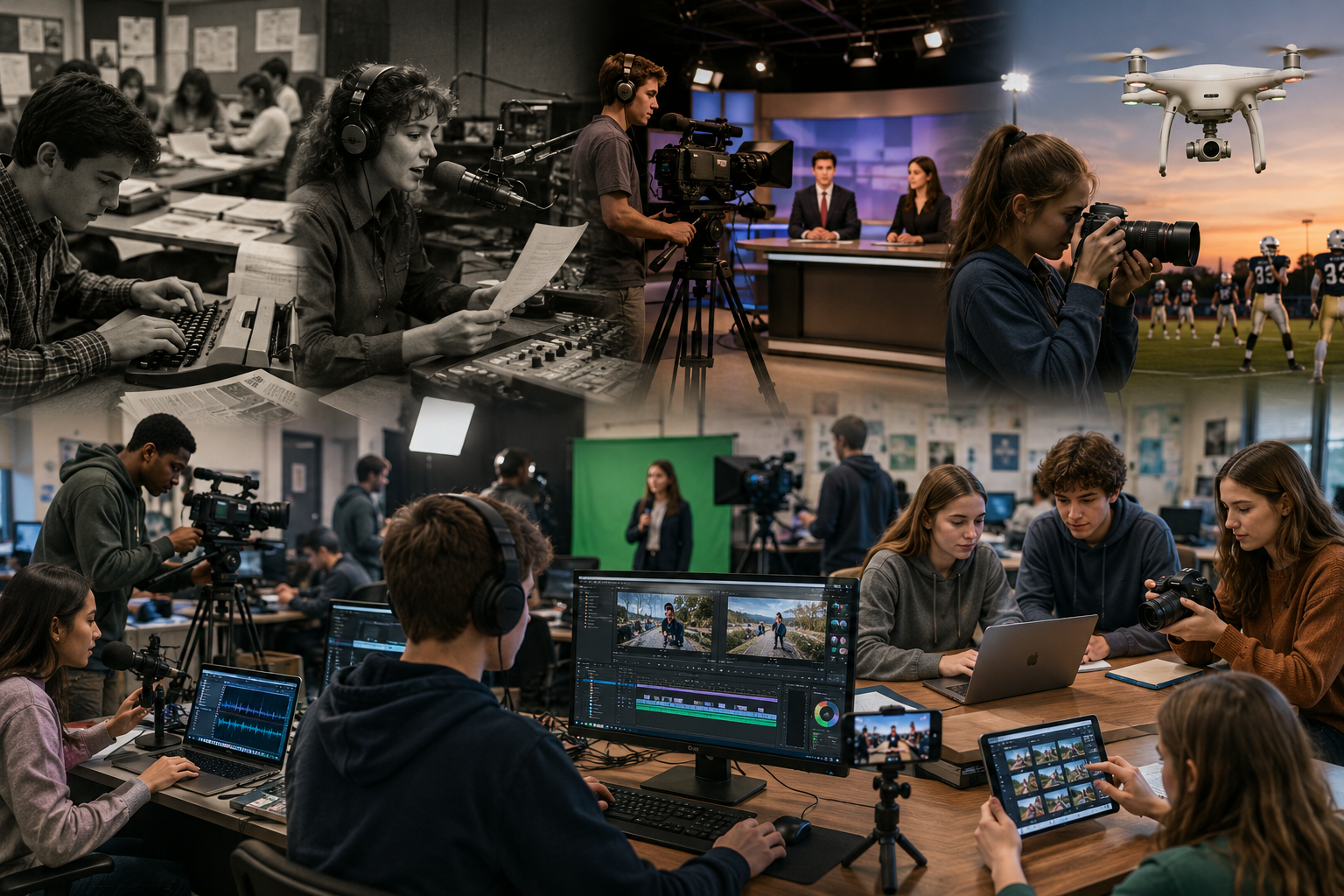
High school media programs are preparing future creators by teaching students how to tell stories, communicate with purpose, and produce content for a rapidly changing digital world.
There was a time when the heartbeat of a high school media department could be heard in the shuffle of paper, the clacking of keyboards, and the urgency of a looming print deadline. In classrooms tucked away near English departments or administrative offices, student journalists hurried to finish articles, finalize layouts, and send the next edition of the school newspaper to print. Reporters chased down quotes in hallways. Editors debated headlines. Photographers rushed to develop film or upload images before the final bell.
By the next morning, stacks of freshly printed newspapers would appear throughout the building. Students grabbed copies between classes, flipping pages to find their friends, read about last night’s game, or catch up on school news. It was simple, tangible, and powerful. The message was clear: stories mattered, and students had a voice in telling them.
From Print to Broadcast: Expanding the Student Voice
That voice did not stay confined to print.
As technology advanced, many schools expanded their media programs to include student-run radio stations. Suddenly, storytelling was no longer just written—it was spoken. Students stepped behind microphones, learned how to script segments, manage sound, conduct interviews, and deliver content with clarity and confidence. The radio booth became a new kind of classroom, one that rewarded preparation, presence, and personality.
Then came another shift.
Television studios began appearing in high schools, transforming morning announcements into full-scale productions. Cameras rolled. The lights turned on. Teleprompters guided student anchors through daily broadcasts. Behind the scenes, production teams managed audio, switching, graphics, and editing. What had once been a simple announcement over a loudspeaker became a polished program watched by an entire school community.
Each step in this evolution added something new, but it never replaced what came before. It expanded it.
Today’s Media Classroom: A Working Production Lab
Today, high school media programs no longer fit into a single category. They are no longer just newspapers, radio stations, or TV studios. They are dynamic, multimedia environments where students learn to create content across platforms. A single media class may include journalism, video production, podcasting, photography, graphic design, livestreaming, and social media strategy—all within the same program.
Walk into a modern media classroom, and the transformation is clear.
One group of students may be editing a highlight reel from last night’s football game, cutting together footage captured from multiple cameras and even drone angles. Another group may be recording a podcast, discussing school events, or interviewing a guest. Across the room, a student is designing graphics for social media, while another writes a feature story for the school website. In a corner, a livestream team prepares to broadcast an upcoming event, checking audio levels and testing connections.
It is not one class. It is a working media lab.
Real-Time Storytelling: Friday Night Lights, Reimagined
On a Friday night, that lab often moves outside the classroom.
At a high school football game, a full student media team may be at work. One student operates the main camera, tracking every play. Another manages a secondary angle, capturing sideline reactions. A third student handles the livestream, ensuring the broadcast reaches families who cannot attend. In the press box, two students call the game, providing play-by-play and analysis. On the sidelines, another student clips highlights in real time, posting key moments to social media before the next drive begins. By Saturday morning, a polished recap video is already live, complete with interviews, graphics, and music.
What once took days now happens in hours.
Schools as Media Companies
This shift reflects a much larger change happening beyond school walls. The way people consume information has transformed dramatically. Audiences no longer rely on a single source or format. They move seamlessly between video, audio, social media, and written content, often within minutes. News is no longer something that arrives once a week or even once a day. It is constant, immediate, and interactive.
Schools have responded to this shift in a powerful way: they have become their own media companies.
Across the country, districts now produce a steady stream of content: videos, newsletters, podcasts, social media updates, livestreams of athletic events and graduations, and features highlighting student achievement. These are not side projects. They are essential tools for communication, transparency, and community engagement.
In many cases, students are at the center of this work.
They are filming games on Friday nights, editing recaps on Saturday mornings, and posting highlights before the weekend ends. They are interviewing principals, teachers, and community leaders. They are producing content that reaches not just their peers, but families, alumni, and the broader community. They are learning, in real time, what it means to communicate with an audience.
Tools of the Trade: Professional Skills in High School
And they are doing it with tools that mirror professional environments.
Today’s media students work with high-quality cameras, audio equipment, lighting setups, editing software, and livestreaming platforms. They learn how to frame a shot, capture clean audio, edit video, design graphics, and analyze engagement. They understand how different platforms require different approaches. A long-form feature story is not the same as a short video clip. A podcast requires a different rhythm than a social post. A livestream demands preparation and adaptability.
AI in the Media Classroom: Power and Responsibility
Increasingly, they are also learning to work with emerging technologies.
Artificial intelligence is becoming part of the modern media classroom in ways that are both practical and powerful. Students use AI tools to generate captions, transcribe interviews, translate content for broader audiences, clean up audio, and organize large amounts of footage quickly. For some students, AI is also helping improve accessibility, making content easier to consume for viewers with different needs. It allows them to produce more content, more efficiently, and with greater reach.
But these tools also introduce important questions.
Just because something can be created faster does not mean it should be published immediately. Students must learn how to balance speed with accuracy, creativity with responsibility, and automation with human judgment. AI can assist with production, but it cannot replace critical thinking, ethical decision-making, or the ability to ask the right questions. Those remain at the core of every strong media program.
From Classroom to Career Pathways
This is where the true value of modern media programs becomes clear.
They are not simply teaching students how to create content. They are teaching them how to communicate with purpose.
That skill extends far beyond the classroom.
Students who participate in media programs graduate with experience that translates directly into real-world opportunities. Some will pursue careers in journalism, broadcasting, filmmaking, or photography. Others will move into marketing, public relations, digital media, or communications. Increasingly, students are entering fields like sports media, social media management, content creation, and brand storytelling. Some launch their own photography or video businesses before they even graduate. Others manage social accounts, produce highlight reels for athletes, or create content that builds a following online.
These are not future skills. They are current ones.
In a world driven by information, communication is no longer a niche skill. It is a universal one.
Confidence, Voice, and Impact
And perhaps most importantly, media programs give students something that cannot be measured on a test: confidence.
There is a unique sense of ownership that comes from creating something for an audience. When students publish a story, produce a video, or host a podcast, they are putting their work into the world. They are learning to take risks, accept feedback, and improve. They are learning that their voice matters.
That lesson stays with them.
The Future of Storytelling Starts Here
Somewhere today, a student is walking into a high school media classroom for the first time. They may think they are there to learn how to edit video, record audio, or operate a camera. What they are really learning is how to tell stories that matter.
The newspaper may have become a podcast. The radio station may have become a livestream. The television studio may now include drones, digital editing, and artificial intelligence.
But the mission has remained remarkably consistent.
Give students a voice. Teach them to use it responsibly. And help them tell the stories that bring a community together.
Every school has stories worth telling.
Every student has a voice worth hearing.
And in today’s world, knowing how to communicate may be just as important as what you know.
Winthrop High School- Media Department – Wake Up Winthrop 6.12.2026 *LAST EPISODE OF THE SCHOOL YEAR*
Subscribe to edCircuit to stay up to date on all of our shows, podcasts, news, and thought leadership articles.