



AI rules for schools should begin with one simple principle: Students should never have to guess whether AI is allowed.
Yet that is exactly what is happening in many classrooms. A student may be encouraged to use AI for brainstorming in one class, prohibited from using it in another, and receive no direction at all in a third. Teachers are often left to establish their own expectations, while families hear conflicting messages about whether AI is a learning tool, a shortcut, or a form of cheating.
That inconsistency is a failure of policy, not of students.
Schools do not need a single rule requiring AI to be used—or banned—in every classroom. They need a shared framework that establishes clear boundaries while allowing teachers to make instructional decisions based on the student’s age, the subject, the assignment, and the learning objective.
The goal is not to remove judgment from the classroom. It is to give educators, students, and families enough clarity to exercise that judgment responsibly.
Begin With Purpose, Not Punishment
A strong school AI policy does not begin with a list of consequences. It begins by explaining why the school is addressing AI at all.
AI can help students brainstorm, practice, ask questions, translate information, receive feedback, and explore difficult concepts. It can also produce inaccurate information, reinforce bias, expose private data, weaken original thinking, and complete work students need to learn how to do independently.
Both realities belong in the policy.
The U.S. Department of Education’s guidance on artificial intelligence in schools emphasizes responsible implementation, privacy, improved learning outcomes, and engagement with teachers and families.
Effective guidance answers five basic questions:
- Who may use AI?
- When is AI permitted?
- Which tools are approved?
- How must AI assistance be disclosed?
- What happens when expectations are not followed?
If students cannot easily find those answers, the policy is not ready.
Give Every Assignment an AI Status
Districtwide guidance can establish common expectations, but individual teachers still need to define how AI applies to specific assignments.
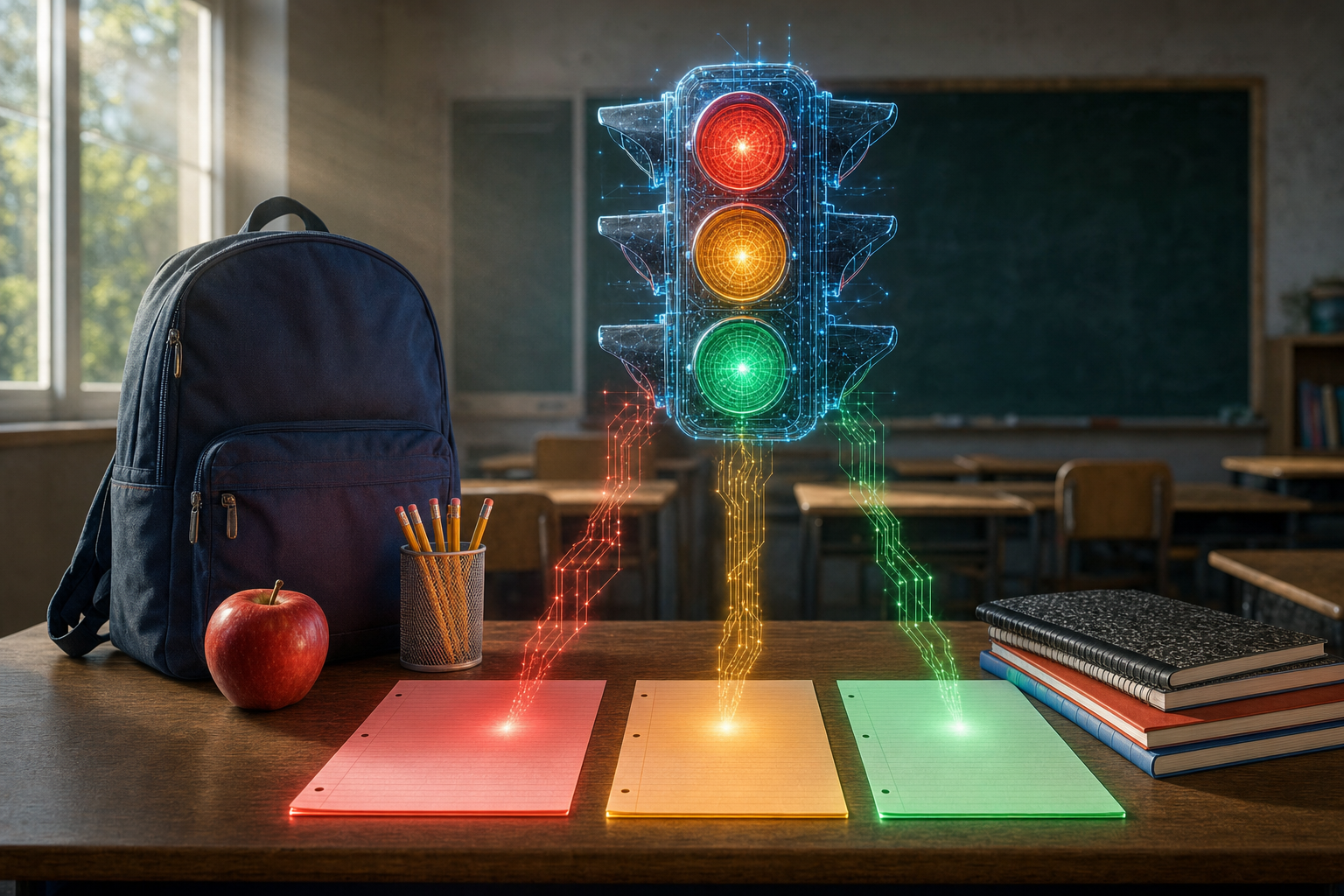
One practical approach is to place every assignment into one of three categories.
Independent Work
Students may not use generative AI during the assignment.
This category is appropriate when teachers need to assess what students know or can produce independently. Examples may include in-class writing, foundational math practice, reading comprehension checks, vocabulary assessments, laboratory observations, and other demonstrations of individual understanding.
The direction should be explicit: “Complete this assignment without generative AI assistance.”
AI-Assisted Work
Students may use AI for limited support, but not to produce the final response.
Permitted uses might include brainstorming, generating practice questions, receiving feedback, checking organization, translating directions, or asking for another explanation of a difficult concept.
The student remains responsible for the ideas, analysis, evidence, and final product.
AI-Integrated Work
AI is intentionally included in the learning experience.
Students might compare AI-generated answers, identify inaccuracies, improve a weak response, examine bias, develop prompts, create media, or document how their thinking changed after interacting with an AI system.
In these assignments, the ability to question and evaluate AI is part of what the teacher is assessing.
Posting the AI status at the top of an assignment, rubric, or learning management system page eliminates ambiguity before the work begins.
Require Disclosure, Not a Confession
When AI is permitted, disclosure belongs in the learning process. It should not be treated as an admission of wrongdoing.
Students need to be able to explain:
- Which AI tool they used
- What they asked it to do
- Which parts of the work it influenced
- What they changed or rejected
- How they verified important claims
- What thinking remained their own
A simple statement may be enough:
I used an AI tool to brainstorm possible topics and review the organization of my draft. I wrote the final response and verified the supporting information using the assigned sources.
The TeachAI Guidance for Schools Toolkit recommends that AI use be disclosed and explained. Formal citations may be appropriate for research papers, while a short AI-use statement may work better for daily assignments.
The purpose is transparency. Students need to understand that responsible AI use includes being honest about how the work was produced.
Establish Age-Appropriate Expectations
The same AI rules cannot be applied identically from kindergarten through 12th grade.
Elementary School
AI use is most appropriate when it is teacher-directed and connected to a specific learning objective. Students may interact with an approved tool as a class, evaluate an AI-generated story, compare images, or discuss why an answer may be incorrect.
Young children cannot be expected to independently manage open-ended AI platforms, privacy settings, or complex terms of service.
Middle School
Students can begin using approved AI tools within structured activities. Expectations at this level can focus on protecting personal information, checking claims, recognizing bias, distinguishing assistance from answer generation, and telling the teacher when AI was used.
This is also an important age for teaching students that a confident response is not necessarily an accurate one.
High School
Students can develop greater independence while accepting greater responsibility. They can learn to document prompts, cite AI assistance, compare sources, evaluate outputs, analyze bias, and decide when AI improves or weakens their work.
High school students still need AI-free opportunities to demonstrate foundational knowledge, write independently, solve problems, and develop their own voice.
UNESCO’s guidance on generative AI in education calls for a human-centered, age-appropriate approach that protects privacy and preserves human agency. Schools must also follow each platform’s minimum-age requirements and any applicable parental-consent provisions.
Protect Student Information
No AI policy is complete without clear privacy boundaries.
Students and educators must not enter protected or personally identifiable information into an unapproved AI platform. That includes:
- Full student names connected to school records
- Grades and confidential assessment results
- Disability, accommodation, or health information
- Disciplinary records
- Counseling information
- Student login credentials
- Addresses, schedules, or location information
- Identifiable photographs, recordings, or student work
Even removing a student’s name may not be enough if the remaining details could identify the individual.
Before approving a tool, districts need to examine vendor terms, data-retention practices, model-training policies, age restrictions, administrative controls, and student data privacy agreements. The U.S. Department of Education’s Student Privacy Policy Office provides resources for evaluating educational technology and understanding FERPA responsibilities.
“Do not enter personal information” is not sufficient guidance. Effective guardrails define what personal information includes and provide realistic examples.
Apply the Rules to Educators, Too
The expectations cannot stop at the student’s desk.
Teachers and administrators need to verify AI-generated information before using it. Instructional materials require review for accuracy, bias, accessibility, and alignment with academic standards. Family communications must be personalized and checked before they are sent.
AI must not independently determine grades, disciplinary consequences, special education services, course placement, student risk levels, or other high-impact decisions.
Educators also need to consider whether disclosure is appropriate when AI substantially contributes to a lesson, assessment, communication, or resource. Modeling transparency is one of the most effective ways to teach it.
If students are expected to explain their AI use, adults must be prepared to do the same.
Do Not Treat AI Detection as Proof
Schools understandably want a reliable way to determine whether AI completed a student’s work. Current AI-detection systems cannot provide that certainty.
A Stanford-led study found that several AI detectors frequently misclassified writing by non-native English writers as AI-generated. The researchers cautioned against using such systems in evaluative educational settings because of concerns about reliability and fairness. The published study found that more than 61% of the tested TOEFL essays were falsely classified by the detectors examined.
A detection score may prompt a closer look, but it cannot automatically produce an accusation or academic penalty.
Teachers need to examine the full body of evidence:
- Does the work match the student’s established performance?
- Can the student explain the argument and evidence?
- Are outlines, notes, drafts, or version histories available?
- Did the student follow the assignment’s disclosure requirements?
- Can the student reproduce or defend key parts of the work?
A conversation with the student is more educational and more defensible than a verdict generated by another algorithm.
Design Assessments That Reveal Thinking
AI policy cannot carry the full burden of protecting academic integrity. Instruction and assessment must evolve as well.
Schools need to preserve opportunities for in-class writing, oral explanations, demonstrations, discussions, drafts, problem-solving, and teacher observation. These approaches provide evidence of how students think, not just what they submit.
Teachers can also design assignments that require students to:
- Connect content to local or personal experiences
- Use specific classroom discussions or sources
- Submit notes, drafts, and revisions
- Explain why they made particular choices
- Defend their reasoning in a brief conference
- Critique an AI-generated response
- Identify and correct inaccurate AI claims
- Compare independent work with AI-assisted work
The answer is not to make every assignment “AI-proof.” That may be impossible. The better goal is to make student thinking visible.
Bring Families Into the Conversation
Families need a clear explanation of how the school approaches AI before concerns arise.
Communication can identify approved uses, prohibited uses, privacy expectations, disclosure requirements, age restrictions, and whom parents should contact with questions. Families also need to understand that AI expectations may differ across assignments because the learning objectives are different.
Schools can provide examples of productive home use, such as asking AI to generate practice questions, explain a concept in another way, or provide feedback without rewriting the student’s work.
Clear communication helps parents reinforce the same message students hear at school: AI can support learning, but it should not replace it.
A Student AI Agreement
A classroom or school AI agreement can be short enough for students to understand and specific enough to guide their decisions:
- I will use AI only when my teacher permits it.
- I will use only school-approved tools and accounts.
- I will not enter personal or confidential information.
- I will explain how AI contributed to my work.
- I will verify important facts with reliable sources.
- I will not submit AI-generated work as entirely my own.
- I will remain responsible for everything I submit.
The agreement must be taught, discussed, and revisited. A checkbox buried inside an acceptable-use policy will not build responsible habits.
Clear Rules Create Confident Users
Schools do not need to wait for a perfect, permanent AI policy. The technology will continue changing, and guidance will require regular review.
They do need a clear starting point.
Establish shared expectations. Label assignments. Protect student information. Require disclosure. Preserve independent learning. Train educators. Communicate with families. Give students a fair process when concerns arise.
The purpose of AI rules for schools is not to catch students using technology. It is to teach them when its use is appropriate, how to remain honest, and why human judgment still matters.
AI may change the tools students use to learn. It does not change the purpose of education: developing knowledge, curiosity, independence, judgment, and the ability to think for oneself.
Subscribe to edCircuit to stay up to date on all of our shows, podcasts, news, and thought leadership articles.
Related reading
More on Artificial Intelligence