 EdCircuit Staff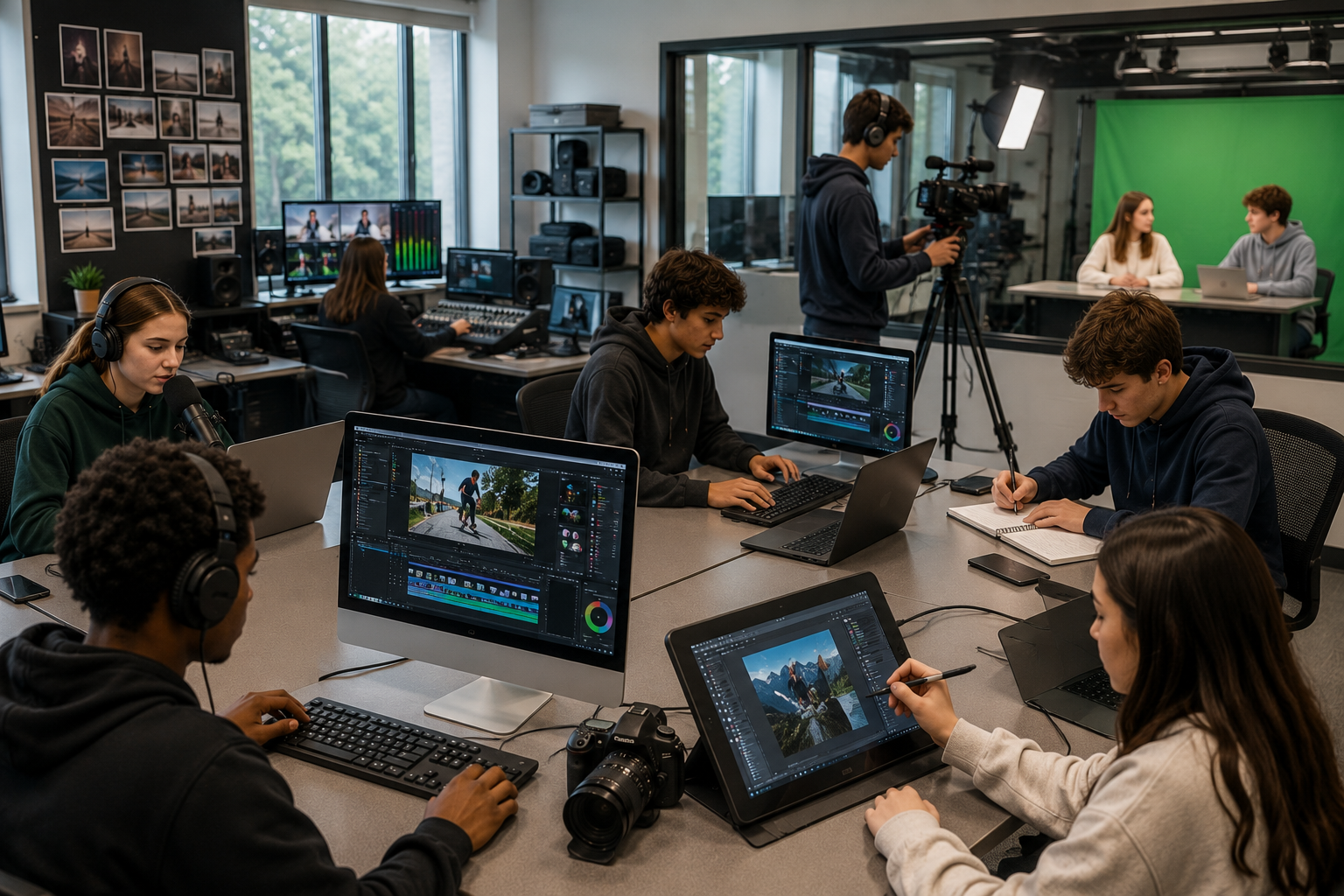
Inside today’s high school media classroom, students are not just learning about media; they are actively producing it in real time.
Walk into one of these classrooms, and it does not feel like a traditional learning environment. It feels like a production studio. There is movement, energy, collaboration, and purpose. Students are not sitting quietly at desks completing worksheets. They are working in teams, solving problems, managing deadlines, and creating content that will be seen, heard, and shared.
At any given moment, multiple projects are happening at once.
One group of students may be editing video footage from a recent school event, carefully selecting clips, adjusting audio, and adding graphics to create a polished final product. Across the room, another group may be recording a podcast, testing microphones, reviewing notes, and preparing to interview a guest. A third group might be designing social media graphics or writing captions for upcoming posts, thinking about how to engage their audience.
In another corner, a livestream team is preparing for an upcoming broadcast. They are checking camera angles, running audio tests, and coordinating roles. Each student has a responsibility: camera operator, director, audio technician, on-air talent. When the broadcast begins, there is no pause button. They have to be ready.
It is not simulated work.
It is real.
In many schools, student-created content is now the primary way the community experiences school life—through social media, video, and livestreams.
A Classroom Built on Roles and Responsibility
One of the most important shifts in today’s media classroom is the structure. Instead of working individually, students often take on defined roles within a team. Much like a professional newsroom or production company, every role matters.
There are writers who research and craft stories. There are editors who refine content and ensure accuracy. There are videographers who capture footage and photographers who frame key moments. There are producers who oversee projects, making sure everything stays on schedule. There are hosts, anchors, and interviewers who bring stories to life on camera or through audio.
Students quickly learn that their work impacts others.
If a videographer misses a shot, the editor has less to work with. If a script is not ready, the production is delayed. If audio is not captured correctly, the final product suffers. These are real consequences, and they create a level of accountability that is difficult to replicate in traditional assignments.
At the same time, they also create opportunities.
Students learn to rely on each other. They learn to communicate clearly, solve problems under pressure, and adjust when things do not go as planned. They begin to understand what it means to be part of a team working toward a shared goal.
From Idea to Execution: The Production Process
Every project in a media classroom follows a process, and students experience each step from start to finish.
It often begins with an idea.
A story about student achievement. A recap of a game. A feature on a teacher. A preview of an upcoming event. Students brainstorm topics, discuss angles, and decide how best to tell the story. Should it be a video? A podcast? A written article? A social post? The format matters.
Once the idea is set, planning begins.
Students outline scripts, schedule interviews, gather equipment, and assign roles. They prepare questions, research their subject, and think through the flow of the final piece. This stage teaches organization and foresight—skills that are critical in any field.
Then comes production.
Cameras are set up. Audio is checked. Interviews are conducted. Footage is captured. This is where preparation meets reality. Unexpected challenges arise—background noise, lighting issues, missed moments—and students must adapt quickly.
After production comes editing.
This is where everything comes together. Students review footage, select the best clips, add transitions, adjust audio levels, include graphics, and refine pacing. They learn that editing is not just technical—it is storytelling. What they choose to include or leave out shapes how the story is understood.
Finally, the content is published.
Whether it is posted on a school website, shared on social media, streamed live, or distributed as a podcast, the work reaches an audience. That audience may include classmates, parents, teachers, administrators, and community members.
And that changes everything.
In a single class period, a team might shoot footage, edit a video, design graphics, write captions, and publish content before the bell rings—reaching hundreds or even thousands of viewers before the school day ends.
The Pressure and Power of a Real Audience
In a traditional classroom, most assignments are seen by one person: the teacher.
In a media classroom, the audience is much larger.
Students know their work will be viewed, shared, and discussed. That reality raises the stakes. It pushes them to be more thoughtful, more precise, and more invested in the outcome. They begin to understand that communication is not just about completing a task—it is about connecting with people.
They also learn to handle feedback.
Not every piece will be perfect. Sometimes a video does not perform well. A post may not get the engagement they expected. A broadcast may have technical issues. These moments become learning opportunities. Students reflect, adjust, and improve.
This cycle—create, publish, reflect, improve—is at the heart of the media classroom experience.
Technology That Mirrors the Real World
The tools used in today’s media classrooms are increasingly aligned with industry standards.
Students work with professional or near-professional cameras, microphones, lighting equipment, and editing software. They learn how to operate tripods, frame shots, manage audio levels, and use editing platforms to produce high-quality content. Many also explore graphic design tools, analytics dashboards, and streaming platforms.
These tools are not introduced for the sake of technology alone.
They are introduced because they support the process of communication.
Students learn that the tool is only as effective as the person using it. A high-end camera does not guarantee a strong story. Clear audio does not replace thoughtful questions. Technology enhances communication, but it does not define it.
AI in the Media Classroom: Power and Responsibility
Artificial intelligence is beginning to play a larger role in media classrooms, and students are learning how to use it in meaningful ways.
They use AI tools to transcribe interviews quickly, saving hours of manual work. They generate captions to make content more accessible. They experiment with translation tools to reach broader audiences. Some use AI to help organize ideas or refine scripts.
These tools increase efficiency, but they also require careful guidance.
Students must learn when to rely on AI and when to rely on their own judgment. They must understand the importance of verifying information, maintaining originality, and preserving authenticity. AI can assist with production, but it cannot replace creativity, curiosity, or ethical decision-making.
Those lessons are essential.
Preparing Students for What Comes Next
Perhaps the most powerful aspect of today’s media classroom is how clearly it connects to the real world.
Students are not guessing what these skills might be used for—they are using them now.
Some students build portfolios that include video work, photography, writing samples, and social media campaigns. Others begin freelancing, taking photos at events or creating content for local organizations. Some discover a passion for storytelling that leads them toward careers in journalism, broadcasting, or film. Others realize that these skills apply to fields like marketing, communications, education, or business.
Even students who do not pursue media careers benefit from the experience.
They leave with the ability to communicate clearly, think critically, work collaboratively, and adapt to new tools and challenges. These are skills that matter in every profession.
More Than a Class
Inside today’s high school media classroom, something bigger is happening than content creation.
Students are finding their voice.
They are learning how to ask questions, listen carefully, and tell stories that matter. They are discovering how to work with others, meet deadlines, and take ownership of their work. They are building confidence, not just in their technical abilities, but in their ability to contribute something meaningful.
For many students, it becomes more than a class.
It becomes a place where they feel connected, challenged, and inspired.
A Classroom That Reflects the Future
The high school media classroom is not just keeping up with change—it is helping students lead it.
As technology continues to evolve, so will the tools and platforms students use. But the core experience will remain the same: creating, communicating, and connecting.
They are not preparing for the future.
They are already creating it.
Subscribe to edCircuit to stay up to date on all of our shows, podcasts, news, and thought leadership articles.