
AI in Schools: What Technology Should Never Decide
Where schools must draw the line between useful automation and decisions that require human judgment

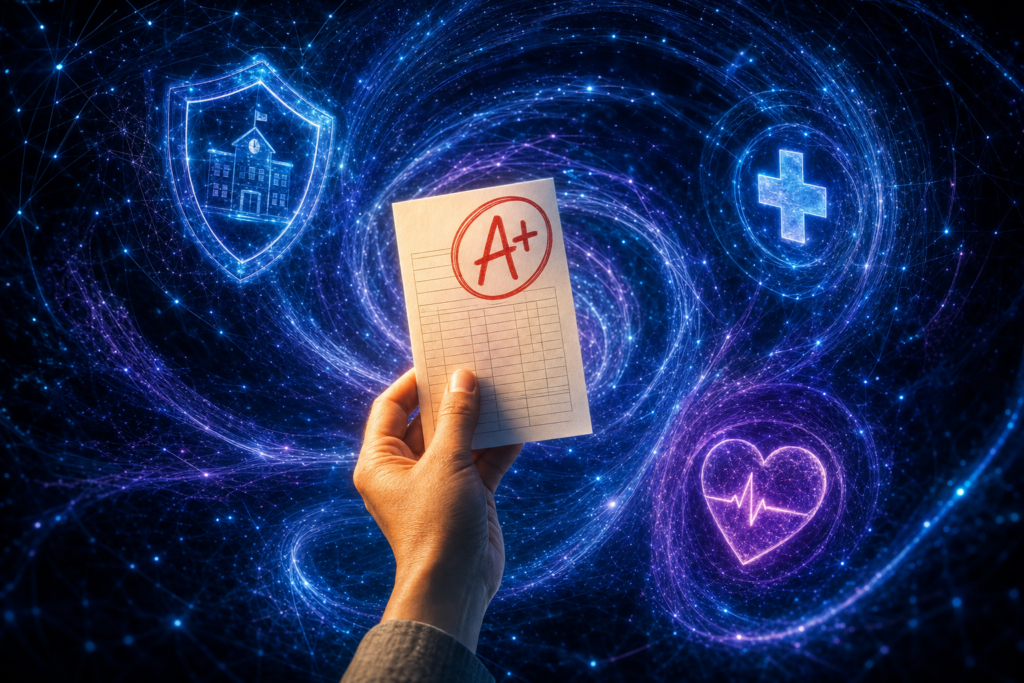
AI in schools can support educators, but decisions involving grades, discipline, services, safety, and opportunity must remain in human hands.
AI in schools can organize information, identify patterns, suggest resources, and help educators notice concerns. It can also be confidently wrong.
Imagine a ninth-grade student whose attendance has fallen sharply. A district dashboard labels her “high risk” and predicts that she is unlikely to graduate on time. Based on her attendance, grades, and missing assignments, the system recommends an intensive intervention. It also suggests moving her out of an advanced course to reduce her workload.
The recommendation appears objective. It is supported by data and expressed with the certainty of a mathematical calculation.
What the system does not know is that the student has been arriving late because she helps get her younger brother to school while her mother recovers from surgery. Her lower math grade reflects three missing assignments, not an inability to understand the material. The advanced course is also the class she cares about most—and one of the strongest reasons she continues coming to school.
A counselor who knows the student might see a family that needs temporary flexibility and transportation assistance. An algorithm may see only a collection of risk factors.
That difference matters.
As artificial intelligence becomes more deeply embedded in education, school leaders will face growing pressure to use it for more than lesson planning and administrative work. AI systems are already being developed to evaluate student writing, predict academic performance, recommend interventions, identify behavioral risks, monitor online activity, create schedules, support hiring, and analyze teacher performance.
Some of those uses may be helpful. Others move technology uncomfortably close to decisions that can alter a student’s education or an educator’s career.
The question is no longer simply whether schools can use AI to make these decisions.
The question is whether they should.
Drawing the Line Between Assistance and Authority
Most schools do not intend to place an algorithm in charge. The shift usually happens more quietly.
A risk score influences which students are invited into an advanced program. An automated flag is treated as evidence of academic dishonesty. A generated summary becomes the starting point for a special education meeting. A behavior prediction shapes how an administrator interprets a student’s actions.
No policy may explicitly say that the technology has final authority. Yet if educators rarely question its output, the practical result is almost the same.
People tend to trust recommendations that appear precise, particularly when those recommendations are produced by complicated systems. A score of 92 percent can feel more reliable than a teacher’s concern or a counselor’s professional judgment—even when no one can clearly explain what the number represents, which information produced it, or how often the system is wrong.
This is where schools must establish a firm boundary: AI can support a high-impact decision, but it cannot own that decision.
The NIST Artificial Intelligence Risk Management Framework encourages organizations to govern, map, measure, and manage AI risk throughout the life of a system. NIST also emphasizes the need to clearly define human roles and responsibilities when AI contributes to decision-making.
For school districts, this requires more than purchasing an approved tool and reminding employees to “use professional judgment.” Leaders must identify which decisions AI may inform, which decisions it may never make, and who remains accountable when its output causes harm.
When a Decision Changes a Student’s Future
Not every use of AI carries the same level of risk. A tool that helps draft a family newsletter is not equivalent to one that influences whether a student is suspended, placed in remedial coursework, referred for a mental health evaluation, or denied access to an academic opportunity.
The closer a decision comes to a student’s rights, safety, identity, education, or future, the more directly people must remain involved.
Grades and academic integrity
AI can help educators create practice questions, compare work with a rubric, or identify areas where a student may need additional feedback. It should not have final authority over grades, academic credit, promotion, or graduation.
Student work exists within a classroom context. Teachers know what was taught, how an assignment was introduced, what support a student received, whether accommodations apply, and how the work compares with the student’s previous performance. They can ask follow-up questions. They can review drafts. They can give a student another opportunity to demonstrate understanding.
A scoring system sees only the information it receives.
The same boundary should apply to AI-detection tools. A detector’s output may give a teacher a reason to look more closely, but it is not proof of misconduct. No student should fail an assignment or receive an academic dishonesty charge because software produced a probability score.
When concerns arise, the teacher should review the student’s notes, drafts, citations, document history, and previous work. Most importantly, the teacher should speak with the student.
That conversation may confirm inappropriate AI use. It may also reveal tutoring assistance, a new writing strategy, an accessibility tool, or a student whose formal writing sounds different from classroom conversation. The purpose of the review is to establish what happened—not to defend the software’s conclusion.
Discipline and behavior
Disciplinary decisions require evidence, context, consistency, and due process. They also sit within a long history of unequal outcomes.
An AI system trained on previous disciplinary records may absorb the patterns contained in those records. Removing race, disability, language status, or sex from the dataset does not automatically remove the possibility of bias. Attendance, neighborhood, course history, previous referrals, and school mobility can all function as proxies for circumstances that disproportionately affect particular groups.
Predictive labels can also shape how adults view a child. Once a student has been classified as a behavioral risk, an ambiguous action may appear more deliberate, defiant, or threatening than it otherwise would.
Federal civil rights protections still apply when schools use automated systems. The Department of Education’s Office for Civil Rights enforces laws prohibiting discrimination in covered educational settings based on race, color, national origin, sex, disability, and age. A district cannot transfer its responsibility for fair treatment to a vendor, model, or dataset.
AI may help organize incident reports or reveal districtwide patterns worth examining. It should never determine whether a student is guilty, what the student intended, or which consequence is appropriate.
Those judgments must remain with educators who can examine the evidence, listen to the student, consider disability-related needs, apply policy consistently, and explain the final decision.
Special education and student services
A screening system may help a school notice students who need additional attention. It cannot diagnose a disability or decide whether a student qualifies for services.
Special education decisions are intentionally collaborative and individualized. Under the Individuals with Disabilities Education Act, parents have the right to participate in meetings involving their child’s identification, evaluation, educational placement, and access to a free appropriate public education. IDEA also provides procedural protections involving records, notice, independent evaluations, mediation, and complaints. These safeguards are outlined in the Department of Education’s IDEA resources for parents and families.
Section 504 decisions also require people who understand the student, the evaluation data, and the available placement options. The Department’s Section 504 guidance states that schools must draw from multiple sources, document the information considered, and examine significant factors affecting the student’s learning.
AI can help organize records, summarize assessment results, or prepare questions for a meeting. It cannot replace the people in that meeting—and it should never predetermine the outcome before the student, family, teachers, and specialists have been heard.
Safety and mental health
School safety tools present one of the most difficult challenges for education leaders.
AI products may claim to detect threats, monitor online activity, recognize emotional distress, analyze student writing, or identify unusual behavior. Schools are understandably interested in anything that could help them respond before a crisis occurs.
But both missed warnings and false alarms can cause serious harm.
A student may search for information about self-harm because she is worried about a friend. Another may use violent language while discussing a novel. A sarcastic message between classmates may look threatening when separated from its context. A student with a disability may behave in a way that a monitoring system mistakenly interprets as suspicious.
An automated alert may justify a timely review. It should not automatically label a student dangerous, trigger discipline, produce a mental health conclusion, or initiate law-enforcement involvement.
When safety may be at risk, trained professionals must assess the actual situation, speak with the student, review credible evidence, consider context, and follow established crisis or threat-assessment procedures. Urgency makes qualified human judgment more important, not less.
Districts must also tell their communities what is being monitored, what information is collected, who can access it, how long it is retained, and what may happen when a student is flagged. Surveillance that students and families do not understand can damage trust, even when it was introduced with good intentions.
Placement and opportunity
Some of the most consequential decisions in education do not look like punishments.
Who is recommended for gifted education? Who receives an intensive intervention? Which students are invited to take algebra early, enroll in an Advanced Placement course, visit a college, apply for a competitive program, or explore a particular career?
AI could help schools identify students whose abilities have been overlooked. It could also reinforce old patterns if predictions based on the past are allowed to shape future opportunities.
If certain students have historically been underrepresented in advanced coursework, a system trained on past enrollment data may treat their underrepresentation as normal. If attendance and discipline are heavily weighted, students experiencing poverty, housing instability, family caregiving responsibilities, or unreliable transportation may be classified as less likely to succeed.
The denial may never appear in writing. It may take the form of a missing invitation, a lowered recommendation, or a counselor who unknowingly spends more time with students the system considers “college ready.”
Students should never be reduced to the likelihood that they will repeat someone else’s path.
Schools can use AI to expand the group of students considered for an opportunity. They should not use it to quietly close the door.
Human Oversight Must Be More Than a Signature
Schools frequently describe their AI systems as operating with a “human in the loop.” That phrase sounds reassuring, but it does not tell families whether the person is meaningfully involved.
If an administrator receives an automated recommendation but cannot review the underlying information, challenge the result, or understand why it was produced, the administrator is not providing real oversight.
Meaningful human review requires the responsible person to:
- Know that AI contributed to the recommendation
- Review the evidence and data behind it
- Understand the tool’s intended purpose and limitations
- Speak with the affected student, family, or employee when appropriate
- Have the authority to reject the recommendation
- Document and explain the final decision
The person reviewing the output also needs time. A counselor responsible for hundreds of students cannot meaningfully investigate dozens of automated alerts each morning. When the volume of recommendations exceeds a school’s capacity to examine them, staff members will inevitably begin accepting the system’s conclusions.
Families and eligible students may also have rights concerning information maintained in education records. The Department of Education’s FERPA overview explains rights to inspect education records, request amendments to information believed to be inaccurate, and control many disclosures of personally identifiable information.
Districts should determine whether AI-generated scores, classifications, summaries, and alerts become part of a student’s education record. An unexplained label should not follow a child from year to year without a way to inspect it, correct inaccurate information, or challenge its continued use.
Six Questions Before Approving a High-Impact Use
Before adopting an AI system, school leaders should identify the most serious action someone could take based on its output.
Could the system affect a grade, disciplinary record, course placement, special education referral, safety response, academic opportunity, or employment decision?
If so, leaders should be able to answer six questions:
- What decision will the system influence?
Broad promises about improving outcomes are not enough. The district should identify the specific decisions staff members may make with the output. - What information produces the recommendation?
Leaders should know where the data comes from, how current it is, and whether it was originally collected for a different purpose. - How accurate is the system for the district’s students?
Overall accuracy can hide substantial differences among student groups, languages, disabilities, grade levels, and uncommon situations. - What happens when the system is wrong?
A harmless spelling suggestion and a false safety alert do not require the same safeguards. - Can the affected person understand and challenge the result?
Students, families, and employees should not have to discover on their own that an automated recommendation influenced a consequential decision. - Who can suspend the system?
A district needs a clear process for stopping use when the tool performs poorly, causes harm, creates inequitable outcomes, or is used outside its approved purpose.
The U.S. Department of Education’s 2025 AI guidance supports responsible AI integration while emphasizing privacy, compliance with existing requirements, and engagement with affected stakeholders—especially parents.
That engagement should happen before a high-impact system is deployed, not after families begin challenging its decisions.
UNESCO has made a similar argument internationally. Its 2025 education work emphasizes that AI in education must remain grounded in human rights and that the future of learning will be shaped by the governance and ethical choices leaders make now.
Technology Cannot Carry Responsibility
The strongest case for AI in education is not that it can remove people from difficult decisions. It is that it can give people better information and more time to make those decisions well.
Teachers need relief from repetitive work. Counselors need better ways to notice students who are struggling. Administrators need help understanding complex systems. Families deserve communication that is timely and accessible.
AI can contribute to all of that.
What it cannot do is sit across from a student and recognize that the story behind the data has changed. It cannot take responsibility for a false accusation, an unfair placement, a missed accommodation, or an opportunity quietly withheld. It cannot rebuild trust with a family after a harmful decision.
People must do those things.
The goal is not to keep AI out of every consequential conversation. It is to make sure technology enters those conversations in the proper role: as a source of information, a prompt for better questions, and sometimes a warning that deserves careful investigation.
Never as the final authority.
The best use of AI in schools will not be the one that replaces human judgment. It will be the one that helps educators exercise that judgment with greater clarity, fairness, and care.
Editor’s note: edCircuit is vendor-neutral and does not endorse products or services. Any mention of a specific solution is included for contextual and informational purposes only.
Subscribe to edCircuit to stay up to date on all of our shows, podcasts, news, and thought leadership articles.
Related reading
More on Artificial Intelligence