
 EdCircuit Staff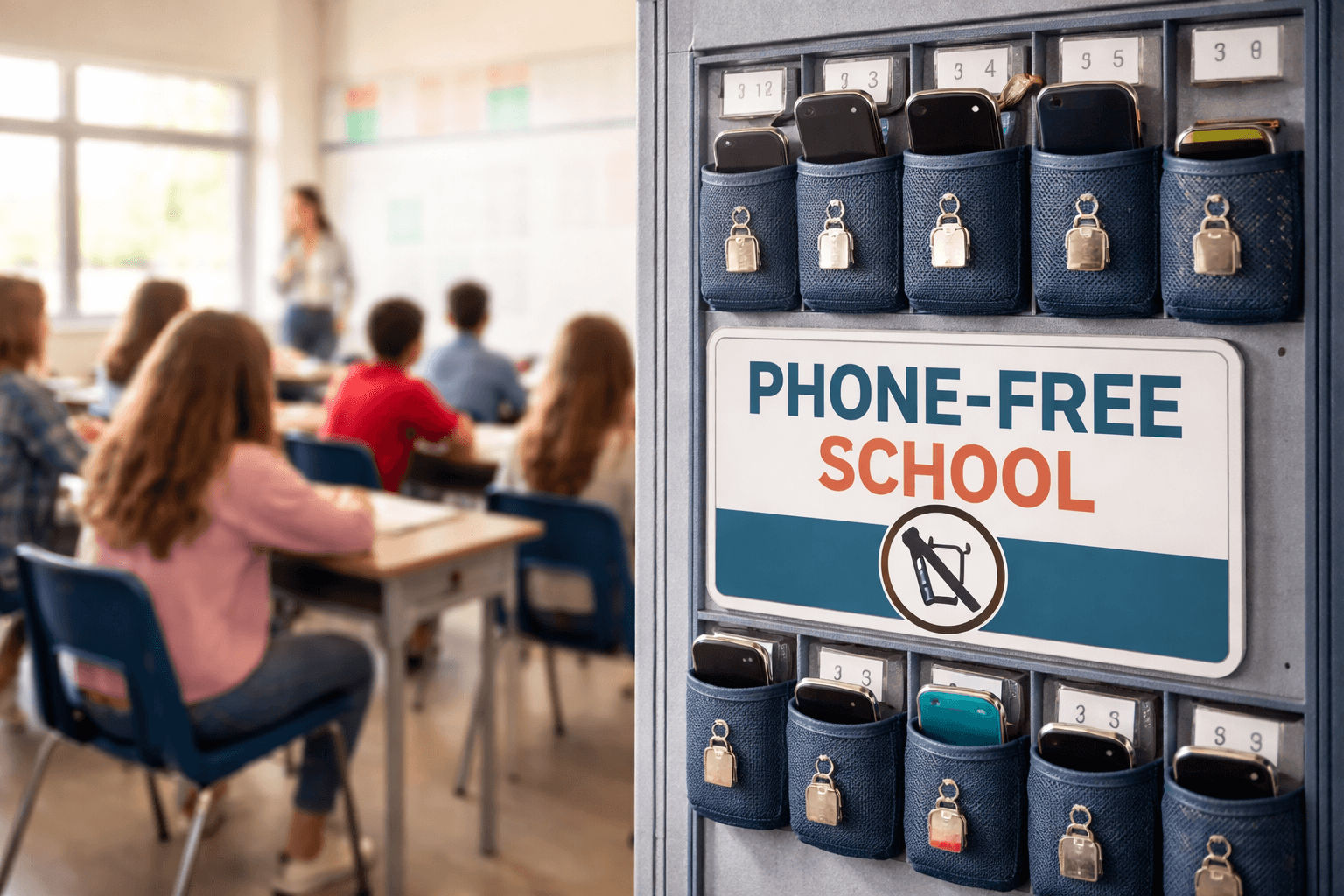
Table of Contents
Phone-free schools are moving from debate to policy, and the states taking the issue seriously are starting to make a clear distinction: restricting phones is not the same thing as removing them from the school day.
That is the central takeaway from the new Phone-Free Schools State Report Card, a national review of state laws and executive orders on student phone use in schools. The report looks at all 50 states and grades them against a model policy built around one simple idea: the less students can access their phones during the school day, the better the conditions for learning, attention, and school culture.
The report is part of the broader Distraction-Free Schools initiative, a policy effort focused on helping states and school systems reduce digital distractions in education. The initiative provides model legislation, research summaries, and implementation guidance for districts considering stronger phone policies. Rather than focusing only on banning devices, the project looks at how schools can create environments where student attention, peer interaction, and classroom instruction are less shaped by the constant pull of smartphones.
That sounds obvious. In practice, it is not.
For years, schools have tried to split the difference. Some banned phones during class but allowed them in the hallways. Some told students to keep them in backpacks. Others left the decision to individual teachers, turning phone enforcement into one more classroom battle. On paper, many of those approaches looked reasonable. In real schools, they often left the problem untouched.
This report helps explain why.
It argues that the strength of a phone policy is not just about whether a state says students cannot use phones. It is about when the restriction begins, when it ends, and whether the device is actually out of reach. That last point matters more than many policymakers seem to realize. A phone in a student’s backpack is still a phone in a student’s mind. It still vibrates. It still pulls attention. It still turns the teacher into the enforcer.
That is why the report’s highest standard is not simply a ban. It is bell-to-bell, inaccessible storage.
And right now, only North Dakota and Rhode Island meet it.
What the Report Actually Measures
One reason this report stands out is that it does more than count how many states have “done something” about phones. It examines whether those actions are likely to work.
State grades were based on laws or executive orders passed in 2024 or 2025 and measured against six criteria in the model bill. The report makes clear that policy strength begins with two basic questions. First, how much of the school day is covered? Second, where are the devices stored?
That framework produces four main categories.
At the top is bell-to-bell, inaccessible storage, the gold standard. Students are required to silence or turn off phones and store them securely from the first bell to dismissal. The report is unusually direct about why this matters. Stronger policies lead to better outcomes when students have less time with devices and less access to them during the day.
The next category is bell-to-bell, accessible storage. This is still far stronger than a classroom-only rule, but it leaves an opening. Students may be barred from using their phones all day, yet still keep them in a locker or backpack. That sounds manageable until you think about how teenagers actually interact with their devices. The phone is still there. The urge is still there. The teacher still has to police it.
Then there is class instructional time only, which the report treats as a meaningful but limited response. These policies acknowledge that phones interfere with learning, but they do not address the rest of the school day, where social pressure, distraction, and online conflict often build.
Last is policy required, no mandated elements, which is really another way of saying the state has recognized the issue without deciding how seriously to solve it. These laws require districts to have a policy, but they do not define what the policy must include. The result is predictable: uneven implementation, mixed expectations, and vastly different student experiences across districts.
The report also identifies states where bills failed, where no bill was introduced, and where legislation is still pending.
That matters because it shows this is not a settled issue. It is a live one.
What the State Map Reveals
The map is one of the most striking parts of the report because it shows both how far the movement has come and how far it still has to go.
Only two states, North Dakota and Rhode Island, earned an A for policies that require bell-to-bell inaccessible storage. That is a remarkably small number, given how much public discussion there has been around phone bans in schools. It tells us that while many leaders are talking about the problem, very few have passed policies strong enough to fully address it.
The largest group falls into the next tier: 17 states plus Washington, D.C., earned B grades for bell-to-bell restrictions with accessible storage. States in this category include Alabama, Arkansas, Florida, Georgia, Louisiana, Missouri, Nebraska, New Hampshire, New Jersey, New York, Ohio, Oklahoma, Oregon, South Carolina, Texas, Vermont, Virginia, and Washington, D.C.
This is real movement. It should not be dismissed. A full-day restriction is a serious policy change, and it signals that states are beginning to see phones as a schoolwide issue rather than a classroom annoyance.
But the difference between an A policy and a B policy matters. The report is blunt on this point: when devices remain accessible, students and teachers are not set up for success equally. Students with strong phone habits still have the urge to check them. Teachers still carry the burden of monitoring. The school may have restricted the rule, but it has not fully removed the friction.
Eight states landed in the class instructional time only category: Indiana, Iowa, Kentucky, Nevada, North Carolina, Tennessee, West Virginia, and Wisconsin. These laws protect lessons, at least in theory, but leave other parts of the school day untouched. The report notes that this overlooks both the cognitive interference caused by phones and the social and emotional harms that can spill over into the school day.
Nine states fell into the policy-required, no-mandated elements bucket: Alaska, Arizona, California, Colorado, Idaho, Maine, Minnesota, New Mexico, and Utah. These states have acknowledged the issue, but they have not defined a serious statewide response. That is often where policy starts to sound stronger than it is.
Four states saw bills fail: Connecticut, Maryland, Mississippi, and Wyoming. Two states, Montana and South Dakota, had no bills introduced. Eight states were marked incomplete because legislation was pending: Delaware, Hawaii, Illinois, Kansas, Massachusetts, Michigan, Pennsylvania, and Washington.
Put all of that together, and the picture becomes clear. The country is moving toward a tighter school phone policy. But most states are still in the middle of that shift, not at the end.
Why Stronger Policies Work Better
The report’s core argument is not ideological. It is practical.
The stricter the school cell phone policy, the better the odds that it will improve student focus and teacher morale. That is because phones are not just occasional distractions. They are designed to interrupt. A weak policy asks students to resist that pull over and over again while asking teachers to enforce a rule that is easy to break and hard to monitor.
A stronger policy changes the environment.
When a phone is secured and inaccessible, the burden shifts away from the individual teacher and becomes part of the school structure. There is less negotiation, less inconsistency, and less room for the quiet drift that happens when students check a screen between activities and carry that distraction into the next class.
That is one reason bell-to-bell policies are getting more attention. They do not just protect lecture time. They reshape the entire school day.
And that broader school-day impact matters. A class-period ban still allows lunchroom scrolling, hallway filming, social media conflict, and the mental residue of whatever students have just seen online. A stronger policy creates a break from all of that. It gives students hours of the day when they are not tethered to a device, not performing for a feed, and not managing the latest group chat drama while trying to learn algebra or participate in a seminar.
That is a very different kind of intervention.
What Is Working in Schools That Get Serious About It
One of the most compelling parts of this conversation is that the benefits of stronger phone policies do not stay abstract for long. Schools that implement them tend to describe changes that are visible almost immediately.
Teachers report fewer interruptions and less low-level conflict over phone use. Instead of repeatedly asking students to put their devices away, they can teach. That may sound small, but anyone who has spent time in a classroom knows how much energy is lost to constant redirection. A policy that reduces that friction is not a marginal improvement. It changes the feel of instruction.
Administrators often describe shifts in school culture as well. Students talk more during lunch. They interact more naturally between classes. In some schools, adults notice something they had almost forgotten to expect: eye contact, conversation, and unstructured social interaction that is not filtered through a screen.
The report also points to supporting evidence beyond the grading framework itself. The broader policy package tied to this work includes a growing body of implementation guidance and supporting research. A national survey of more than 20,000 educators suggests stricter cell phone policies are linked to fewer distractions and greater teacher satisfaction. School leaders have also shared low-cost implementation strategies and practical lessons from campuses that have already made the shift.
That matters because it pushes back on one of the most common objections, which is that only wealthy districts can enforce strong policies. The implementation materials suggest otherwise. High-cost tools like locking pouches are one option, but not the only one. Some schools use lockers. Some use structured collection systems. Some rely on simple, low-cost storage routines paired with clear expectations and consistent enforcement.
The point is not that there is only one model. The point is that strong implementation is possible when schools are serious about it.
What Is Not Working
The report is just as useful for showing where policy breaks down.
The most common failure is the half-measure dressed up as a solution.
A policy that bans phones during instructional time only may sound sensible, but it leaves the larger culture of phone dependence intact. Students can still use devices during passing periods, lunch, and other unstructured times. Online conflict still enters the building with them. Social media still shapes the emotional temperature of the day. And because students regain access repeatedly, the transition back into focused learning becomes harder.
The second failure is the lack of strong enforcement of accessible storage. This is better than a class-only ban, but it still leaves schools with the same basic vulnerability: if the phone can be reached, it will often be checked. That creates uneven enforcement, especially in large schools where consistency is hard to maintain from room to room and adult to adult.
The third failure is leaving everything to districts without clear statewide standards. In theory, local flexibility sounds wise. In practice, it often produces confusion. One district writes a serious policy. Another adopts vague language. One principal enforces it consistently. Another leaves it to teacher discretion. Students and families end up navigating different rules not because the evidence differs, but because leadership does.
And then there is the political failure: states that recognize the concern, introduce bills, and still do not pass anything. Those stalled efforts matter because they show how quickly momentum can get diluted once enforcement, parent pushback, emergency communication, and local control enter the conversation.
That does not mean the issue is overblown. It means solving it requires more than agreement that phones are a problem.
What Policymakers Still Get Wrong
The report also exposes a misunderstanding that continues to shape weaker state responses. Too many policymakers still treat student phone use as a behavioral problem rather than an environmental one.
If the issue is framed as behavior, the solution becomes student self-control and teacher enforcement. Students should know better. Teachers should manage their classrooms. Schools should encourage responsible use.
But if the issue is environmental, the response changes. The question becomes: what kind of school day are we creating, and what conditions make sustained attention possible?
The report clearly leans toward the second view. It suggests that school leaders should not build policy around the hope that students will resist a device engineered to capture their attention. They should build a policy around structures that make attention more likely in the first place.
That distinction is important for another reason. It shifts the conversation away from punishment and toward design. The enhanced 2026 model bill, referenced in the materials, maintains the same core principles while adding clearer guidance on enforcement and protections against exclusionary discipline. That suggests the movement is learning as it grows. The aim is not simply to ban phones. It is to build firm, workable, and fair policies.
The Bigger Story Behind the Report
This is not only about phones.
It is about whether schools are willing to draw clearer boundaries around attention in an era built on distraction. It is about whether educators can create parts of the day that are protected from the logic of constant connectivity. And it is about whether policymakers are ready to match public concern with policies that actually change school conditions.
That is why this report matters beyond the grades.
It gives education leaders a more honest language for talking about school smartphone policies. It shows that not all bans are equal. It clarifies why some approaches produce better results than others. And it offers a policy framework for states that are still trying to decide whether they want symbolic action or meaningful change.
For superintendents, principals, and school boards, the message is difficult to miss. If a district wants the benefits of a phone-free school day, it cannot rely on vague classroom rules and hope for the best. The policy has to be coherent. The storage has to be clear. The expectations have to be schoolwide. And the rationale has to be communicated well enough that families understand the goal is not control for its own sake, but a better learning environment.
For teachers, the report validates what many have been saying for years: phones are not a side issue. They shape attention, behavior, and classroom culture in ways schools can no longer afford to ignore.
For parents and students, the report raises a more uncomfortable but necessary question. Have we normalized a level of digital intrusion into the school day that no longer serves children particularly well?
That may be the hardest part of this conversation. Phone-free schools are often discussed as a policy fight. They are also a cultural correction.
Where the Movement Goes From Here
The national trend is unmistakable. More states are acting. More school leaders are willing to rethink the place of smartphones in schools. More evidence is being gathered. More implementation tools are becoming available.
But the next phase of this work will be defined by whether states are willing to move past partial measures.
The report shows a country in transition. The issue has clearly broken through. What has not yet happened is full alignment between what leaders say they want and the policies they are actually passing.
If the goal is fewer distractions, stronger teacher morale, healthier student relationships, and more focused classrooms, then the report leaves little ambiguity about the direction of travel. Bell-to-bell matters. Inaccessible storage matters. Clarity matters.
The states earning the highest marks are not simply the states that took action. They are the states that recognized a harder truth: a phone policy only works when it changes the conditions of the school day, not just the wording of the rule.
That is the real turning point.
And it is why this report deserves serious attention from anyone shaping the future of school policy.
Subscribe to edCircuit to stay up to date on all of our shows, podcasts, news, and thought leadership articles.