



 EdCircuit Staff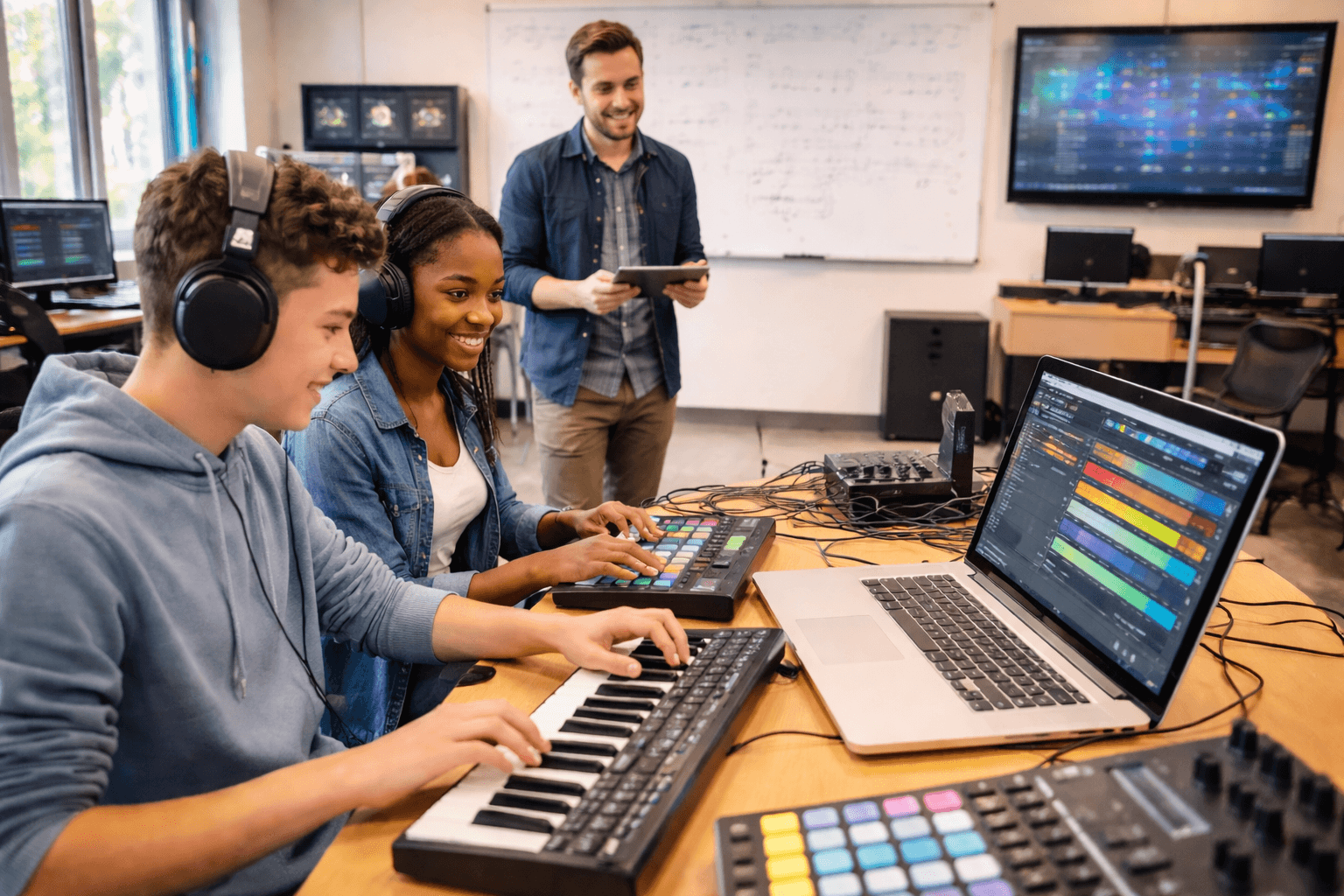
Music education has changed a great deal over the past 15 years, and technology in music education is a big part of why. Walk into a modern music classroom and you may see students building a beat on a laptop, layering digital instruments into a soundtrack or working on a shared composition online, while a jazz ensemble rehearses across the room. Rehearsal, notation and performance remain at the heart of the subject. What has grown around them is a set of tools that let students compose, record and produce music, and now artificial intelligence as well.
Access is the starting point. The Arts Education Data Project’s first national study found that 92 percent of U.S. public school students had access to music education, leaving about 3.6 million students without it. Those figures are from the 2018–19 school year and are the most recent national estimate. As schools mark Music In Our Schools Month each March, the evolution of the music room is a reminder of how much music teachers have taken on.
From music rooms to creative studios
Fifteen years ago, most school music programs centered on band, orchestra and choir: reading notation, practicing scales and rehearsing for concerts. A teacher might have used notation software or an electronic keyboard lab, but digital production tools were rare. Today many music teachers also use digital audio workstations (DAWs), MIDI keyboards and production software. Students can layer sounds, change tempo, add effects and build complete pieces with tools similar to those used in professional studios.
Performance and ensemble playing remain essential. What has changed is that composition, recording, editing and production are now realistic parts of a school music course, not only extras for students who take lessons outside school.
Students as composers and producers
Online platforms make it possible for any student with a device to create music layer by layer:
- Soundtrap for Education is an online platform for creating music and podcasts.
- BandLab offers an online studio, with a version designed for schools.
- Noteflight is an online notation editor; its Noteflight Learn edition gives a class a private site with assignments and links to Google Classroom and other learning platforms.
These tools connect school music to the music students already know from streaming, video games and social media. Students who do not see themselves as performers may find their way into music through composition, beat-making or sound design.
Collaboration beyond the classroom
Cloud-based tools let students start a project in class, continue it at home and share it with classmates who add their own parts. That mirrors how much professional music is made today, by artists working together across cities. It also changes the teacher’s role: music teachers can listen to drafts, leave comments and guide revisions, turning composition into a cycle of trying, listening and improving.
Artificial intelligence in the music room
AI tools can now suggest melodies, chord progressions and rhythm patterns, or produce a backing track from a short description. The National Association for Music Education’s AI Task Force published guiding principles for AI in music education in July 2025, grounded in the national music standards. It describes ways AI tools can enhance creativity, support performance and deepen student reflection, and it addresses assessment and the ethical responsibilities of teachers and students.
In practice, AI is most useful when students use it to test ideas and then make the musical decisions themselves: why one chord progression works better than another, how a melody should develop, what the piece is trying to express. A student who struggles with notation can still explore composition this way, while an advanced student can try more complex arrangements. Teachers should be clear about when AI may be used, and students should credit it, just as they would credit a sample or someone else’s melody.
Preparing students for music careers today
Many working musicians now combine roles: performer, composer, producer and sound engineer. Careers in film and game scoring, podcast production and audio for media all combine musical skill with technology. Students who learn both in school gain skills that carry beyond music, including creative problem solving, collaboration and confidence in sharing their work.
What school leaders can do
- Protect the core. Keep ensembles and musicianship strong while adding technology, rather than replacing one with the other.
- Fund equipment and software. Headphones, MIDI keyboards, devices and licenses need a budget line, not only donations.
- Support teacher learning. Music teachers need time to learn production tools and to plan how AI fits their program.
- Set clear AI rules. Use NAfME’s guidance to decide when students may use AI and how they credit it.
- Close access gaps. Check which of your schools offer music at all, and which offer composition and production as well as ensembles.
The modern music classroom shows that tradition and technology in music education can work together. Students still learn to listen, play and perform, and many now also learn to compose and produce. For the wider picture of AI in schools, see edCircuit’s guide to AI in education.
Related reading
Subscribe to edCircuit to stay up to date on all of our shows, podcasts, news, and thought leadership articles.
More on Artificial Intelligence

