
 EdCircuit Staff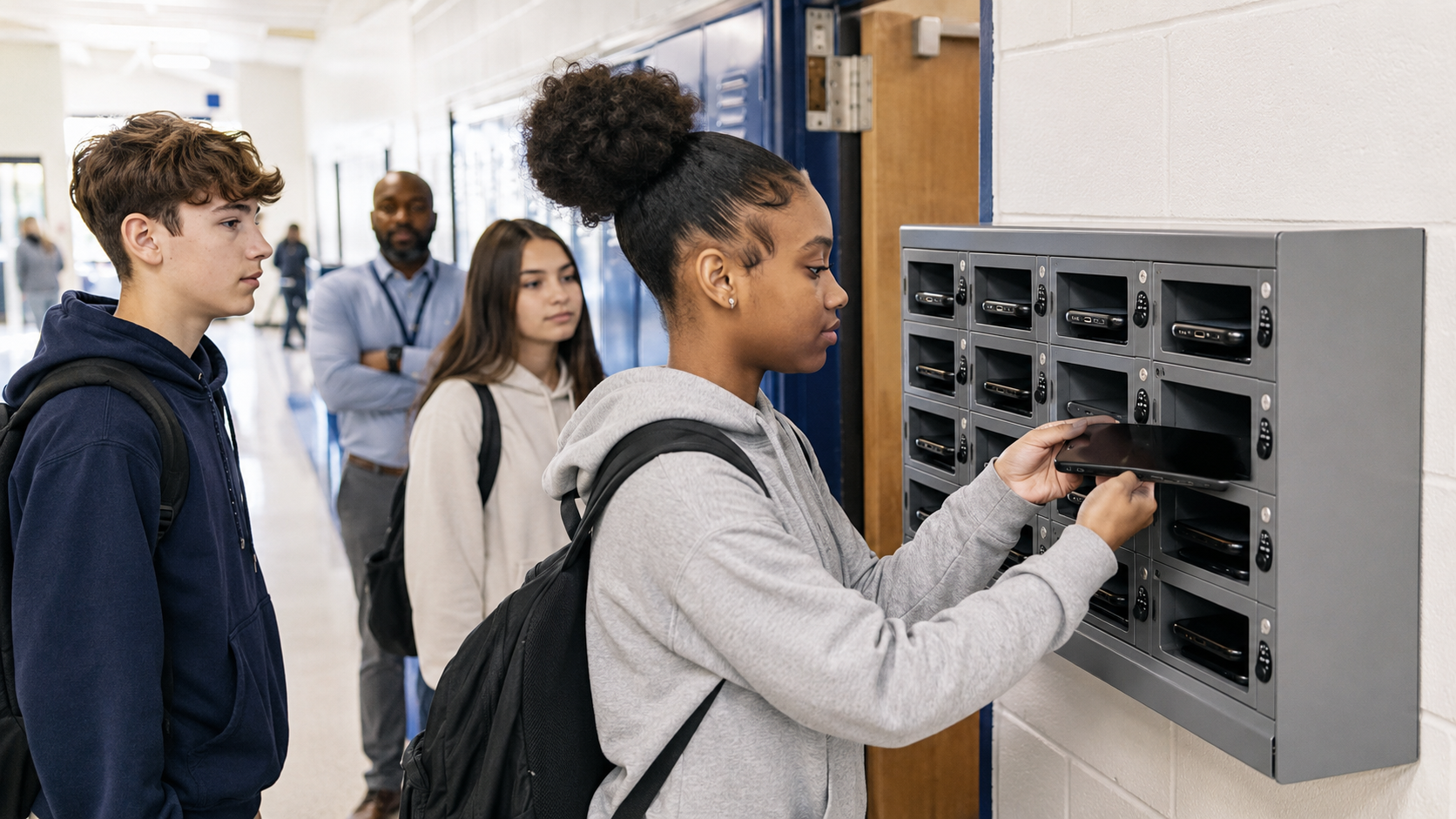
School cell phone bans are moving from policy debate to daily practice. For states and districts beginning the 2026–27 school year with new restrictions, passing a rule was only the first step. Now schools must decide where hundreds—or thousands—of phones will go each morning, who will be responsible for them, and how students can reach a device when access is truly necessary.
Those decisions are producing very different versions of a “phone-free” school day.
A phone powered off inside a backpack remains within reach. A phone locked in a pouch stays with the student but cannot be opened without an unlocking device. A phone placed in a locker, classroom pocket, or centralized storage cage shifts some degree of responsibility to the school.
The distinction may determine whether a policy becomes part of the school routine or creates a new source of confusion and conflict.
The national debate has shifted toward implementation
As of July 2026, the National Conference of State Legislatures reported that 42 states, Washington, D.C., and Puerto Rico had enacted legislation related to cell phone use in schools. Some states restrict phones only during instruction. Others require devices to remain inaccessible from the opening bell through dismissal.
More states may soon join them. Washington Gov. Bob Ferguson announced an “Away for the Day” proposal in June that would require personal smart devices to remain unavailable throughout the school day beginning in September 2027. State officials plan to consult with students, educators and families about enforcement, exceptions, district support and emergency communication before releasing the full proposal.
That work is important because the language used in state law shapes what districts can do locally. A requirement that phones remain “out of sight” gives schools more flexibility than a requirement that they be stored away from the student in an inaccessible location.
What does “put away” actually mean?
Wicomico County Public Schools in Maryland is implementing a “Bell to Bell, No Cell” rule. Students may use personal devices before the first bell and after dismissal, but not during instruction, lunch, passing periods, shuttle-bus transportation or other school-day activities. Phones and other covered devices must be powered off or silenced and stored out of sight.
Wisconsin law requires districts to restrict phones during instructional time, allowing for a less restrictive local approach. Appleton Area School District required middle school students to keep phones in lockers last year. High school students may keep a powered-off phone in a backpack or on their person during class, then use it in hallways and at lunch. District leaders told WSAW that they will monitor the rollout and make adjustments if needed.
Kansas has chosen a stricter standard. HB 2299 requires devices to be turned off and securely stored away from the student in an inaccessible location throughout the school day, including recess, lunch and passing periods. Students may leave their devices at home or in a vehicle.
New York makes a similar distinction. State guidance says an ordinary backpack is not sufficient because the student retains continuous access. A locker can comply, but only if the school prevents students from accessing it for an unauthorized purpose. New York City Public Schools allows schools to use assigned lockers, shared lockers, individual pouches or another secure system.
Together, these policies expose the central question behind phone storage: Is the district trying to stop visible use, or remove the opportunity for use?
Keeping the phone with the student
The simplest and least expensive approach is to let students retain possession while requiring devices to remain powered off and out of sight.
Spokane Public Schools has used that model since the 2024–25 school year. Elementary and middle schools are phone-free throughout the day, while high schools restrict phones during class. Students keep their devices, but they must remain out of sight during restricted times.
This approach avoids a morning collection process and limits the school’s responsibility for personal property. It also depends heavily on students following the rule and adults enforcing it consistently. A phone inside a backpack can still be checked in a restroom, hallway, or under a desk.
Traditional lockers create more separation without requiring the school to collect every phone. Appleton used lockers for its middle school students. In Kansas, Piper Unified School District permits locker storage, while Basehor-Linwood purchased lockers specifically for phones.
Lockers are a logical option in buildings where every student has one and access can be limited. They are less useful when students do not regularly use lockers, combinations are forgotten or students can visit them throughout the day without supervision. Schools also need procedures for late arrivals, early dismissals and students leaving campus for career and technical education or college-credit courses.
When the school controls the storage
Some schools collect devices in the classroom. At Neenah High School in Wisconsin, every classroom has a phone pocket with an assigned slot for each student. The routine makes compliance easy to see, but students must move their phones from room to room throughout the day. That makes the system better suited to an instructional-time restriction than a bell-to-bell ban.
Oakland Unified School District is using classroom lockboxes for elementary students. Phones are placed in the box at the beginning of the day and returned after dismissal. The system removes access, but it also requires schools to identify devices and manage early dismissals, approved use, and end-of-day distribution.
At Wyandotte High School in Kansas, students place phones in a supervised storage cage in the morning and retrieve them after school. Central storage creates the greatest physical separation, but it also turns arrival and dismissal into a daily logistics operation. Staff must match devices to students, prevent long lines, and respond when a phone is reported missing or damaged.
There is also the question of responsibility. Kansas addressed it directly in HB 2299 by stating that schools and their employees or agents are not liable for damage to or storage of devices brought to school. Districts in other states cannot assume they have the same protection. Their policies must account for state law, insurance coverage, and procedures for documenting confiscated or centrally stored phones.
Locking pouches split the difference
Locking pouches allow students to keep possession of their phones without being able to use them. A student powers off the device, places it inside an assigned pouch, and carries the pouch until authorized staff or a magnetic station unlocks it.
Oakland is using pouches for middle and high school students. School-level procedures show how much planning sits behind the routine. Students who forget a pouch may have to leave their phone in an office lockbox. Lost or damaged pouches can require replacement, temporary storage and additional follow-up.
Pouches reduce the school’s custody of personal property, but they introduce other costs. Districts must purchase, assign and track them, replace damaged equipment and install enough unlocking stations to avoid a dismissal bottleneck. Staff also need a way to open a pouch immediately when a student has approved access or a genuine emergency.
New York allocated $13.5 million for storage solutions, acknowledging that local flexibility does not eliminate the cost of implementation.
Could geofencing replace physical storage?
Massachusetts lawmakers are considering another option. Under legislation debated in August, districts could use secure storage bags, geofencing technology that limits device operation on school grounds or an alternative plan approved by the state. The proposal would cover classrooms, lunch and hallway transitions.
Geofencing could reduce the need to collect devices, but it raises a different set of questions. Districts would have to define which functions are disabled, which devices and operating systems are covered, how approved exceptions are activated and what happens when the technology fails. Because the phone remains physically with the student, schools would also need to determine whether the system meets the state’s intended standard for inaccessibility.
Access is the real test of a phone-free policy
A district cannot simply announce that exceptions will be allowed. It needs a process that works without requiring a student to explain a private medical condition in front of classmates or wait through a lengthy approval during an urgent situation.
Calvert County Public Schools, which is moving ahead of Maryland’s 2027–28 implementation deadline, identifies four exceptions: a documented IEP or Section 504 accommodation, a documented health need, language translation when school-issued technology is insufficient and principal-approved caregiving responsibilities. Calvert’s policy also eliminates the lunch-period access previously available to high school students.
Richmond Public Schools requires approved access to be documented in an IEP, Section 504 plan, individualized health care plan or language support plan. Its district guidance explains that diabetes monitoring and assistive technology may require individualized arrangements.
Kansas goes further by allowing medical or educational-plan access only when the personal device is the intervention of last resort and no reasonable alternative is available.
Whatever standard a district adopts, staff need to know who approves access, how they will be notified and who can retrieve a stored phone or open a pouch. The procedure must also work during testing, field trips, evacuations and classes held in another building.
Families need a reliable way to reach students
For many parents, the most difficult part of a phone ban is losing direct access during an emergency or a last-minute transportation, work or caregiving change.
Richmond directs parents to contact the main office or use email and ClassDojo. Students can request designated phones in the counselor’s office, nurse’s office, main office and other locations. During a schoolwide emergency, the district communicates through automated calls and texts, email, its website and social media.
Oakland advises families to call the school for urgent contact and uses ParentSquare for broader communication. New York requires schools to provide a way for parents to reach students when necessary, while New York City schools must give families at least one direct school phone number.
These alternatives will build confidence only if they work. Office lines must be staffed, voicemail must be monitored and family contact information must remain current. Messages should be delivered quickly and in the languages families use. Schools also need accessible phones for students and a backup communication method when power or internet service is interrupted.
Policy boundaries should be just as clear. Richmond permits phones on school buses under defined conditions, while Wicomico includes shuttle-bus transportation in its restriction. Families should not have to guess whether a student can use a phone while waiting for a bus, attending an after-school activity or traveling to an off-campus program.
The details will determine whether the policy works
Before the first day of implementation, every district should be able to answer a short list of questions:
- Is the policy limited to instructional time, or does it restrict access all day?
- Which devices are covered, including watches, earbuds, tablets and smart glasses?
- Where will devices be stored, and does that location meet state requirements?
- Who is responsible when a device is lost, damaged or confiscated?
- How will late arrivals, early dismissals and off-campus programs be handled?
- How will students receive approved medical, disability, translation or caregiving access?
- How will families and students communicate during routine changes and emergencies?
- Can arrival and dismissal operate without long lines or lost instructional time?
Early reports offer reasons for optimism. Neenah leaders say classroom phone pockets have improved engagement and student discussions. Richmond’s April 2026 update reported better focus, improved engagement and fewer bullying incidents and hostile group chats. Spokane reported a 36% decline in lunchtime behavior referrals and an approximately 22% drop in failure-to-cooperate cases during 2024–25.
Those reports do not prove that one storage method caused the changes. Spokane, for example, introduced its phone policy alongside an initiative encouraging students to participate in clubs, sports and other in-person activities. Districts will need longer-term data on achievement, attendance, behavior, mental health and disciplinary patterns.
The next stage of school cell phone bans will not be defined only by how many states pass laws. It will be defined by what happens when students arrive each morning: where the phone goes, who is responsible for it, when it can be accessed, and whether everyone understands the process.
The policy may begin with a vote. Its success will depend on the routine schools build around it.
Subscribe to edCircuit to stay up to date on all of our shows, podcasts, news, and thought leadership articles.