
 EdCircuit Staff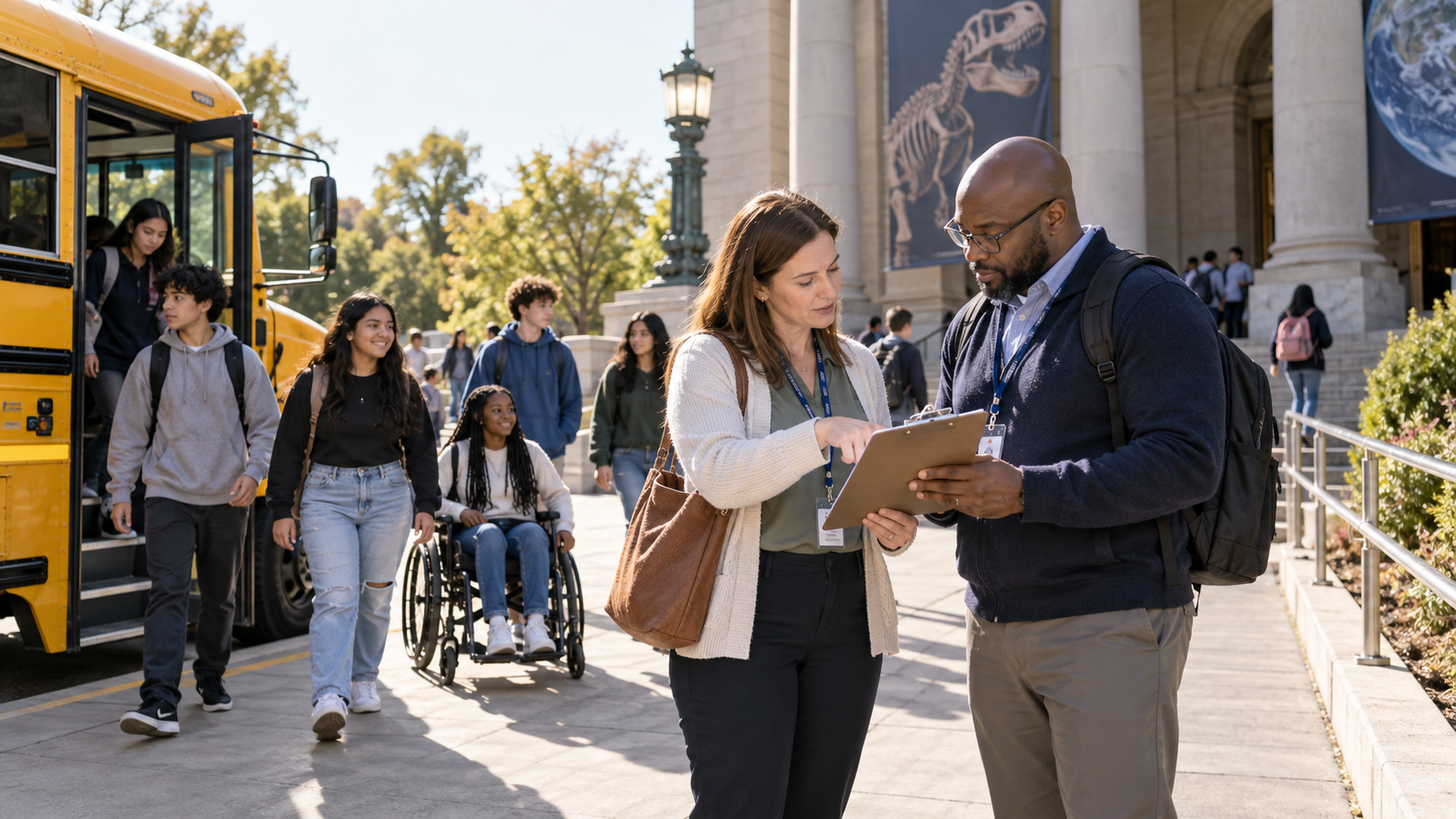
School trip safety begins before the bus moves and continues until every student is released to an authorized adult.
A signed permission form gets a student onto the bus. It does not manage what happens after the bus pulls away.
It does not tell a chaperone what to do when a student changes groups. It does not confirm whether a parent is authorized to take a student home from an away game. And it does not update the roster when the plan changes.
Those details may seem routine—until a bus is ready to leave and one student cannot be found.
That is the focus of the latest episode of Safer Ed, Safety in Motion: Who Is Responsible When Students Leave Campus? The conversation looks beyond transportation and examines the moments when responsibility moves from one person, place, or part of the plan to another.
The School’s Responsibility Travels With the Student
Schools regularly extend learning beyond the classroom. Students travel to museums, athletic contests, performances, competitions, college visits, career centers, and community organizations.
These experiences also take students away from familiar systems: established exits, nearby administrators, the school nurse, regular communication tools, and spaces designed around their needs.
Once the group leaves campus, safety has to travel with it.
The vehicle is only one part of that responsibility. The National Highway Traffic Safety Administration describes the school bus as one of the safest vehicles on the road, but it notes that children face greater risk while approaching or leaving it. Loading zones, parking lots, roadside stops, and unfamiliar venue entrances therefore deserve the same attention as the ride.
Adults need to know where students will wait, where the vehicle will load and unload, and who will supervise those movements. A stadium entrance after dark may require a different plan than the school’s regular bus loop. The safest unloading point should be identified before students step off the bus.
Every Transition Is a Handoff
Trips are built around transitions:
- Classroom to bus
- Bus to venue
- One chaperone group to another
- Activity area to meeting point
- Venue back to transportation
- School supervision to an authorized adult
Problems develop when the adults on either side assume the other person has taken responsibility.
That is why “everyone is responsible” is not a plan. One adult should serve as the trip leader, with a backup prepared to take over. Chaperones should know which students they are supervising. The driver’s responsibility for operating the vehicle safely should not be confused with the trip leader’s responsibility for student supervision and accountability.
Roles also need to be clear when plans change. Who can delay departure? Who contacts the school? Who communicates with families? Who stays with the larger group if a student needs individual assistance? Those decisions are harder to make for the first time in a dark parking lot or beside a disabled bus.
A Head Count Is Not an Accountability System
A head count can reveal that someone is missing. It cannot tell adults who is missing.
An accurate roster can—but only when it reflects the group that is actually traveling. A list created days earlier becomes unreliable when a student is absent, joins at another location, changes groups, or leaves with an authorized adult.
Attendance should be confirmed at predictable checkpoints: before departure, after arrival, before leaving the venue, after reboarding, and before final release. Whenever responsibility changes, the roster should change with it.
Parent Pickup Is a Transfer of Responsibility
The end of an away event often feels informal. Families gather, students carry equipment, coaches answer questions, and parents ask to take their children home.
This is exactly when a clear release process matters.
A message passed through another student is not confirmation. Neither is an adult saying, “I thought the coach approved it.” Schools should establish who can authorize a change, how the receiving adult’s identity will be confirmed, and who updates the roster.
The process does not need to be complicated, but it must be direct and consistent with district policy. Until the handoff is confirmed, the school still has an unresolved responsibility.
Medical and Accessibility Planning Cannot Wait
Off-campus planning must account for students who need medication, emergency supplies, mobility support, sensory accommodations, communication assistance, or another individualized response.
The school nurse may not be on the trip. The adult who normally supports the student may not be present. Trip leaders should know what support is required, where authorized medication or equipment will be kept, and which adults are trained to respond. That information should be protected and limited to those who need it, but privacy should not leave responsible adults unprepared.
Accessibility also extends beyond transportation. The U.S. Department of Education’s Office for Civil Rights states that students with disabilities have an equal right to opportunities including field trips and extracurricular activities. Schools should consider the full experience: the vehicle, entrance, restrooms, schedule, activity spaces, evacuation routes, and emergency communication.
Inclusion cannot be added after the bus arrives.
Do Not Build the Communication Plan Around One Phone
Personal cell phones are convenient until a battery dies, a signal disappears, or the adult with the contact list is managing an emergency.
A stronger plan identifies a primary school contact and a backup. Essential numbers should be available in more than one place. Adults should know who will communicate with families and which channel will be used.
This prevents several people from sending partial or conflicting information. Families do not need speculation. They need accurate updates from a designated source—even if the first message simply confirms that the school is aware of the situation and will provide more information.
Five Questions to Ask Before the Bus Moves
Before the next field trip, away game, performance, or competition, the adults responsible for the group should be able to answer five questions:
- Who is leading the trip, and who takes over if that person is unavailable?
- Who is responsible for each student at every transition?
- Is the roster current, accessible, and updated when plans change?
- How will medical, accessibility, and communication needs be supported away from school?
- How will the school confirm and document the final release of every student?
A brief trip-specific safety sheet can make those answers usable. It might include the current roster, adult assignments, emergency contacts, student support considerations, transportation details, meeting points, and an alternate return plan.
Adults should review it together before departure. Students also need a short briefing: where to meet, how to contact an adult, what to do if separated, and why they cannot leave—even with someone familiar—without completing the school’s release process.
Listen to Safer Ed
In Season 4, Episode 3 of Safer Ed, we examine how schools can maintain clear responsibility when students travel beyond the building—and what can happen when a routine handoff is assumed rather than confirmed.
The central lesson is simple: responsibility does not transfer because someone assumes it has. It transfers when the right people communicate, confirm, and document the handoff.
To learn more about how duty of care follows students across school settings, explore Science Safety’s free Duty of Care learning module.
Safer Ed is sponsored by Science Safety and produced in partnership with edCircuit.
Subscribe to edCircuit to stay up to date on all of our shows, podcasts, news and thought leadership articles.