
 EdCircuit Staff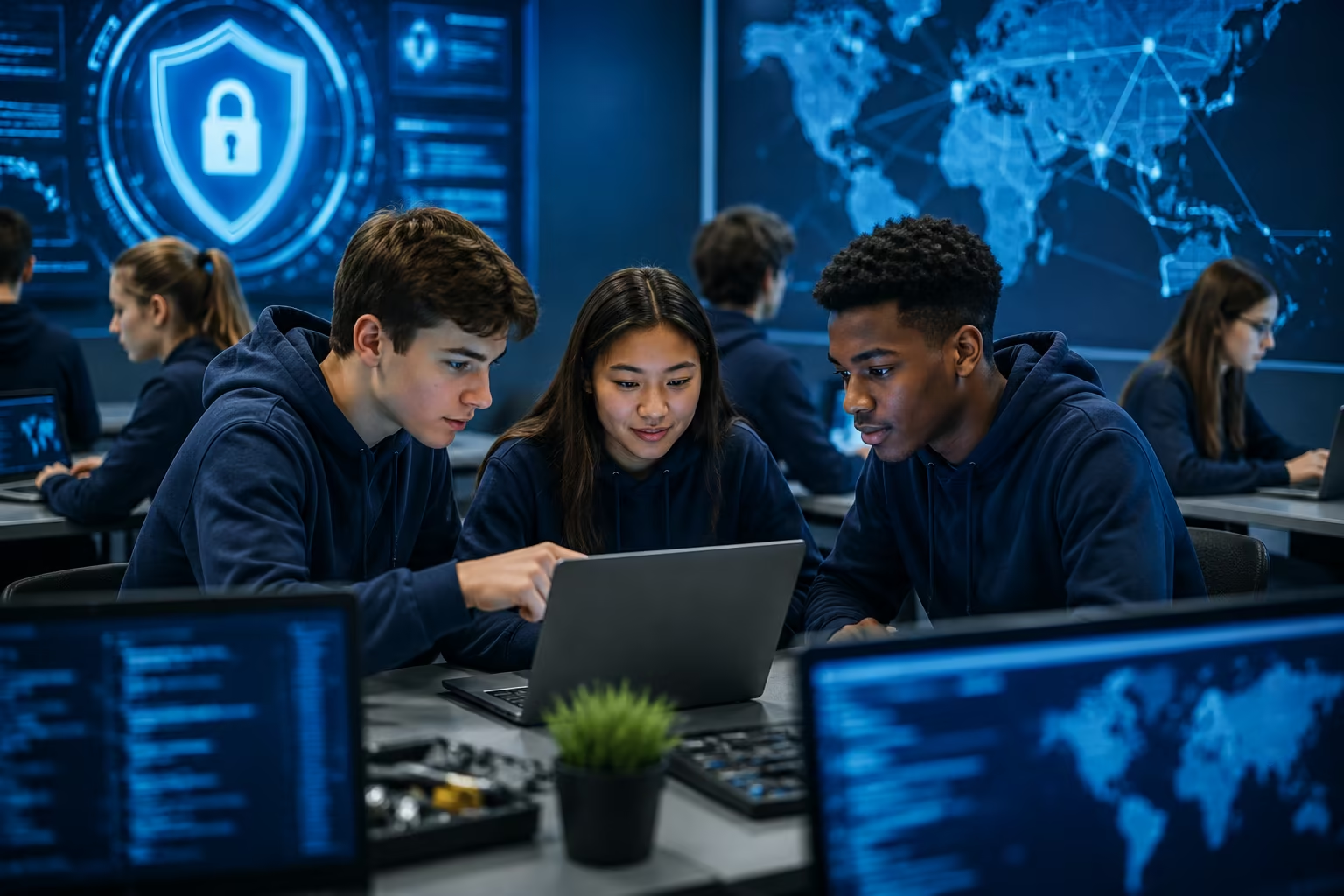
Student cybersecurity teams are rapidly becoming one of the most impactful cybersecurity and career-readiness initiatives in K-12 education, helping schools prepare students for a future where digital security touches every profession, industry, and community.
At 6:15 on a Tuesday morning, a district technology director receives the call every school leader dreads.
A staff member clicked a suspicious email.
Several accounts appear compromised.
The technology team immediately begins investigating whether sensitive systems have been affected.
While the incident is eventually contained, it serves as another reminder of a reality facing school districts nationwide: cybersecurity is no longer simply an IT issue. It is a districtwide responsibility that affects students, teachers, administrators, families, and entire communities.
Every day, schools rely on technology to deliver instruction, manage transportation, process payroll, maintain student records, support special education services, communicate with families, and operate safely. The modern school district runs on interconnected digital systems.
At the same time, cyber threats continue to grow in frequency and sophistication.
Ransomware attacks disrupt learning.
Phishing campaigns target employees.
Data breaches expose sensitive information.
Artificial intelligence is creating both new opportunities and new risks.
Yet amid these challenges, a remarkable movement is quietly emerging in schools across America.
Students are stepping forward.
What began years ago as computer clubs and technology groups has evolved into something far more significant. Student cybersecurity teams are appearing in middle schools, high schools, career centers, and district programs nationwide. These students are not simply learning about cybersecurity. They are developing technical expertise, leadership skills, communication abilities, and problem-solving strategies that will serve them throughout their lives.
For school leaders searching for meaningful STEM opportunities, authentic career pathways, and innovative ways to prepare students for the future, student cybersecurity teams may represent one of the most promising educational movements of the decade.
A Challenge Schools Can No Longer Ignore
Cybersecurity has become one of the defining educational challenges of the modern era.
School districts manage enormous amounts of sensitive information, including student records, employee information, transportation systems, financial data, health records, and operational infrastructure. Every year, the digital footprint of schools continues to expand.
At the same time, technology leaders are being asked to do more than ever before.
Support instruction.
Protect data.
Manage thousands of devices.
Maintain networks.
Deploy new technologies.
Respond to incidents.
Train staff.
And do it all while navigating budget pressures and staffing shortages.
The challenge extends beyond education.
Across virtually every sector of the economy, organizations are struggling to find qualified cybersecurity professionals. Industry workforce studies continue to show hundreds of thousands of cybersecurity positions remain unfilled across the United States, with millions of openings worldwide.
For schools, this reality creates both a challenge and an opportunity.
The challenge is protecting increasingly complex digital environments.
The opportunity is helping students enter one of the fastest-growing and most important career fields in the world.
The New Robotics Movement
Fifteen years ago, robotics programs began appearing in schools across America.
Initially, many educators viewed robotics clubs as specialized activities that would appeal to only a small group of students interested in engineering and technology.
Then something unexpected happened.
Robotics programs flourished.
Students became engaged.
Communities rallied around competitions.
Business partnerships formed.
Career pathways emerged.
Thousands of students discovered interests that shaped their futures.
Today, cybersecurity appears to be following a remarkably similar path.
What robotics was to engineering education in the early 2010s, cybersecurity may become to digital security, artificial intelligence, and technology leadership in the late 2020s.
The comparison matters because cybersecurity affects every industry.
Hospitals depend on cybersecurity.
Banks depend on cybersecurity.
Manufacturers depend on cybersecurity.
Government agencies depend on cybersecurity.
School districts depend on cybersecurity.
Every organization that relies on technology relies on cybersecurity.
The students competing on cybersecurity teams today may become the professionals protecting critical infrastructure tomorrow.
Real Programs Are Already Making an Impact
The growth of student cybersecurity teams is not a future prediction.
It is already happening.
Across the country, students are participating in programs such as CyberPatriot, where teams learn to secure operating systems, identify vulnerabilities, defend networks, and respond to simulated cyber incidents.
Programs such as GenCyber have introduced thousands of students and educators to cybersecurity through immersive camps and hands-on learning experiences.
Organizations, including the National Cyber League, provide opportunities for students to test their knowledge through realistic cybersecurity scenarios that mirror challenges faced by professionals.
These experiences are doing more than teaching technical skills.
They are helping students discover purpose.
Students gain confidence.
They learn teamwork.
They develop resilience.
They experience success and failure in environments that encourage growth.
Most importantly, they begin to see themselves as future cybersecurity professionals.
A Story Playing Out in Schools Nationwide
In districts across the country, a familiar story is unfolding.
A student joins a cybersecurity club because a friend encourages them to attend a meeting.
Perhaps they enjoy gaming.
Maybe they build computers.
Maybe they simply enjoy solving puzzles.
Initially, cybersecurity seems interesting.
Then they participate in a simulated cyber defense challenge.
Working alongside teammates, they investigate suspicious activity, identify vulnerabilities, and protect systems from mock attacks.
Something changes.
Technology becomes more than entertainment.
It becomes purpose.
Over time, that student earns certifications, competes in events, develops leadership skills, and begins exploring career opportunities.
By graduation, they have something many students are still searching for.
Direction.
Educators frequently report seeing students thrive in cybersecurity programs because the learning feels authentic. Students are not simply memorizing concepts for a test. They are solving problems that resemble challenges professionals encounter every day.
That authenticity creates engagement.
And engagement creates opportunity.
Students as Cybersecurity Ambassadors
One of the most overlooked benefits of student cybersecurity teams is their ability to strengthen cybersecurity culture throughout an entire district.
Technology departments often spend countless hours educating users about cybersecurity best practices.
Yet students frequently learn best from other students.
When student leaders discuss password security, phishing awareness, social engineering, digital citizenship, and responsible technology use, the message often resonates differently.
Some districts have empowered student cybersecurity teams to create awareness campaigns, produce educational videos, support digital citizenship initiatives, and present information to school boards and community organizations.
The students gain leadership opportunities.
The district gains advocates.
The community gains awareness.
Cybersecurity becomes part of the culture rather than simply another policy.
That shift can be transformative.
Why Superintendents Should Pay Attention
For superintendents, student cybersecurity teams represent much more than another extracurricular activity.
These programs align directly with priorities district leaders discuss every day.
Career readiness.
Student engagement.
Workforce development.
Community partnerships.
Innovation.
Future-focused learning.
Student cybersecurity teams create opportunities to collaborate with businesses, colleges, workforce development organizations, government agencies, and military partners.
They provide authentic experiences that help students connect classroom learning to future careers.
In an increasingly competitive educational landscape, cybersecurity programs can become visible examples of how schools are preparing students for a rapidly changing world.
Parents notice.
Community leaders notice.
Business partners’ notice.
Most importantly, students notice.
From the Classroom to the Security Operations Center
One of the most exciting aspects of student cybersecurity teams is how closely the experience mirrors the real world.
In professional environments, cybersecurity experts often work within Security Operations Centers, commonly known as SOCs. These teams monitor networks, investigate suspicious activity, identify vulnerabilities, and respond to threats before they become major incidents.
While student teams are not defending enterprise-level systems, many are developing the same mindset.
They investigate anomalies.
They analyze evidence.
They collaborate under pressure.
They create response strategies.
They learn to think like defenders.
The similarities are striking.
A student participating in a cybersecurity competition this year may spend an afternoon responding to simulated threats. Ten years from now, that same student could be protecting a hospital system, financial institution, government agency, manufacturing facility, or school district.
That journey often begins with a single after-school meeting and an educator willing to create an opportunity.
Artificial Intelligence Is Changing the Conversation
Artificial intelligence is creating an entirely new dimension for cybersecurity education.
Today’s students will enter a workforce where AI and cybersecurity are deeply interconnected.
AI-powered tools can identify suspicious activity, automate investigations, detect anomalies, and strengthen security operations.
At the same time, cybercriminals are using AI to generate sophisticated phishing campaigns, create convincing deepfakes, automate attacks, and enhance social engineering efforts.
The threats are evolving rapidly.
The defenses are evolving just as quickly.
Tomorrow’s cybersecurity professionals will need to understand both.
Student cybersecurity teams provide ideal environments for exploring these emerging realities.
Students can discuss ethics.
Evaluate risks.
Explore responsible innovation.
And learn how powerful technologies can be used both positively and negatively.
These conversations prepare students for careers that will look dramatically different from those of today’s technology leaders.
Building the Workforce Pipeline of Tomorrow
Few industries face workforce shortages as significant as cybersecurity.
Demand continues to grow across healthcare, education, finance, manufacturing, defense, government, and technology sectors.
This creates a tremendous opportunity for schools.
Every student who discovers cybersecurity through a district program represents potential future talent entering a field where demand continues to outpace supply.
Some students will pursue college degrees.
Others will enter technical training programs.
Some will earn certifications and begin careers shortly after graduation.
Regardless of their path, exposure to cybersecurity during middle school and high school can influence future decisions in meaningful ways.
The workforce pipeline does not begin in college.
It begins in schools.
Starting Small Can Lead to Something Big
One of the most encouraging aspects of student cybersecurity programs is how often they begin with simple ideas.
A teacher notices student interest.
A technology director volunteers to help.
A local company offers mentorship.
A librarian provides meeting space.
A handful of students gather after school.
That is often enough.
Momentum builds.
Students recruit friends.
Competitions generate excitement.
Partnerships emerge.
School leaders recognize the value.
What begins as a club can become a pathway.
What begins as a pathway can become a workforce development initiative.
The biggest barrier is rarely funding.
It is simply taking the first step.
The Next Generation of Digital Defenders
Every generation has opportunities that help define its future.
For previous generations, those opportunities may have been manufacturing, aviation, engineering, or computer science.
For today’s students, cybersecurity is emerging as one of those defining opportunities.
Schools that invest in student cybersecurity teams today are doing more than creating extracurricular activities.
They are helping shape the workforce, leaders, innovators, and digital defenders that communities will depend upon for decades to come.
The student participating in a cybersecurity competition today may someday stop a ransomware attack targeting a school district.
The student learning about phishing awareness after school may eventually protect a hospital network.
The student exploring cybersecurity through a career-tech pathway may one day defend financial institutions, government agencies, military operations, or critical infrastructure.
Every student cybersecurity team represents more than an extracurricular activity.
It represents opportunity.
It represents innovation.
It represents leadership.
It represents the future.
The future of cybersecurity is not being built solely in corporate offices, government agencies, or university laboratories.
In many cases, it is already being built in classrooms, media centers, career-tech programs, and after-school clubs across America.
The next generation of digital defenders is already here.
The question is no longer whether student cybersecurity teams belong in K-12 education.
The question is how many students will have the opportunity to participate before the rest of the world realizes just how important they have become.

First Alert 6 – National Youth Cyber Defense Competition
Subscribe to edCircuit to stay up to date on all of our shows, podcasts, news, and thought leadership articles.