
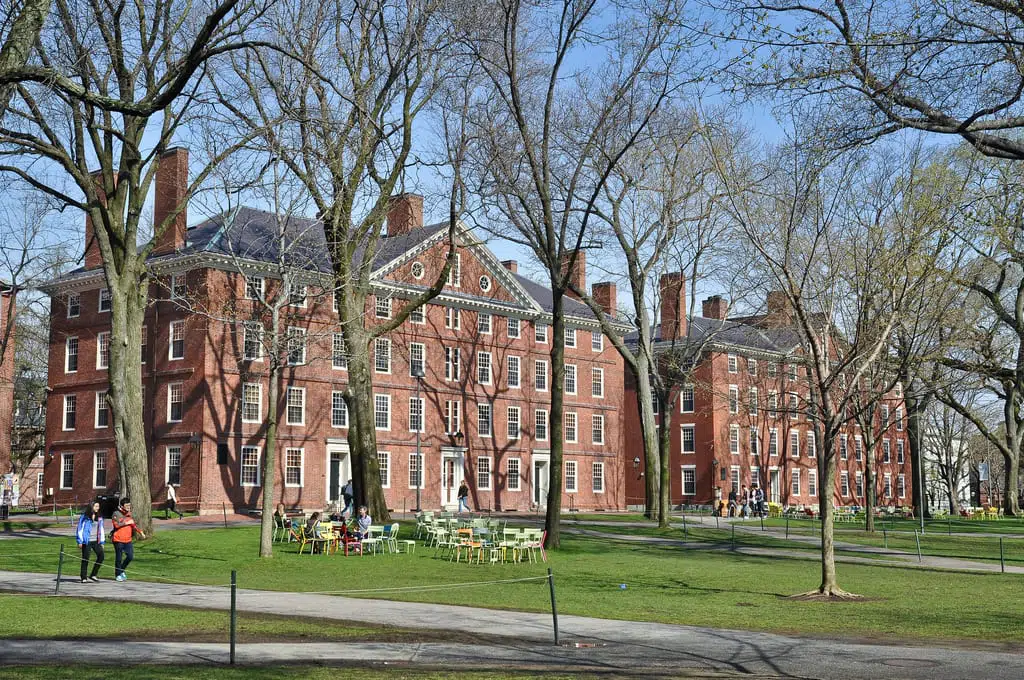

The InformED Report for May 5, 2017 began at Harvard University, which had named Rihanna its 2017 Humanitarian of the Year for her foundation’s work in education and health. It then went to Australia, where a record number of international students had enrolled in 2016. The edition closed with a Supreme Court ruling for Ehlena Fry, a Michigan girl with cerebral palsy whose school had refused to let her bring her service dog, Wonder.
In this edition
- Harvard named Rihanna its 2017 Humanitarian of the Year and gave her the Peter J. Gomes Humanitarian Award for her education and health work.
- Australia enrolled a record 554,179 full-fee-paying international students in 2016, up more than 10 percent on the year before.
- The Supreme Court ruled unanimously that Ehlena Fry’s family could pursue its lawsuit against her former school district over her service dog.
Rihanna named Harvard’s Humanitarian of the Year
People’s Brianne Tracy and Refinery29’s Suzannah Weiss reported that the Harvard Foundation had named Rihanna the 2017 Harvard University Humanitarian of the Year, with the Peter J. Gomes Humanitarian Award presented at a ceremony on campus in late February. The foundation’s director, S. Allen Counter, cited the oncology and nuclear medicine centre she had built to diagnose and treat breast cancer at the Queen Elizabeth Hospital in Bridgetown, Barbados. Refinery29 noted that she was being honoured largely for her work promoting education and health care.
Much of that work runs through the Clara Lionel Foundation, which Rihanna founded in 2012 to fund education and health programs around the world. In 2016 it launched a scholarship program for students from Brazil, Barbados, Cuba, Haiti, Grenada, Guyana and Jamaica to attend college in the United States. Speaking of that program, Rihanna said higher education would “provide perspective, opportunities, and learning to a group of kids who really deserve it.” For educators, the award was a reminder that celebrity philanthropy can carry real weight in education when it funds something specific and sustained, such as scholarships, rather than a single appearance.
A record year for international students in Australia
ABC News political reporter Julie Doyle reported federal Education Department figures showing 554,179 full-fee-paying international students in Australia in 2016, more than half a million and an increase of more than 10 percent on 2015. Higher education had the largest share, at 43 percent, and the largest numbers came from China and India. Education Minister Simon Birmingham called international education Australia’s third-largest export sector, generating more than $21 billion in economic activity.
In The Sydney Morning Herald, Matthew Knott added that those students generated 712,884 enrolments in all, and that there were hopes the political uncertainty unleashed by Donald Trump and Brexit would draw still more students to Australia. That part was a forecast, not a finding. For American colleges, the figures were a useful comparison: a competitor country was treating international students as a major export industry and planning for growth.
InformED Report spotlight: Ehlena Fry and her service dog, Wonder
The spotlight went to the Supreme Court. USA Today’s Richard Wolf reported on the case of Ehlena Fry, a 13-year-old girl with cerebral palsy, and her goldendoodle, Wonder, which helped her through the school day. Her Michigan school district had refused to let her bring the dog to school, and her family sued. In February 2017, in Fry v. Napoleon Community Schools, the Court ruled unanimously that the family could pursue the lawsuit, in a case the disability community had watched closely.
The legal question was narrow but important. The district argued that the family first had to go through the special education hearing process under the Individuals with Disabilities Education Act. The Court, in an opinion by Justice Elena Kagan, held that this step is required only when the core of a complaint is about the denial of an appropriate education. A claim of disability discrimination, such as being refused a service animal, can go straight to court. The case was sent back to the lower courts to apply that test, so the family had won the right to bring its claim, not yet the claim itself.
For school leaders, the ruling widened the ways families could challenge decisions about students with disabilities, and it drew attention to how schools handle accommodations that sit outside a student’s education plan. Clear, written policies on service animals, made with the federal disability laws in view, were the practical response.
Further reading from that week
- Fortune: Shakira’s cause of choice: early-childhood development and education
- The PIE News: International students in Germany up 6%
- CU Independent: Understanding emotional support animals and disability service animals
Sources
- Brianne Tracy, “Rihanna Named Harvard University’s 2017 Humanitarian of the Year,” People, February 2017.
- Suzannah Weiss, “Harvard Is Awarding Rihanna For Her Charity Work,” Refinery29, February 23, 2017.
- Julie Doyle, “International students studying in Australia reach record number, Education Department figures show,” ABC News, February 22, 2017.
- Matthew Knott, “International student numbers surge ahead of potential Trump-inspired influx,” The Sydney Morning Herald, February 2017.
- Richard Wolf, “‘Ruff’ justice: Supreme Court rules for disabled girl, service dog,” USA Today, February 22, 2017.
About the InformED Report
The InformED Report is edCircuit’s short news program on education. This edition first ran on May 5, 2017. In 2026, edCircuit re-presented it with a new anchor and this full written account. Both report the stories as they stood on that date and link the original reporting, so readers can see exactly where each claim came from.
Subscribe to edCircuit to stay up to date on all of our shows, podcasts, news, and thought leadership articles.