How Administrators Can Gain Buy-In
What are the reasons SEL is important to implement on a schoolwide basis?
Although social-emotional learning (SEL) is considered one of the hottest topics in education, there is still a need for educators to understand why it is important. In a world where uncertainty and trauma are increasing, many students come to school weighed down by concerns that render them mentally and emotionally unprepared for learning. Preoccupied with the dangers they face in their everyday lives, or those that loom over the world at large, more and more students are in a constant state of “fight or flight.” As caring adults who are a consistent presence in their lives, our job is to assure them that they are safe and they belong in our classrooms. When the basic human needs for safety and belonging are met, children can turn their attention to learning.
 Despite this logical and compassionate approach to the classroom, there are some educators who are unsure how SEL fits into the scope of their job description. They may be overly focused on academics due to the pressures of raising test scores, or they may feel that addressing the social and emotional needs of students is beyond their expertise. However, as Durlak (2011) notes, time spent on SEL, which includes culture, climate, and relationships, improves achievement. Therefore, in order for SEL implementation to be successful, it must be schoolwide and comprehensive.
Schoolwide means that it needs to be adopted by all stakeholders, including administrators, teachers, students, and families. Comprehensive means that it must be an integrated and intentional approach to the way school is done.
How do administrators set positive examples of SEL leadership for teachers to follow?
 The job of the administrator is to lead his or her team and champion new initiatives. As Leman and Pentak (2004) point out, a good leader is like a shepherd who “leads people in a manner that makes them want to follow” (112). Being a leader who others want to follow means investing in relationships.
In the demanding world of education, we must remember that people are more important than our never-ending to-do list. When administrators invest time to get to know people and what is happening in their lives, both at work and beyond, then the staff wants to follow. The old saying is true, “People don’t care how much you know until they know how much you care.”
How can you as an administrator demonstrate care and concern for your staff? Do you celebrate the small wins? Do you publicly acknowledge individual accomplishments? Do you give thanks to your team in words and actions? Once this culture of honor and appreciation is established, then teachers are more likely to follow.
What must administrators say and do to gain teachers’ buy-in for SEL initiatives?
 Not only must a solid foundation of strong and healthy relationships among administration and staff be created, but there must also be clear communication about the vision and mission of the school. The vision is the big picture – what we want to become. The mission is the work – what we do, who we serve, and how we serve. Articulating the vision and mission of the organization provides a focus for everyone on the team. The first step to creating buy-in for SEL is to include it in the vision and mission statements.
The second step for gaining and increasing buy-in for SEL is follow-through. Once there is understanding and agreement about incorporating SEL into the teaching and learning, then there must be actions to support that intention. Here are some suggestions:
- Continuous professional development about integrating SEL with academics
- Ongoing coaching sessions on SEL practice
- Schoolwide SEL curriculum adoption
- Scheduled time for intentional SEL instruction, such as during the morning meeting or advisory period
- Revision of disciplinary practices from punitive to restorative
After SEL implementation is initiated, it must be sustained. Since SEL requires time and emotional energy, teachers need to be reminded that it is a priority. They need to hear regularly that teaching children is more important than teaching material. Additionally, teachers must be encouraged to attend to their own self-care, knowing that they can only give what they have.
Likewise, students and families need clear communication about the school’s focus on SEL. Utilizing a common language for SEL competencies sets behavior expectations for students and creates stronger family-school partnerships.
Three things every administrator must know how to explain about SEL
 Education is the business of helping people grow. SEL empowers people ― students, teachers and families ― to identify what is going on in their heads and their hearts, so they can use their hands to build up and not tear down. Therefore, we must attend to the needs of the whole child – academically, physically, emotionally, and socially. In many areas, the school is the center of community life. School leadership, including administrators and teachers, is responsible for advocating for the needs of children and families.
Administrators must understand the following about SEL:
- Focusing on SEL will impact the culture – the what we do — and climate – the how it feels — of the school.
- Attention to SEL requires a paradigm shift in the way we do school. People do not serve data; data serves people.
- Change takes time. Successful SEL implementation requires a long-term commitment.
- EdSource – As social and emotional learning expands, educators fear the ‘fizzle’
- Edutopia – Creating Buy-In for SEL at Your School
- DML Central – Selling Social-emotional Learning

 by Jim Britt
 Our Sentence Analytics software addresses the needs raised by Mr. Harward. To begin, let’s examine what makes sentence diagramming so difficult. The biggest obstacle to success with sentence diagramming is the laborious and time-consuming process of drawing the complicated diagrams by hand. This process is frequently inconsistent and incomplete. If the student should make an error, correcting it becomes a difficult and drawn-out procedure. At this point, the student can become discouraged and disengaged from the learning process. However, we have reinvented the process: our software takes care of the drawing!
 Many students are coming to testing from a culture of failure. The exam has defeated them on more than one occasion. They need a change of heart. As Cheryl Johnson states, “Creating a culture of learning is as much about changing a mindset as it is about delivering learning that makes an impact.” (“The Latest Trend for Learning 2018” eLearning Industry 01/12/2018) Our program is designed to recast the mindset of failure with one of competence. It also gives teachers the tools and practice needed to get a flying start.
  Jim Britt graduated from the
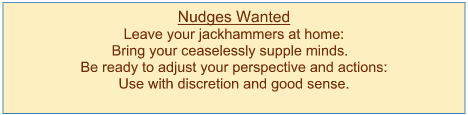
 Nudge: Touch or push lightly; gently prod or urge into action; get someone’s attention. As in: She nudged him towards the teacher’s desk; He nudged his teammates to run a little faster; it took a little nudge from my mother to finish my homework.
 Effective assessment means that students understand the learning intentions and how their learning will be appraised. They have multiple ways to show what they have learned and take increasing responsibility for their learning outcomes. In these settings, assessments are supportive of students, focus on visible and achievable expectations, engage learners, are consistent, reasonable, and emphasize improvement over final scores. Rather than a jackhammer, consider a velvet mallet, or a gentle nudge under the desk.
  Give students a role in constructing test and assessments
 To summarize, nudges are most effective when they have a track record such as those that build confidence or strengthen ownership. The best ones are:
 In the
 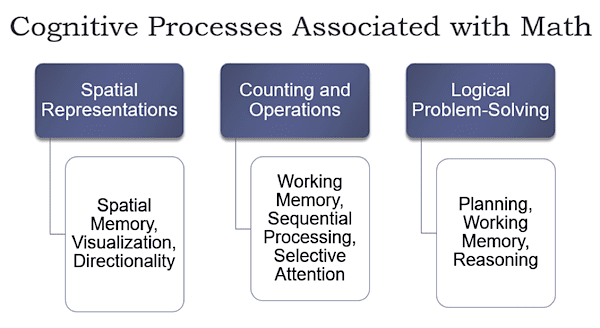 The relationship of math success to visual-spatial abilities is strongly supported by research, and the correlation actually appears to increase as the complexity of the mathematical task increases. The important aspect of visual-spatial processing is not just remembering the shape, size, color and number of objects, but their relationships to each other in space. It turns out that visual memory by itself (what things are) is somewhat error-prone, but spatial memory (where things are) is associated with correct answers, and is thus an important aspect of mathematical problem-solving. Within visual-spatial processing, we can distinguish cognitive skills such as the following:
 Finally, math is problem-solving. There are other types of problem-solving, of course, but problems with numbers almost always call for mathematical thinking and logic. In the discussion above, we have already highlighted some of the cognitive skills we use for problem-solving, but higher-order cognitive processes are often required to be successful in math. And here we can start with Planning:
 As we observed in the previous article on reading, there is significant overlap in the cognitive skills needed for reading and math. It bears repeating that we don’t have two brains; we just have one, of course, and we use it for reading and math and everything else we do. As we acknowledge how critical these skills are to learning, it raises the question of how we can support our students in developing these skills so that they can be effective learners. In the next article in our series, we will look at how cognitive skills develop and how they can be strengthened in ways that contribute to improved academic performance.











 Danny Wagner is Senior Editor, Education Reviews at
 As someone who did not grow up with English as my first language, I always found it particularly difficult to read science articles and textbooks. Usually, the text included so much technical vocabulary and jargon that I was overwhelmed by the number of new words I had to stop and look up; oftentimes I would have trouble understanding entire sentences if they contained multiple unknown words or phrases. Looking back, reading would have been much easier if I had the skills to break down sentence structures in order to identify the key nouns and verbs. Sentence diagramming is a pedagogical approach that guides students through complex sentences, breaking them up into more manageable pieces that help students understand the meaning of specific words. In science courses, much of the vocabulary is unfamiliar as most people do not encounter it in their day-to-day interactions, which could lead to higher levels of confusion and misunderstanding, especially for English Language Learners (ELL).
 In order for students in Texas to graduate, they are required to pass a biology end-of-course exam. Throughout this course, students study living organisms which includes subjects like anatomy, behavior, and interaction. The amount of reading required to learn this information is staggering, and test questions are often long sentences describing different scenarios the students would have to navigate through to provide a correct answer. For students not yet proficient in the English language or content, this can act as a roadblock and hinder their success.
 Students encounter similar comprehension issues in other science courses, including physics, geology, aquatic science, and astronomy. Upon learning a long list of new vocabulary words, they must read and understand articles using these new terms. Too often, students give up as soon as they see test questions in paragraph form because the process of making sense of it all is too discouraging. If we were to teach them how to break down each question in order to get to the main point, it would make the process more tolerable for those who struggle with the English language and could lead to higher success rates. As previously stated, sentence diagramming is an approach to teaching and learning that helps readers overcome literacy challenges by understanding the main point each sentence is trying to convey, especially in vocabulary-riddled text.
 Joy Lin attended the