EdTech is a resource and a tool, not the focus of the lesson
“When teaching a rapidly changing technology, perspective is more important than content.”
by Mac Bogert
 I had the pleasure to work as a carpenter for some years, under the guidance of a smart—and patient—master carpenter. “Measure twice, cut once” is advice I still apply to my work, even when a saw isn’t involved.
He also offered this jewel: “A tool is no better than the fool”. So, a better tool doesn’t improve results if the person using it hasn’t mastered the application of the new tool.
The internet is a tool for gathering and applying information. We all have access to the same limitless amount of data. Because of this universal access, teaching is less and less about information, more and more about meaning. When I was in school, that was not the case. My best teachers had access to more information than I did. My other teachers did too.
The difference between my best and the rest was a respect for connection. The best teachers focused on meaning and gave us students a paradoxical gift—the opportunity to struggle with understanding. While some teachers emphasized the importance of memorizing dates —1066, 1492, 1776, 1861, 1914, 1964— the best teachers regarded dates as navigation points, jumping off places to engage in a conversation within the context of the information.
Technology has changed the classroom before, say from chalk and the blackboard to film strips and overhead projectors. These advances, however, didn’t offer as perfect an opportunity to support a transformation of what teaching looks like.
As Sonny Magana points out in Disruptive Classroom Technologies: A framework for Innovation in Education:
“Educational technologies can be either a disruptive innovation or distractive innovation; the dependent variable seems to be the manner in which the technology is used.”
Simply put, we can either see this disruption as a resource or a threat. A new generation of learners needs a new generation of teaching. Not a new generation of teachers. The technology won’t wait for a new generation of teachers; we need a new frame for how we define ourselves now. Students don’t learn simply from what we teach, but from our perspective—our expectations and assumptions about what learning should be. We can model agility, flexibility, and respect for learning by shifting how we manage our responsibility to lead, a process of challenging our own assumptions about teaching and learning.
As we grapple with using technology to support disruption and learning, let’s consider what Roger von Oech points out in A Whack on the Side of the Head.
 A runner who loves to explore, Roger was checking out his new neighborhood some years back and came upon a friendly pooch named Aslan. He got in the habit of running by Aslan’s yard every day, stopping for a visit before finishing his run. One day, disappointed at not seeing his four-legged friend, he knocked on the door and was saddened to hear that Aslan had died during the night. The next day (and on succeeding days), he found himself running by Aslan’s yard even though the reason for doing it was no longer there.
He calls this the Aslan Phenomenon—learned behaviors that generate habits (of thinking as well as of doing) at a time and place when they make sense. Things change, but we keep operating within the same habits even though the reason for them is gone.
As a lifelong teacher, I’ve run into my own Aslan Phenomena more times than I can count. Sitting students in rows. Making sure they understand class objectives. Seeing myself as the resident expert. Asking the pro forma “Are there any questions?” rather than “I want two really good questions right now.” Following lesson plans, no matter what. The list goes on. And I try to help my adult clients do the same thing in their organizations, large and small, where Aslan Phenomena thrive.
Those of us responsible for learning can be skeptical of any assumptions or practices that happen in school even though the reason for them is gone. What are the “leftovers” in our assumptions about teaching that inhibit realizing the full potential of the technological toboggan ride? How can we change our thinking to take advantage of the energy of new technology and a new kind of student?
“The first rule of the jungle is eat or be eaten. The first rule of our role in any organization is frame or be framed”
Anonymous
Three ideas power a new way of framing our responsibility, a new approach that can take advantage of rapidly evolving technology.
First, we can let go of the idea that we control what others learn. Each of us learns uniquely. Understanding is and always has been individual. We can influence what people memorize by rewarding them for parroting information. And information can be a powerful baseline for comprehension, but it’s not the same as understanding. We encourage others to gain insight when we serve as a resource rather than as a director.
Technology provides us the perfect platform to serve as navigators, consultants rather than directors. We don’t need uniform results (a leftover from the industrial approach to schooling); we do need uniform access. That includes a vital role for teachers who act as mentors and coaches in a community of learning that explores possibilities, some congruent, some divergent. Answers rather than the answer.
Second, we can welcome what we don’t know. Instead of being breathing encyclopedias, we acknowledge that learning is continuous, for everyone. Our insight grows through relationships between what we already understand and what we don’t. Wide-eyed and pleasantly surprised provides the habitat for life-long learning. Not just for students, but for all of us. Instead of “teaching” them, we can become trusted partners in learning, our experience a layer that enrichers their understanding.
We’ve all had the experience of being startled by a child’s mercurial adaption to technology. We can be comfortable with our role not because of what we know but because of our devotion to meaning.
Third, we can accept learning as dynamic. People learn through leaps of insight which are available only when we let go of information as the goal of learning. The platform we each carry, our pocket computer (we call them cell phones, but they’re computers with a phone app) is constantly morphing.
We need everyone’s input, every day. Though we can help provide a structure to make sense of the barrage of new information, new apps, new programs and a world of accelerating change, that structure will not be comfortably linear, but punctuated by quantum leaps and a necessity to see learning not as an activity but as a way of life, finishing school not as graduation but as commencement, and a life-long hunger for discovery and application.
“Teaching is closer to the kind of science, like engineering, computer science, or architecture, whose imperative it is to make the world a better place, a design science.”
We have seen in the past decade the impact of change on those who are stuck in Aslan Phenomenon thinking. Technology is not the answer to that trap, but a vehicle for a better kind of learning. It’s an answer to the question every teacher asks: “What resources can I find to help us all learn and grow?
For audiophiles, you can listen to a brief podcast on this topic. Simply click on the link below:
Author
 Since 1994, Mac Bogert has been president of Aza Learning, providing innovative coaching and learning programs focused on leadership and creative thinking. He began teaching in 1971 after attending Washington and Lee University and the University of Virginia. He’s taught in a variety of schools, from elementary to college, today providing learning support for 200 clients nationwide.
He recently published Learning Chaos: How Disorder Can Save Education, which suggests we don’t need to make people learn but to remove the barriers that prevent learning. Mac lives in Annapolis, MD, where he works, writes, sails and plays blues guitar, though not all at the same time.
Follow Mac on Twitter.
Further Reading
- Washington Post – Don’t confuse educational technology that helps kids learn — and doesn’t
- EdSurge – Understanding the Limits of Education Technology and Risk Taking in Schools
- TrustED – 5 #edtech myths debunked

 It’s just us students in the middle car as we race to learn as much, and as fast, as we can. The teachers are in the first car, leading the “education caravan” because they’re the only ones who know where we are going. Our parents are in the third car, trailing – trying to keep up in the old minivan. We keep looking back to make sure they are with us, but really, we have to focus on the teachers’ car in front of us. It’s been pounded into us that if we fall behind, we’ll get lost and never reach our life goals.
  Today’s kids have it harder. There is more pressure to succeed from parents and teachers than ever before. There are societal pressures around fashion, entertainment, social media, and what college you got into. Combining the Internet with smartphones brings about cyber-bullying, pornography, gambling, scams, twisted and evil content, hyper-violent video immersion games, malware, and identity theft. Then there are predators and stalkers, gangs, haters, sexting, FOMO, and increased isolation. These are not just scary things but are real dangers that must be faced and figured out. In students’ quest for independence, missteps are common and come with lasting consequences. School violence, shootings, depression, and suicide are always in the back of their minds.
  Technology, in and of itself, is not a good or bad thing. It is not a force or influence on people. It is the way we use and interact with technology that determines our end experience of it. Since teachers control the classroom and are the primary implementers and managers of these great educational changes, then it is also their responsibility to not lose anyone off the back of the caravan. This means they need to take action to deliberately involve parents, give parents a role, and allow children to see their parents as relevant parts of their learning experience. Teachers need to ask, or even demand, that districts and EdTech system developers find a way to include parents.
  Steve Clark
 Opportunity for Success
 Ownership
 When arts funding in the California public school system was drastically cut, Dr. Theresa Rouse was heartbroken. As a district superintendent in Central California and a person who has been passionate about music from an early age, there was no doubt in her mind or philosophy that the arts were a critical part of a child’s development and education. From the age of six, she played piano, sang in the school and church choir, played the violin, and was part of the orchestra from elementary school all the way through high school. When turning her focus on superintendent positions back home in the Midwest, Dr. Rouse heard about the progressive arts program in the
  Dr. Theresa Rouse became Superintendent of Schools for
  Patrick M. Baker is passionate about urban education, innovation, and the arts. After pursuing degrees in music education and educational leadership, he and his wife moved to the Chicago suburbs where he began his career as a music educator and arts administrator. He currently serves as the Fine Arts Coordinator for
 Education technology has become quintessential in today’s modern classrooms, with teachers and students expecting access to the latest and greatest in learning tools. Not surprising, right? But what is surprising is the amount of money school districts leave on the table when they delay their technology refreshes until summer.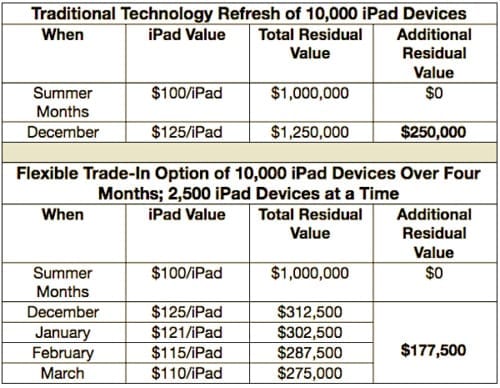
 As K-12 school districts feel increasing pressure to justify technology costs, the goal for some is to save money in the short-run. This has led to an influx of low-cost education technology alternatives to the iPad, such as Google’s Chromebook — but at the cost of what’s best for the education experience and a school’s budget (after only a few years, Chromebook’s trade-in value may be as low as $0). When schools are mindful of the bigger picture and focus more on long-term sustainability, they provide a better experience for students, while also positioning themselves as sound financial stewards.
 Dave Saltmarsh is global education evangelist at