
https://vimeo.com/247201015
Attracting top-level minority talent to the educational professions
 With Christopher Stewart, it all started many years ago when his oldest son started school. That’s the reason why he got involved in education and as he says, “It’s the reason I’m here, and that’s the only reason why we’re having this conversation.”
Chris became a parent activist and a parent advocate. But, he says, “I’m sitting here in spite of the system, not because the system did anything good to draw me in.”
He sees a crisis in the education community across the country when it comes to attracting top-level talent to teaching and other educational professions. From the dynamic teachers in the classroom all the way up to software designers and beyond, the best minds are going elsewhere with more attractive opportunities. “We have a 150-year-old school system in a lot of places that hasn’t changed enough, and it doesn’t make itself very attractive to the most talented,” Chris says. But even deeper, he sees a critical crisis attracting talented people of color.
 “For black kids who have a black teacher once or twice in their school career, it makes a big difference in their graduation rates and their college acceptance rates,” he says. “There is a push almost everywhere to increase the rates of people of color leading educational initiatives, but it’s not fast enough, and it’s not producing enough leaders.” He says there is a real lack of incentives to attract the brightest minds to come back to education as a profession after college.
“It will be a catastrophe if we don’t get more kids of color and low-income kids across the finish line,” Chris says. “The land of opportunity only starts opening up the moment that you’re qualified to participate in it. And we are not qualifying enough people of color to actually participate.”
About Christopher Stewart:
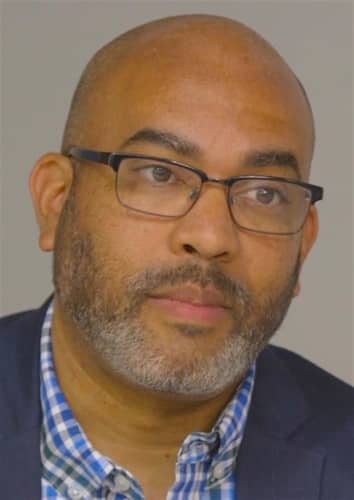 Chris Stewart is Senior Partner and Chief Executive of the Wayfinder Foundation. He is a lifelong activist and 20 year veteran of nonprofit work. Stewart has served as the former Director of Outreach and External Affairs for Education Post, the Executive Director of the African American Leadership Forum (AALF), and an elected member of the Minneapolis Public Schools Board of Education where he was radicalized by witnessing the many systemic inequities that hold our children back.
In 2007 Chris was elected to the Minneapolis Public Schools Board of Education. In that role, he helped establish the Office of New Schools, an area of the Minneapolis Public Schools to implement school reform strategies. At the same time he created the Equity and Achievement Committee, authored a board-level “Covenant with the African American Community,” and advocated safe, orderly, and rigorous schools that prepare students for the real world.
In 2011, Chris organized community members for two campaigns in Minnesota: Action For Equity, a grassroots effort to spur innovation in family and education policy at the state level, and the Contract for Student Achievement, a coalition of community organizations working to achieve greater flexibility for underperforming schools through changes to Minneapolis’ teachers’ contract. Since 2009 Chris has been president and principal with Yielding Assets, LLC, a grassroots consultancy helping government, nonprofit, and foundation clients create self-sustaining, social good projects.
Chris serves as chair of the board of SFER’s Action Network and also serves on the board of Ed Navigators.
Chris blogs and tweets under the name Citizen Stewart and publishes at Citizen Education. He is based in the Minneapolis area.
Follow Chris Stewart on Twitter.
Author
Dr. Berger is one of many industry education correspondents for the Mind Rocket Media Group, An educator and former school administrator. He often hosts education panel discussions and develops strategic content. As an academic Dr. Berger is a guest lecturer at Vanderbilt University’s Owen Graduate School of Management. A former assistant principal, he has been an adjunct undergraduate professor and developer of online college courses. He is a passionate Detroit sports fan who has also adopted Nashville sports teams as his own.
Contact the Mind Rocket Media Group if you are interested in an industry interview and a placement on EdCircuit.
- New School for New Orleans – Preparing the next generation of civil rights leaders
- The Verge – Over 200 black leaders gathered in Palo Alto to discuss diversity in tech
- Mirror – Future leaders writing new chapter for Black History Month in Federal Way


 Kara Mulkusky, the MTSS Instructional Specialist at Bay City Schools, takes it a step further. She sees an urgency in teaching kids the social and emotional skills needed to succeed far into their futures. “What are we doing to teach those students on a school-wide level,” she asks? “What are our expectations that we want our students to learn? How are we modeling those expectations for our students? And what are we doing to make sure that those positive behaviors are reinforced appropriately so that they’re maintained throughout life?”
 Using restorative discipline, they ask students with behavioral issues, what happened? Why did it happen? What were you thinking? How can we fix it? They follow what they’ve termed the “R cubed factor” which represents recover, reflect, and return. Sarah adds, “The most critical factor is the second ‘R’ which is to reflect. It’s the reflection piece that includes all five restorative questions ending with ‘What can we do to repair the harm that’s been done? What can I do to make things right?’”
 Sarah has been in the educational field for 15 years, 10 of which were in the classroom at the elementary level. Upon obtaining her Master’s Degree in 2014, Sarah pursued her passion for Educational Leadership and accepted the Coordinator for Student Placement Options position with the Bay District Schools in Panama City, Florida where she could share her passion for student success through social and emotional avenues. Viewing discipline as a learning experience that must be taught and focusing on positive relationship-building rather than punitive consequences, Sarah hopes to be a change-agent for this restorative discipline approach.
  Kara is originally from Pennsylvania where she graduated from

 It’s not just the testing; it’s also the mindset of the way we traditionally teach our kids. And that starts with the teachers. Her district is a member of the Texas Public Accountability Consortium (
 As an undergrad at
 “Corporate America is a bureaucratic organization,” he says. IBM doesn’t do a lot of innovations internally; CISCO doesn’t do a lot of innovations internally. They go out and buy nimble, innovative companies and introduce them into their model.”
 Dan Forest has served as
 Yes, there is. In this case, the suspension cost Gronk
  Ask any math teacher and they’ll tell you how much they hate the phrase from students, “I stink at math,” which they hear all too often. That’s an “I’m giving up” phrase and for some reason, acceptable by society. But my wife remembers a different outlook from when she was an ELL teacher and her Asian students always put it differently by saying, “I have to work harder to get better in math.” That’s resilience… so apply that ‘never give up’ attitude through the use of sports with your students and suddenly they may change their perspective on math and anything else they’re having trouble with.