Talia Milgrom-Elcott leading the charge for STEM teachers in US schools Hear more from Talia Milgrom-Elcott and other innovative analysts, thought leaders, and educators at the 2018 Future of Education Technology Conference (FETC), January 23-26 in Orlando, Florida. Learn more here.
 When President Obama called for the country to recruit 100,000 STEM teachers in ten years in his 2011 State of the Union address, Talia Milgrom-Elcott decided she was going to lead the charge to make it happen. In a rare case of a citizen answering the call of a president, Talia formed 100Kin10 (one hundred K in ten), a recruitment group with a goal of leading the charge to attract those 100,000 teachers.
Talia rolled up her sleeves and took the challenge head-on with drive, determination, and, as she says in hindsight, a little bit of naivety and foolishness. But it all came together, and at the halfway point the group has recruited more than 200 organizations to join in the recruitment and retention of STEM teachers in American schools.
The journey is far from over, but it is considered a success already. For information on how to help or join the movement, visit 100Kin10.org.
This article was originally published in the Huffington Post by Dr. Rob Berger.
About Talia Milgrom-Elcott
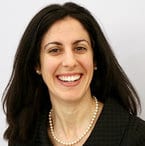 Talia is widely recognized for her visionary and innovative approach to tackling large, systemic challenges. At 100Kin10, she’s creating a new model for networked, nimble, and iterative collaboration that’s relentlessly focused on identifying—and solving—some of our most intractable social challenges.
Under her leadership, what began as a call in President Obama’s 2011 State of the Union address for 100,000 excellent STEM teachers in 10 years is becoming a reality, with more than 250 leading organizations from across sectors coming together in an unprecedented movement to train and retain 100,000 excellent STEM teachers by 2021. With 100Kin10, Talia is building a new type of collective-impact effort that breaks the mold for how organizations collaborate, learn from one another, and together tackle challenges that none could successfully address on its own.
Talia earned her chops in education and philanthropy working with amazing mentors as a Program Officer at Carnegie Corporation of New York from 2007-13, and as part of Chancellor Joel Klein’s leadership team at the New York City Department of Education before that.
Talia graduated magna cum laude from Harvard College and Harvard Law School. She lives in Brooklyn with her husband and three little kids. She used to read lots of books and magazines, run, practice yoga, and sit in cafes reading the Sunday Times. Now she plays with Legos, magnetiles, and “stuffies” and reads books with pictures, a great tradeoff, all things considered.
Follow Talia Milgrom-Elcott on
Talia Milgrom-Elcott speaking at the upcoming FETC:
AuthorDr. Berger is one of many industry education correspondents for the Mind Rocket Media Group, An educator and former school administrator. His video interview work and conversational podcasts have been featured in various media outlets. He often hosts education panel discussions and develops strategic content. As an academic Dr. Berger is a guest lecturer at Vanderbilt University’s Owen Graduate School of Management. A former assistant principal, he has been an adjunct undergraduate professor and developer of online college courses. He is a passionate Detroit sports fan who has also adopted Nashville sports teams as his own.
Contact the Mind Rocket Media Group if you are interested in an industry interview and a placement on EdCircuit.
Further Reading
- Deseret News – Salt Lake company expands into online STEM programs for teachers, consumers
- Juneau Empire – A new STEM collaboration has Juneau teachers working hand-in-hand with scientists
- eSchool News – Where will STEM education be in 5 years?

 Sierra Vista Middle School in Irvine, California has a local treasure in music teacher Henry Miller. He was nominated last year for the National GRAMMY Music Educator Award presented by the
  And it had a big hit. Programs that were large and had multi-course offerings were reduced significantly. It took a very long time for a lot of schools until they actually recovered from it.
 HM:
HM: If they see that I’m here for kids to be able to create a quality experience for my students ─ that what I’m doing benefits them ─ then, I get the support. I’ve been very fortunate to be able to have colleagues who are open, and I don’t have people who are “This is mine, and that is yours and ne’er the twain shall meet.”
 HM:
HM: It’s not a competitive environment where I’m trying to beat you or play better than you. We’re all working together; the kid who may be the concertmaster in the orchestra is just an important as the one who is sitting last chair in the violin section. If that one kid doesn’t play their music correctly, it’s going to be heard and it’s going to be detrimental to the overall experience.
 Henry Miller was born in Los Angeles and grew up in Torrance, California. His trumpet playing earned him a scholarship at the
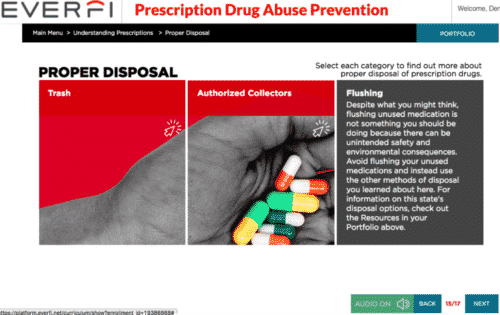
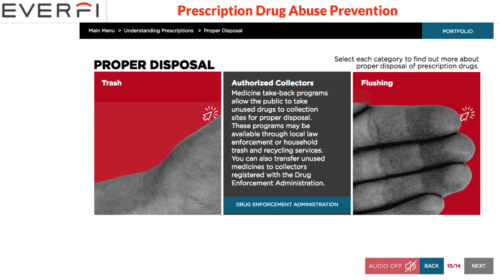
 As we observe the 14th annual National Drug Take Back Day, which is designed to highlight the importance of properly disposing of unused prescription medication in order to prevent accidental abuse and misuse, it’s important to reflect on the impact prevention education can have in sustaining healthy and safe communities.
 Why Safe Prescription Drug Disposal Matters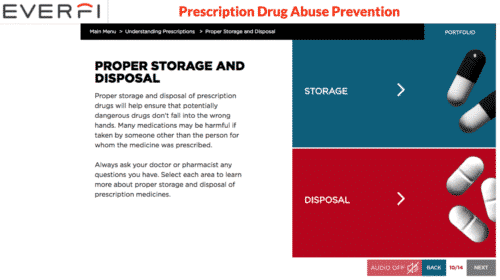


 One of the few technology initiatives I do promote is digital student portfolios. They are defined as online collections of learning artifacts intentionally curated to showcase a student’s accomplishments and growth over time. With the availability and ease of use of digital tools today, there is little reason why students should not be able to experience this authentic process of assessment. Here are ten reasons why every student should have a digital portfolio.
 digital portfolios into the classroom, teachers provide a window into a student’s world with regard to their best work and growth over time. In my last school that had a higher level of poverty, we witnessed several families become engaged in the school experience through their child’s digital portfolio. Using FreshGrade (
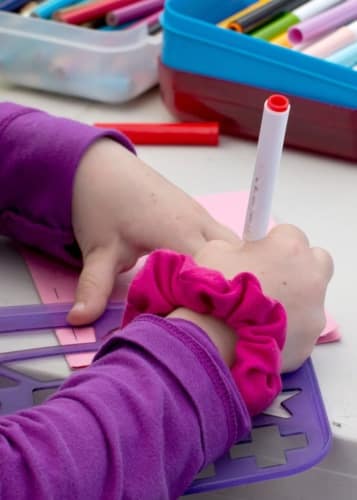 Excellent work does not come out of thin air. In writing my book on digital portfolios, I had to go through many drafts and revisions before it was ready to publish. Students can better understand this process by publishing not only their best work but also their prior attempts and efforts. For instance, an English teacher can expect their students to keep a digital portfolio of their writing using Google Sites (
 Teachers can and should treat digital portfolios as a student-driven assessment experience. They don’t have to own it. In fact, by giving students the autonomy and responsibility to develop their own digital portfolios, kids are likely to own the results of their learning, and subsequently the learning itself. As an example, Lisa Snider is a journalism teacher in Oklahoma. For her high school course, students are expected to keep their own online space for their writing using WordPress. They also produce the school newspaper and yearbook. To pay for technology resources for the course, they have to sell advertising on their publications to purchase the computers, software, paper, and ink. That means their writing has to be worth reading.
 If all students have to represent their accomplishments in school are test scores and grades, we are excluding students who may not be successful in these types of assessments. For example, teachers can have students video recording a performance task, such as a speech or demonstration, and then upload this file to a digital portfolio for families to see. This documentation of student learning adds rich context to the typical grade or score.
 Matt Renwick
 As a gifted coordinator, I get asked a lot of questions. Curiously, the question I probably get asked the most is not what great things are you doing, how can I be involved, or what way do we best reach our gifted students? The question I get asked the most is what does a gifted coordinator do? Even by adults. When I was a teacher, it was easy. Someone asked what I did, I stated I was a teacher, and they just nodded their head like they knew what that meant. Now when I say I am a gifted coordinator, I get a look that indicates befuddlement.
  For example, I have been a gifted coordinator in two different districts, literally right next to one another and serving similar students. However, the expectations in each district were very different. In my original district, the district gifted coordinator had always been a part-time position. They usually got a retired administrator to take on the task or simply added the task to another administrator’s plate. When I was hired, I was still a classroom teacher. Two and a half days a week I would work with students as part of my regular classroom. The other two and a half days I would focus on gifted coordination.
 Then I had the chance to change districts. My new district offered me a full-time position as an administrator. It also gave me resources I had not had previously, including a budget, power to make decisions, a coach for teachers and five days a week to do my job. What this allowed me to do was to have a wider view of the district in regard to gifted. This new district also had elementary pull-out and a middle school magnet program. But I have had the opportunity to expand these services and tailor the needs to individual buildings. Just having conversations with building principals have gone a long way in figuring out ways to best reach students in their schools who are gifted but did not qualify for the gifted programs. Even non-gifted but high achieving students were helped by the work we were doing.
  These two examples represent ends of a spectrum. Different coordinators fall onto different places on this spectrum depending on their job description and the expectations of the district. Ideally, every district would have a full-time gifted coordinator who is gifted-certified who would be looking out for this specialized group of students. Unfortunately, this is not always the case. There are some districts that simply put the responsibility on a principal or assistant superintendent who has their fingers in many other pies, meaning their attention to gifted will be limited at best.
 Higher-level questioning is an integral part of a rigorous classroom. Look for open-ended questions, ones that are at the higher levels of Bloom’s Taxonomy (analysis, synthesis).
 The third component of a rigorous classroom provides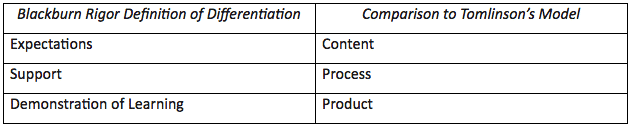
 Finally, we might differentiate how students demonstrate their learning, or the product they complete. Perhaps I want students to analyze a series of events in a social studies lesson. A portion of my students are able to write a detailed analysis of the impact of those events on today’s society. Others may understand the material, but are unable to write an analysis paper. In those situations, it’s easy just to ask them to summarize the material, which is lowering the rigor. Instead, we could provide an opportunity for those students to verbally complete the analysis, perhaps by creating a video. In this case, struggling students demonstrate their learning at a rigorous level, just in a different way.