
Slipping through the gender cracks in secret by Ellen Hurst
 Once upon a time there lived a beautiful prom queen. This prom queen possessed all the requisite physical characteristics that one might expect in a fantasy queen. She had golden tresses, blue eyes, porcelain skin and a perfect white smile. She gave the illusion of developed sexuality without denying the possibility of innocence. She was a combination of loner and outsider. She had the ability to mediate conflicts within her high school population because she had the genius of communication. She could be characterized as a cultural heroine in that she unified the individual and the group.
Our prom queen differs significantly in one aspect of her life. She lived with a secret that she kept hidden throughout her school years. This young woman walked into my office and set my research into motion. This vision of perfection had one veiled flaw. She was an undiagnosed dyslexic.
The majority of teachers in today’s workforce are white, female and middle class. Teachers of color comprise about 16 percent of the teaching force in the United States. In addition, pre-service, as well as in-service teachers, have little experience with children with learning differences or from cultures and languages different from their own.
Our call as advocates is to determine the particular attributes, skills, and dispositions that are needed to increase the probability that all teachers will be able to deliver an academically appropriate pedagogy to stop the industrial mentality of turning out products, flaws and all.
With the advent of Response to Intervention (RTI), all teachers are mandated with the task of meeting the educational needs of all children. General educators are understandably uncertain regarding their level of preparation for their new role of delivering differentiated pedagogy. New research must focus on how well we are preparing teacher candidates with the theoretical understandings and pedagogical skills necessary to meet different learning needs and styles of our children.
 This call to arms to change how and what we are doing to our students must be shouted from the rooftops, “Something is rotten in the state of American education.” I can’t help but suspect that unequal treatment of cisgendered children may have something to do with a collective failure to adequately educate all of our children.
The statistics are grim. Boys are kept back in schools at twice the rate of girls. Boys get expelled from preschool nearly five times more often than girls. Boys are diagnosed with learning disorders and attention problems at nearly four times the rate of girls. They do less homework and get a greater proportion of the low grades. Boys are more likely to drop out of school, and make up only 43 percent of college students. Furthermore, boys are nearly three times as likely as girls to be diagnosed with Attention Deficit and Hyperactivity Disorder (ADHD). Considering 11 percent of U.S. children –6.4 million in all – have been diagnosed with ADHD, that’s a lot of boys bouncing around U.S. classrooms.
Boys do not suffer alone. Many undiagnosed dyslexic girls enter the Literacy “closet” early in life, spending childhood years anxiously avoiding classroom participation in oral reading for fear of embarrassment and disclosure. Because girls tend to be affiliative by nature, the fear of possible peer rejection results in sustained levels of anxiety. Carried further, this fear of disclosure may curtail participation in typical literacy activities such as note writing, emailing, blogging and yearbook signing.
All of us share the common goal of providing equitable learning opportunities for every student in every classroom. This daunting task cannot ignore the elephant in the room – gender. A new study on gender disparities in elementary-school performance examines both the objective and subjective aspects of this deteriorating academic performance (Conwell, Mustard & Van Parys, 2012). Surprisingly, they show that:
…the grades awarded by teachers are not aligned with test scores. Girls in every racial category outperform boys on reading tests, while boys score at least as well on math and science tests as girls. However, boys in all racial categories across all subject areas are not represented in grade distributions where their test scores would predict. Boys who perform equally as well as girls on reading, math and science tests are graded less favorably by their teachers, but this less favorable treatment essentially vanishes when non-cognitive skills are taken into account. For some specifications, there is evidence of a grade ―bonus for boys with test scores and behavior like their girl counterparts. (Conwell, Mustard & Van Parys, 2012, p.1).
 This seems to defy the logic of assessment. It appears to be blatant discrimination. There were some exceptions to this puzzling phenomenon. Teachers didn’t downgrade boys who had identical test scores to girls… on one condition. Boys that shared the girls’ positive attitude toward learning received the same grade. The well-socialized boys received a higher grade for good behavior.
To summarize, boys who match girls on both test scores and behavior get better grades than girls. Boys who match girls on both test scores but have bad behavior are graded more harshly. This means that the issue of what to do with underperforming students just became much more complicated.
Gender is a significant factor at play in determining performance in reading and writing. Yet, it is not the only factor. We cannot lose sight of the fact that the differences among boys and among girls are greater than the differences between boys and girls. We must be careful not to focus on the gender differences between students, but rather to recognize that the effectiveness of certain approaches in literacy instruction may be tied to gender. If we keep this focus, we will be better able to provide appropriate and equitable opportunities for both boys and girls.
There are four distinct categories of students who don’t read:
- The dormant reader: “I’m too busy right now!”
- The uncommitted reader: “I might be a reader, someday.”
- The unmotivated reader: “I’m never gonna like it!”
- The disabled reader: “It doesn’t make sense.”
By understanding these views, we can gain greater insight into why some students choose not to read. The frightening fact is as students get older, they increasingly describe themselves as non-readers. Few have this attitude early in their schooling, but nearly 50 percent describe themselves as non-readers by the time they enter secondary school. The downward spiral continues as students in middle school reported fewer social supports, less self-efficacy, and lower intrinsic motivation—the internal desire to attain academic goals.
 My study of gender and dyslexia began some years ago when the Dyslexic Prom Queen courageously walked into my office. Long before I met her, I had many years working as a reading specialist. Many days have been filled with conversations with parents in which they report they have been told that their child’s reading delay was due to nothing more than a developmental lag. They are told to give it some time and their child will eventually catch up.
When a kindergartener confuses letters, associates the wrong sound with a letter, or cannot distinguish a rhyme, it usually has nothing to do with social maturity. Please do not accept the developmental lag excuse that has been used for generations. If your intuition tells you something is not right, do not wait to seek help.
The National Institutes of Health state that ninety-five percent of poor readers can be brought up to grade level if they receive appropriate early intervention. Of course, it is still possible to help an older child with reading, but children beyond third grade require much more frequent and intensive help. The longer you wait to get help for a child with reading difficulties, the harder it will be for the child to catch up.
Seventy-five percent of children receiving intervention at age nine or later continue to struggle throughout their school careers. Waiting until fourth grade, rather than taking action in kindergarten, will only make the task of remediation more complex and time intensive. It will take four times as long to obtain equivalent results.
Awareness of the red flags of reading disability is the first step to an early and accurate diagnosis. Those red flags will be the subject of my last in this series on Literacy. In the meantime, get up on your rooftop and do some shouting.
Author
 Dr. Ellen Burns Hurst, author of Why Can’t My Daughter Read? and Why Can’t My Son Read? She holds a Ph.D. in Language and Literacy and has spent a career focused on cutting edge reading interventions. Dr. Hurst continues to focus on her passion of changing the reading lives of children and adults through research presentations at national and international literacy conferences. She is an experienced reading/intervention specialist in public and private schools.
Currently, she engaged in her private practice in Atlanta, Georgia. Her past university teaching assignments focused on assessment in the early childhood classroom for undergraduates as well as literacy assessment and linguistic components of literacy at the graduate level. Visit Dr. Hurst’s new global contributions at https://myedexpert.com/vendor/Ehurst/ and learn more at https://whycantmydaughterread.com/.
Follow Dr. Hurst on Twitter.
Further Reading
- TES – Girls lose out in PE gender gap
- New York Times – Gender Gap in Education Cuts Both Ways
- The Times – Bias of female teachers ‘could limit boys’

 Dr. John Booth, superintendent of the
 As Directors of Curriculum for the
  The teachers are allowed significant autonomy but Dr. Mahan says for the teacher, understanding the standards is more important than understanding the curriculum. “There is always a confusion concerning ‘This program is your curriculum,” says Dr. Mahan. “This is a misnomer. You have a curriculum, and you purchase a program with supplemental materials to SUPPORT it.”
  Dr. Farrah Mahan is the Director of Curriculum for the
  Violeta Katsikis has served the students and staff of the
 I have had a lot of conversations in my career where it is offered that the solution to the problem of challenging students is simply to add more rigor. It is as though a teacher could go to the spice rank and hunt amongst the dill and the Cayenne pepper to find a bottle of rigor that can simply be shaken on the class and the problem will be solved.
  To provide an example of different types of thinking, a teacher could ask this question: “What is your favorite book and why?” Students will not have to struggle to figure out what book is their favorite. They may have to think a little harder to determine the why of their choice. A lot of times students know they like something, they just cannot point to what exactly they liked about it. By having them break it down and analyze what elements of the book they enjoyed will access a higher level of thinking.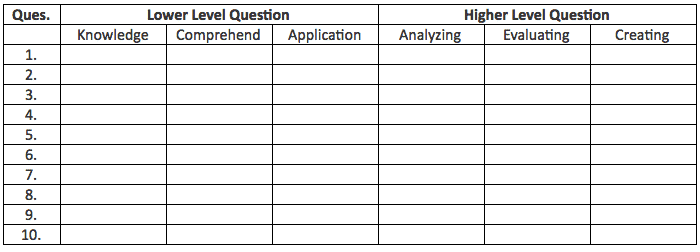
 This fundamental change in your classroom of reflecting on the level of thinking your work requires of students can immediately increase the rigor of your classroom. Some teachers might balk at this prospect because it is too hard. Keep in mind, raising the rigor in your classroom means raising the rigor on your teaching, but just like your students will be better learners, you will be a better teacher.
 Thinking back to my school years, class time was spent taking notes while teachers led lectures from the front of the classroom and homework was all about practicing what we learned. Now as I, and the education industry, age, I see this teacher-centric style of teaching working its way toward retirement, and that is a good thing.
 Even just five years ago, if you walked into a classroom and saw a student using a cellphone, he or she would most likely get in trouble. Now, it’s the new norm. Whether the school has instituted a BYOD program, a 1:1 program or a combination of the two, students are often working on devices during class. This makes it easier for students to collaborate on group projects, do research and present evidence to support their claims during class discussions.
 In many classrooms, the roles of class time and homework have switched. Now, the digestion of new content – the reading and taking notes – takes place at home so time in class can be spent on small group work or projects that allow students to apply the concepts they are learning. This student-centric learning style not only gives students the freedom to express their learning in different ways, it challenges them to hone important non-academic skills such as collaboration, communication, problem-solving and more.
 Because classrooms are becoming more collaborative, the seating arrangement is changing to reflect this. Cafes offer a myriad of seating options for customers, including relaxing couches, secluded individual tables, and bigger tables for groups and many classrooms are adopting this design mindset. Classrooms are beginning to incorporate softer furniture like couches and chairs, as well as reading nook-style areas where students can work on their devices both individually or in groups. Additionally, desks and chairs with wheels are becoming more popular because they provide flexibility. If the class is participating as a whole in a lesson, students can face forward and they can quickly rearrange their desks for group work on the fly.
 School libraries are transforming into true media centers. The shelves of books, magazines and computers for research are now joined by collaborative and informal learning spaces. The media center is becoming a meeting place where students can work on projects. Soft furniture makes the media center more inviting and lounge-like. Some schools are even installing displays in these informal learning spaces so groups can practice presentations, view documents or websites as a whole, and more. Media centers are also expanding the tools they offer. Some rent out video cameras, green screens and even virtual reality goggles for projects.
 As edtech continues to advance, classroom instruction and design will continue to change. The goal of schools is to provide students for a future career, but our workforce looks different now. Upon entering the workforce, students are expected to have foundational knowledge, as well as collaboration and critical thinking skills needed to operate in a highly skilled technical workforce. By creating educational environments that better reflect the “real world,” schools are better preparing their students.
 Early in my career as a principal I came across a student in our hallways that did not look well. The blood was gone from her face and she looked ghastly, standing at her locker, binders in hand, Chromebook under her left arm, musical instrument in its case lying at her feet. The bell had rung; she was late, however she was not in a hurry to make it to class. I stopped and asked if everything was alright, and her eyes immediately welled up with tears.
  Unfortunately, this is an all too common scenario. As educators, we are witness to students who are coming of age in an era of information overload. Students are often overwhelmed, anxious and restless. It is not uncommon for learners to be overscheduled as they try to navigate a do-it-all society with do-it-all perfectly expectations.
  Unmet and unrealized expectations have serious implications for a student. When a goal is not complete, an achievement is not reached, a certain status is yet to be attained – it is often considered failure. For some the setback is genuine because the target was determined by the individual. The due course of the process allows for evaluation and adjustment. This indicates an authentic goal that is intrinsically motivated.
 Beyond challenge, beyond rigor and assessment, beyond mastery and development, lies the true key to learning which is curiosity. With information at the fingertip and answers to questions seemingly accessible at the touch of a screen, the foundational element of curiosity can be lost for a student.
  The more students are asked to complete standardized tasks and assessments, the more internal unrest they will have. Students are naturally intuitive. When asked to complete tasks that are counter to their own internal goals, anxiety and cognitive dissonance can arise. Even worse, high stake tasks that serve no purpose outside of data cultivation are construed as empty and void of purpose.