Highlighting the importance of proper drug disposalby Jon Chapman
 As we observe the 14th annual National Drug Take Back Day, which is designed to highlight the importance of properly disposing of unused prescription medication in order to prevent accidental abuse and misuse, it’s important to reflect on the impact prevention education can have in sustaining healthy and safe communities.
Last year’s National Take Back Day set a record—893,498 pounds of unwanted medicines—about 447 tons—safely deposited at almost 5,400 sites spread through all 50 states, but imagine how much more we can do if we spread the message of prevention through measurable education.
The Prescription Drug Safety Network is a national coalition of partners committed to using prevention education to empower Americans with the skills to make safe and healthy decisions for themselves, their families, and their communities. One of the network’s main initiatives is an evidence-based drug safety curriculum digital platform to educate at risk youth and their families about the safe storage and disposal of prescription drugs.
How to Safely Dispose of Prescription Drugs
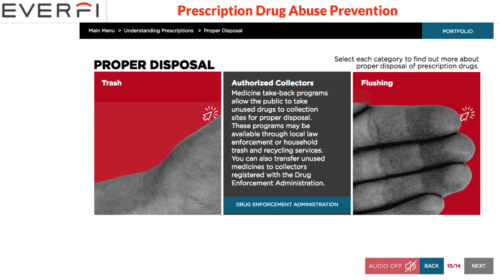
Medicines that are no longer being used can pose unnecessary dangers to families and youth in particular. Drug Take Back Days raise awareness about prescription drug safety and provide an opportunity for individuals to properly dispose of unwanted prescription drugs at a growing number of locations nationwide. Individuals can search for a Drug Take Back site at the DEA’s webpage or by calling 1-800-882-9539.
 Why Safe Prescription Drug Disposal Matters
According to the CDC 1 in 5 high school seniors report having misused prescription drugs at least once. Two-thirds of teenagers who use prescription drugs for nonmedical reasons report getting the drugs from friends or family members, including taking them from medicine cabinets without people knowing. As a result, the importance of properly securing prescription medications, especially opioids, is even more critical.
Seventy-eight people die each day from opioid overdose, and another 20.8 million have a substance use disorder according to the U.S. Surgeon General’s report Alcohol, Drugs, and Health. Young people are particularly vulnerable, The National Institute of Health’s Institute on Drug Abuse reports that nonmedical use of prescription drugs is highest among young adults aged 18 to 25.
Many people who misuse medications or opioids get their first dose by using medications prescribed to others. The growing epidemic of abuse, misuse, dependence, and overdose of opioids in the United States is deeply concerning and it is important that we protect our communities by stopping the abuse before it begins through prevention education.
Media Gallery:
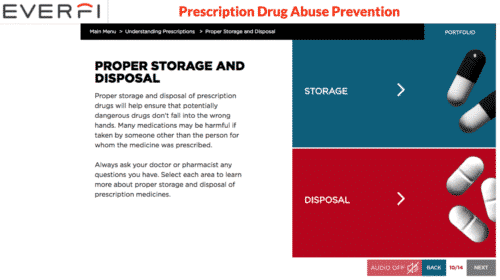
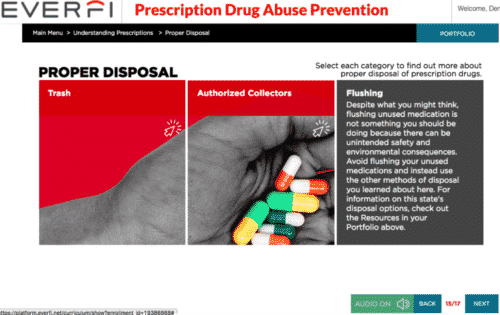
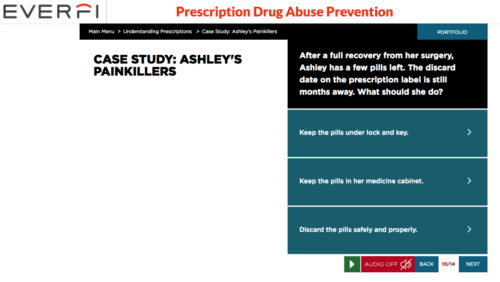
Below are some images and a video from EVERFI’s Prescription Drug Abuse Prevention course, which launched this fall. The course features highly interactive digital learning modules that cover topics such as: proper prescription drug storage and disposal, the science of addiction, interpreting drug labels, refusal skills and other critical skills.
Prescription Drug Take Back Day – EVERFI Prevention Course from EVERFI on Vimeo.
Author
Jon Chapman, EVERFI Co-Founder and President of Global Partnerships
- The Washington Post – Trump declares the opioid crisis a public health emergency
- The New York Times – The Opioid Epidemic: A Crisis Years in the Making
- edCircuit – Operation Prevention:

 One of the few technology initiatives I do promote is digital student portfolios. They are defined as online collections of learning artifacts intentionally curated to showcase a student’s accomplishments and growth over time. With the availability and ease of use of digital tools today, there is little reason why students should not be able to experience this authentic process of assessment. Here are ten reasons why every student should have a digital portfolio.
 digital portfolios into the classroom, teachers provide a window into a student’s world with regard to their best work and growth over time. In my last school that had a higher level of poverty, we witnessed several families become engaged in the school experience through their child’s digital portfolio. Using FreshGrade (
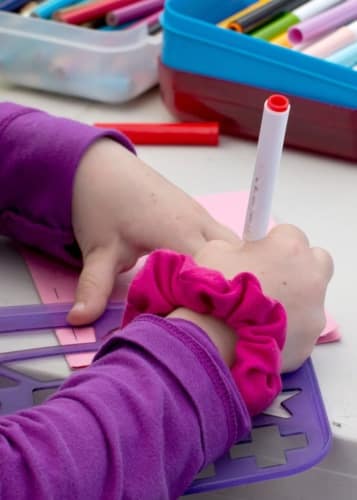 Excellent work does not come out of thin air. In writing my book on digital portfolios, I had to go through many drafts and revisions before it was ready to publish. Students can better understand this process by publishing not only their best work but also their prior attempts and efforts. For instance, an English teacher can expect their students to keep a digital portfolio of their writing using Google Sites (
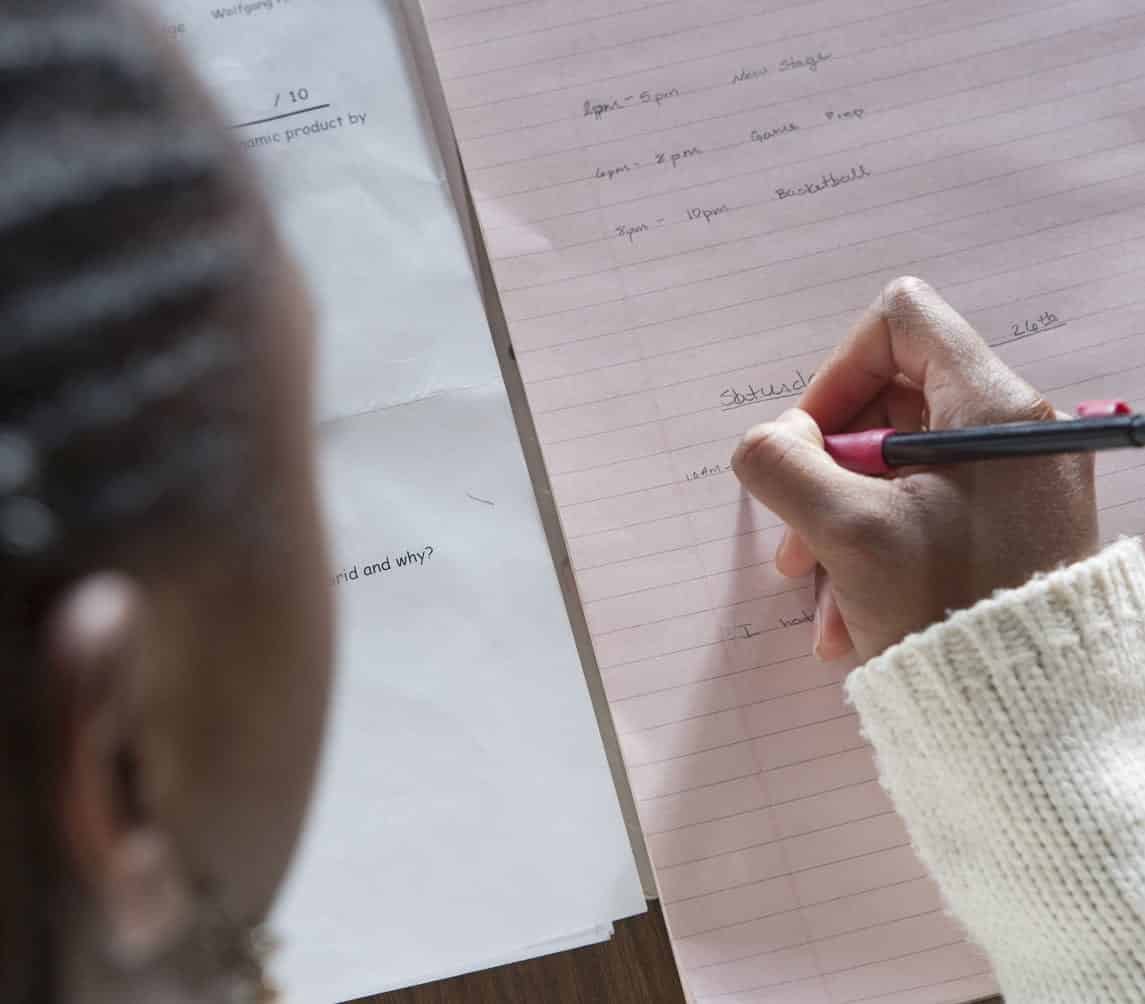 Teachers can and should treat digital portfolios as a student-driven assessment experience. They don’t have to own it. In fact, by giving students the autonomy and responsibility to develop their own digital portfolios, kids are likely to own the results of their learning, and subsequently the learning itself. As an example, Lisa Snider is a journalism teacher in Oklahoma. For her high school course, students are expected to keep their own online space for their writing using WordPress. They also produce the school newspaper and yearbook. To pay for technology resources for the course, they have to sell advertising on their publications to purchase the computers, software, paper, and ink. That means their writing has to be worth reading.
 If all students have to represent their accomplishments in school are test scores and grades, we are excluding students who may not be successful in these types of assessments. For example, teachers can have students video recording a performance task, such as a speech or demonstration, and then upload this file to a digital portfolio for families to see. This documentation of student learning adds rich context to the typical grade or score.
 Matt Renwick
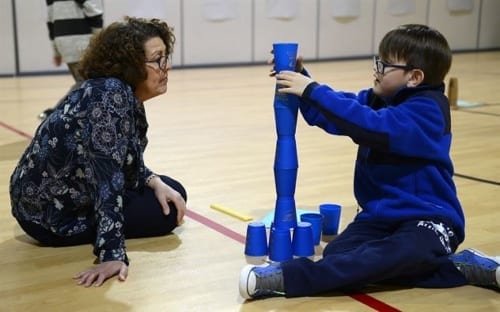 As a gifted coordinator, I get asked a lot of questions. Curiously, the question I probably get asked the most is not what great things are you doing, how can I be involved, or what way do we best reach our gifted students? The question I get asked the most is what does a gifted coordinator do? Even by adults. When I was a teacher, it was easy. Someone asked what I did, I stated I was a teacher, and they just nodded their head like they knew what that meant. Now when I say I am a gifted coordinator, I get a look that indicates befuddlement.
  For example, I have been a gifted coordinator in two different districts, literally right next to one another and serving similar students. However, the expectations in each district were very different. In my original district, the district gifted coordinator had always been a part-time position. They usually got a retired administrator to take on the task or simply added the task to another administrator’s plate. When I was hired, I was still a classroom teacher. Two and a half days a week I would work with students as part of my regular classroom. The other two and a half days I would focus on gifted coordination.
 Then I had the chance to change districts. My new district offered me a full-time position as an administrator. It also gave me resources I had not had previously, including a budget, power to make decisions, a coach for teachers and five days a week to do my job. What this allowed me to do was to have a wider view of the district in regard to gifted. This new district also had elementary pull-out and a middle school magnet program. But I have had the opportunity to expand these services and tailor the needs to individual buildings. Just having conversations with building principals have gone a long way in figuring out ways to best reach students in their schools who are gifted but did not qualify for the gifted programs. Even non-gifted but high achieving students were helped by the work we were doing.
  These two examples represent ends of a spectrum. Different coordinators fall onto different places on this spectrum depending on their job description and the expectations of the district. Ideally, every district would have a full-time gifted coordinator who is gifted-certified who would be looking out for this specialized group of students. Unfortunately, this is not always the case. There are some districts that simply put the responsibility on a principal or assistant superintendent who has their fingers in many other pies, meaning their attention to gifted will be limited at best.
 Higher-level questioning is an integral part of a rigorous classroom. Look for open-ended questions, ones that are at the higher levels of Bloom’s Taxonomy (analysis, synthesis).
 The third component of a rigorous classroom provides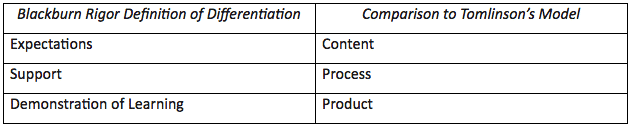
 Finally, we might differentiate how students demonstrate their learning, or the product they complete. Perhaps I want students to analyze a series of events in a social studies lesson. A portion of my students are able to write a detailed analysis of the impact of those events on today’s society. Others may understand the material, but are unable to write an analysis paper. In those situations, it’s easy just to ask them to summarize the material, which is lowering the rigor. Instead, we could provide an opportunity for those students to verbally complete the analysis, perhaps by creating a video. In this case, struggling students demonstrate their learning at a rigorous level, just in a different way.

 Dr. Marilyn Denison wanted to be in education from a very young age and followed her lifelong passion for teaching through college into the classroom.
  MD:
MD: MD:
MD: MD:
MD: We all learn differently, and we shouldn’t have to be at one particular level at one given day in time and then be labeled at that. Again, we learn differently, and we’re interested in different ways of learning and different materials of learning.
 MD:
MD: