
Pathways to Mathematical Meaning
by Jerry Burkhart
Before you read further, spend a few minutes with the image below. What do you notice and what do you wonder?
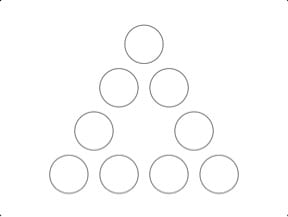
Now take a few moments to reflect.
Were you concerned about anticipating observations or questions I might be “looking for”?
Did you feel comfortable stating or asking “obvious” things?
Did it become easier to generate new ideas as you spent more time with the image?
Was there more to find in the image than you expected?
Do you think you could “improve” at the noticing and wondering process with practice?
How might you use this type of process to support your students’ (and your own) learning?
Check here If you are curious to know how others have thought about this image. As you read further, think back to your experience with the image.
Teaching math differently than you learned it
Research about how people make sense of mathematical concepts demonstrates the need to use students’ ideas as starting points for instruction. Since few of us learned math this way, it may take courage, persistence, and a certain amount of trust to make productive changes in our teaching practice.
So where to start? Clearly, if we are to respond to students’ mathematical thinking, we must first make it visible. By nurturing the habits of observation (noticing) and questioning (wondering) in our math classrooms, we can begin the process of bringing students’ thinking front and center.
The image that began this post is an example of a “noticing and wondering prompt.” Consider two more examples:
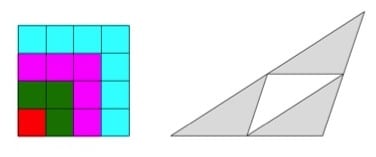
I leave the noticing and wondering to you and your students! As you practice using prompts like these, you gradually learn to recognize—and even create—new examples of images that will elicit interesting ideas from your students.
Unlearning assumptions
It may take time for students to become comfortable expressing their mathematical ideas within such an open-ended format. Both students and teachers may need to unlearn counterproductive assumptions about math arising from earlier learning experiences:
- There is one correct way of thinking.
- Thinking processes always follow rigid rules.
- There is little room for creativity.
However, as you accept students’ responses without judgment, the ideas soon start flowing. Students feed off of and build upon each other’s ideas about images. You gather treasure troves of questions and observations—even for the simplest images. Even ideas that have little to do with math may be valuable, because students are connecting the images to their experience, and you are gaining general insights into how they think.
The next step: prompts and learning goals
After first using noticing and wondering prompts to develop your students’ overall mathematical awareness, curiosity and comfort with sharing ideas, the next step is to bridge the gap between process and content by connecting the prompts to the concepts that you teach. What might these kinds of prompts look like? How can they help your students create mathematical meaning—that is, make sense of mathematical ideas?
A key factor in making sense of math concepts is making connections between them. Spend a few moments with the following prompt for upper-elementary and middle school students. What learning goals could the image address? What might students notice and wonder?
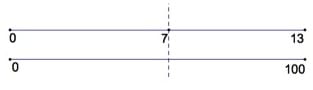
I have used this image to help students develop and compare multiple strategies for calculating the percent of a number. However, students usually begin by producing observations and questions related to concepts and procedures they have learned earlier: fractions, estimation, equivalent fractions, decimals, properties of multiplication and division, and proportions. Notice how this creates the potential to:
- Review and deepen understanding of previously learned concepts
- Connect these concepts to the new learning goals
- Make you aware of students’ misconceptions and insights during instruction
- Help students understand why procedures work
- Support differentiation (because students naturally respond at their level of thinking)
- Support reasoning (by creating opportunities for students to share and compare ideas)
- Develop extensions for students who are ready to explore further (using their “wonderings”)
Notice also how simple many of the images are. Simple prompts tend to encourage a wide range of responses and are likely to be accessible to more students. As discussion progresses, you can modify prompts to zero in on key concepts or to lead the discussion in desired directions.
More examples of prompts that focus on content
Prompts may consist of diagrams, pictures, numbers, or words—anything that leads students to consider mathematical ideas. For many prompts, you can encourage students to make connections to their own experience by asking them to create real-world scenarios that fit the images. Can you imagine doing this for any of the six prompts below? What concepts might the prompts address?
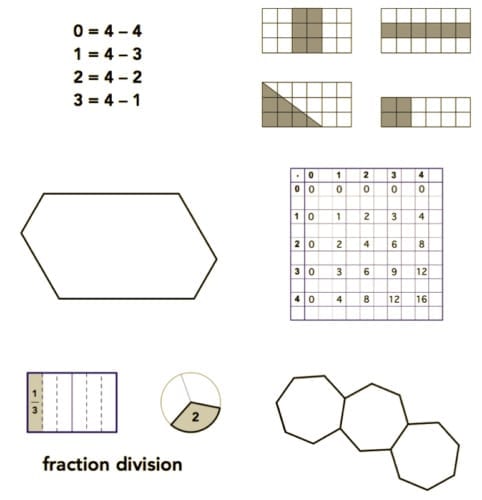
Think about how students might respond to these prompts in different ways and at different levels. Try to imagine how you could modify some of them to make them accessible to more students or to promote further exploration of a concept. Sample responses are available at 5280math.com/noticing-and-wondering/.
Looking ahead
I hope that you can envision how “noticing and wondering” supports positive effective traits and learning skills such as curiosity, confidence, motivation, perseverance, independence, problem solving, creativity, depth of understanding and reasoning. And the process is manageable because you can incorporate it into different aspects of your teaching as you choose—and a little at a time. As you look ahead, consider some of the following ideas.
Places that “noticing and wondering” may fit into your instruction
- Bell-ringers or warm-ups
- Inspiration for new lessons
- Formative assessment
- Enhancing general classroom discourse
- Problem-solving: understanding, exploring, analyzing, and reflecting
- Inspiration for projects
- Differentiation
Building your Practice
- Use prompts to elicit students’ ideas
- Make note of students’ ideas and use them to refine the prompts and your lessons
- Practice using effective questioning and facilitation techniques to focus “noticing and wondering” discussions on your learning goals
- Create, use, and refine your own prompts
Creating your own prompts
Things to consider:
- What is the purpose of the prompt?
- How complex should the prompt be?
- Does it make sense to offer a choice of prompts at different levels of complexity?
- Does it make sense to use a series of prompts to scaffold or extend a concept?
Clearly, there is plenty to learn about building habits of observation and questioning into your math instruction. Fortunately, this learning can happen over time and in the context of teaching and reflection. As you gather observations and questions from your students, you learn more about their thinking and can use this knowledge to enhance lessons each time you teach them. The focus of lesson planning gradually changes from crafting careful explanations to anticipating your students’ thinking and deciding how you will respond.
I would like to invite you to participate in creating a bank of prompts which I have begun at 5280math.com/noticing-and-wondering/. Please contact me at jburkhart@5280math.com to share your images and ideas. Feel free to include information about the grade level, the concepts you are targeting, sample responses from students, or anything else that you think would make the prompts useful for other teachers.
Author
Jerry Burkhart is a mathematics educator and consultant with over 30 years of classroom experience. He is the author of the book series, Advanced Common Core Math Explorations, published by Prufrock Press, and he presents regularly at state, regional, and national conferences on topics related to mathematical talent development.
As founder of 5280 Math Education, he helps schools and districts implement research-based programming for gifted math students and offers tools and strategies for developing and nurturing adventurous math learners.
Websites: 5280math.com myedexpert.com
Further Reading
- Education Week – In Transition to Common Core, Some High Schools Turn to ‘Integrated’ Math
- The Australian – Australian teachers devise better pathway to maths learning
- The Atlantic – Why Kids Should Use Their Fingers in Math Class




 As many as 15 percent to 20 percent of the US school population demonstrates a significant reading disability. But ask the superintendent of one of Atlanta’s school systems and she will tell you and The Atlanta Journal that her system has NO dyslexic children.
 The fundamental and powerful assumptions of our culture regarding literacy are that it is inherently good for the individual, good for the culture, difficult to acquire and should be transmitted in classrooms. If literacy is difficult to acquire, then it becomes necessary to create a multitude of reasons to explain why some read better than others, as well as the cultural imperative to label as inferior those individuals who have poor reading skills. The consequence of believing that literacy is best learned in classrooms enables schools to create a monopoly in which they blindly repeat the same failed instructional practices with the expectation of a different outcome.
 The difficulties and concerns of a parent advocating for the child with reading disabilities are already significant. The confusion and misconceptions surrounding the diagnosis and treatment of dyslexia only add to the parental dilemma. Unfortunately, there are charlatans who will take emotional and financial advantage of the desperate parents of the reading disabled. Providers of costly vision therapy require parents to commit to 60 – 90 hours of left to right tracking exercises at $90 – $120 per hour. Trendy movement therapy promises improved balance in the body and the brain.
 The Dyslexia Institute of America describes three distinct types of dyslexia:
 Dysphoneidetic Dyslexia: A type of dyslexia associated with a combination of differential brain functions in the Angular Gyrus and the Wernicke’s area. A person suffering from this type of dyslexia will have weak visual-motor skills, and is often the most difficult to treat.
 In order to answer this question – “Why Can’t My Child Read?” – we must delve to the complex reading brain as well as the decades long Reading Wars. This will require the acquisition of the vocabulary of literacy and an understanding of the interaction between memory, attention, and reading. Thus, we begin our journey over the next months to determine why our children can’t read.
 Lynn realizes an important part of her job is to be visible to the parents and students of the district. Whether it’s helping with morning drop off or using social media to keep the community aware, parents need reassurance and transparency from school leadership.
 Basically, I touch almost everything in the district. I’ve had the opportunity to really impact teaching and learning, and professional learning. I work diligently with the superintendent and the business manager to refine the budget process; tap into HR issues and challenges we might have there; and work diligently to tell and promote the story about our district.
 I’m probably a little more of an extrovert that might be thinking about somebody who is looking at this role, somebody who is willing to walk up and down the aisles and shake people’s hands and say “hello” and introduce themselves when they’re sitting and waiting for a concert or greeting those parents and taking concerns in a bus line
 Lynn Fuini-Hetten is the Assistant Superintendent in the
 Science is: boring, hard, worksheets, watching videos, vocabulary, my least favorite subject.
 Hey, kids! Today we are going to read Chapter 2.1 and then do the Chapter 2.1 worksheet. Tomorrow we will move onto Chapter 2.2 and then complete the Chapter 2.2 worksheet. Tomorrow, you guessed it, Chapter 2.3 and of course the Chapter 2.3 worksheet. And just to mix it up on Friday we are going to do the Chapter 2 quiz from the back of the book. Go ahead and memorize those highlighted yellow words from the text and don’t actually read the pages in each chapter to fill in those worksheets, just look up answers in the back of the book. If you do all these things, you are bound to get an A+.
 44-minute lectures where a writing utensil can’t move fast enough. Students sit with one hand resting on their face and their other hand has black smudges on the side of it because their hand is moving across their paper faster than the ink can dry. Ugh. That’s rough, but I’ve been there and so have you! Conversation is one of the pillars of my class. And it’s not a one- way conversation where I speak to (or at my students). I want engaging dialogue where all students are participating, asking questions, researching responses, respectfully inquiring or disagreeing, and most importantly… thinking!
 Triple Beam Balance. Expensive Glassware. Density Cubes. What do these three items have in common? They are all science equipment that is unnecessary because it doesn’t actually enhance the learning experience. I get that fancy science gear can be fun at times, but it also sucks the life right out of the yearly budget. We know that times are tough when it comes to school funds, so why not say no thank you to next year’s allotment of high-powered magnets. Instead, why not do an entire curriculum with practical everyday objects.
 Step 1: Put 10 pieces of cereal in each bowl
 You see, in my class, I throw all the lab handouts and step-by-step directions out the window. I want my students to have conversation, creativity, and of course that last pillar, collaboration. When we tell students exactly what we want them to do and exactly how we want them to do it, we stifle the entire learning and thinking process. We disregard their ability to engineer and image. There is nothing greater than putting a bunch of supplies on a table, writing a driving question on the board and then declaring to the kiddos, “Go for it!”

 RTI’s interventions need to be accompanied with cognitive learner strategies. As example, effective learners know that if they receive learning accommodations, that is not an excuse to stop listening and learning, since they are active participants in the RTI process, regardless of the tiered level of intervention that they receive. Students, who exhibit increased cognitive buy-ins, are continually on a road that hones their skills. Effective learners know how to ask for help and how to interact and collaborate with peers and adults. Students then develop skills to shift gears as educators assist learners to navigate the curriculum.
 Time well-allocated and accompanied by a set schedule of responsive intervention is a learner’s friend. The gains achieved are never identical ones for all learners. The tortoise and hare are seated in the same classroom, but a lion of a teacher in a group or pride of interventionists facilitates ongoing growth to nurture each learner’s skills and strengths. School staff collaborates with students and families to determine and deliver the effective instructional approaches. Bottom line is that responsive interventions offered within the RTI framework, honor successful classroom and life outcomes.