Larry Spring, Superintendent of Schenectady City School District, works hard to ensure that race, economics, or disabilities are never indicators of student achievement in his district. To accomplish this, he uses data to uncover inequities that can inform his policy and procedure decisions, increasing the chances that every student can succeed. Under his leadership, student achievement and attendance rates have improved significantly. In 2016, the graduation rate of Schenectady High School was the highest it has been in over a decade.
I had the pleasure of speaking with Larry at the 2017 AASA conference held in New Orleans and touched on various subjects including the evolution in attitudes of superintendents communicating with their peers. The old position of independent decision-making has given way to a collective sharing of ideas and the belief that a collaborative group effort is stronger than the individual.
Extensive communication with the community about district needs and goals is a top priority for Larry. It’s a two-way conversation between parent stakeholders and district leadership to ensure that top issues are being addressed with the community’s best interest in mind.
Larry is willing to fight to ensure all students have the best tools and opportunities to prepare for life. His district filed a case against the state of New York, claiming that the way the state distributes education funding is racially biased. The result was the first time the Office of Civil Rights had opened such an investigation. It was a collaborative effort brought on by school leadership and the community, demonstrating the power of a collective mindset at the local level.
About Larry Spring
 Laurence T. Spring is Superintendent of the Schenectady City School District, a K-12 public system that educates nearly 10,000 children.
Prior to coming to Schenectady in June 2012, Mr. Spring served as superintendent of the Cortland Enlarged City School District for six years, an assistant superintendent for instruction at Wayne Central School District in Ontario, NY for five years, director of student learning at Churchville-Chili Central School District for two years and was an assistant principal for a year. He spent the first five years of his educational career teaching social studies at East Irondequoit Central School District.
Mr. Spring earned a B.A. in History/Psychology from SUNY Geneseo, M.S. in Educational Leadership from the University of Rochester. He is pursuing a doctoral degree from Vanderbilt University.
Follow Larry Spring on Twitter.
- The Columbia Chronicle – CPS CEO: State funding formula a ‘cancer’ on CPS
- San Diego Union Tribune – Poway Unified School District showcases career technical education at expo
- Cook County Record – Chicago Public Schools try again to persuade court to order fix of ‘discriminatory’ school funding

 As I read the first sentence in an
  What makes something an opportunity for us? We might think of opportunity as an “opening” or a “break” — “a chance” to do something we want or need to do. Through assessment, teachers provide an opportunity to figure out where a student is, individually, in their learning. As students learn more, they grow. As students are given a chance to try again — show or demonstrate more — pieces of success get scattered along the learning path — assessments provide students opportunities to “show what you know.”
 Some educators express student concerns about the possibility of failure when it comes to assessment. Other educators counter those concerns by building a culture of learning that views assessment as a support for learning with structures and strategies built into the classroom culture to cultivate and build a growth mindset. Teachers do this in a variety of ways focused on five key elements of a culture of learning:
 As teachers put supports in place that help students be aware of where they are versus where they want or need to be, these supports become part of the culture of learning in a classroom. And engaging learners in the process of planning out how they will get where they need or want to be – becomes part of the opportunity.
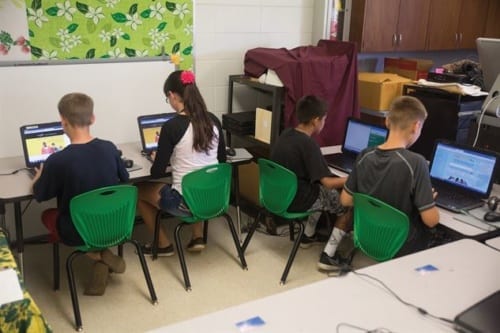 Engaging students in active thinking about assessment as a support for learning and their individual role in the process supports the development of a growth mindset and metacognitive skills, building both self-efficacy and self-regulation in students. This specific assessment reflection strategy gives the teacher information about student understanding of assessment and students’ role in preparing for, engaging in and using the results to support their learning process. This strategy lets learners clarify and build their ideas of success and struggle, which helps promote stronger engagement with future assessment.
 That few teachers identify themselves as writers is troubling, but the notion that their vocation undermines their potential to do so is a bitter irony that is worthy of greater attention. Teachers struggle to find the time and energy to sustain writerly habits, as many over-scheduled working people do. The consequences of limited writing practice may be greater for teachers, though. When teachers aren’t writing, their productivity and progress isn’t the only thing that suffers. They fail to develop the confidence or the skills necessary to support their students as well. According to Duke University political scientist and scholar writer
 In healthy systems where writers thrive, data drive the decisions that are made by students, teachers, and administrators alike. Nuanced understandings about data and its uses are encouraged as well. Rather than relying on numbers generated by tests, teachers learn how to code and establish hunches from qualitative data that are gathered from rich and rewarding learning experiences. People are consistently invited to share their interests, expertise, and needs. Audio and video recordings are captured, making the writing process and the learning that students engage in far more visible. Those who plan for change consider how it will be reflected in the ways people behave and feel rather than focusing exclusively on activities and performance outcomes. Everyone within the system becomes a learner, and all learners engage in consistent reflection. Documentation inspires deeper learning, and time for this kind of data analysis is regularly scheduled and carefully protected.
 The next generation of writers and teachers will likely require fewer reminders about the importance of writing and more opportunities to get better at it. The fact is that most of them are writing outside the classroom for authentic purposes daily, if not hourly. They have meaningful things to say about their lives and their experiences, and they’re connected inside social networks where opportunities to raise their voices and support or even challenge others are ready and waiting for them. Those who are unable to use their words with discretion suffer immediate and even long-lasting discomfort, while others who have a way with words find their abilities to influence others and make a positive difference in their world rewarding.
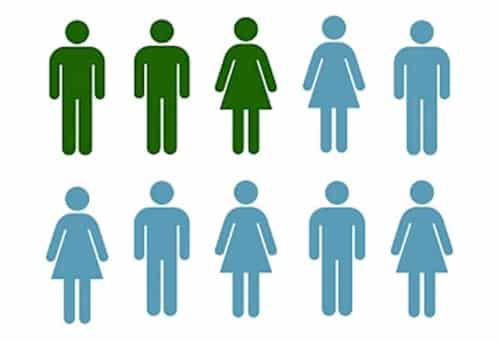 Three out of 10. A statistic that those in education don’t like to talk about. It’s a startling stat about the number of teachers who leave the profession after just five short years. To put that into perspective, if students earned a three out of 10 on an assessment, that would be a failing grade. Schools across the country are earning an F in keeping their educators in the classroom.
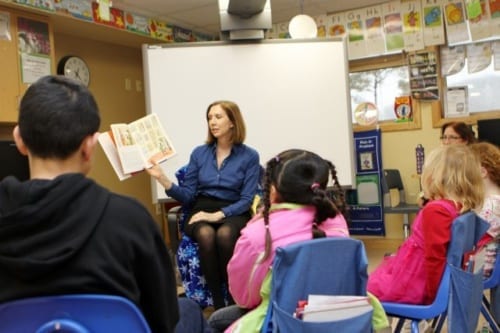 I’m not talking about just in those big, obvious “wow” moments. Don’t get me wrong, when the whole class is well-behaved and earns off-the-charts assessments scores that is great! I’m also not referring to when your instructional coach gives you a level four rating in all domains. That’s great too, but that isn’t what keeps teachers walking into the jungle of education. I’m talking about those little tiny moments of awesome that fit together perfectly to build one great, big awesome year! Like when you sit down at your desk for the first time all morning at 10:42 a.m., have your first sip of coffee and it’s magically still hot. Or when a student dances down the hallway because they have a beat stuck in their head. Let’s step back and cherish those.
 Let me be clear, it’s wasn’t the writing that changed things for me. It was the celebrating. I once read that a simple answer to one question sums up your perspective in life. The question format is every student’s favorite, fill in the blank with no word bank. Life is a ___________. How would you fill in the blank? I know my answer. Party. I believe each and every day we get the opportunity to celebrate this awesome gift. And as teachers, this celebration isn’t a party of one. It’s a party of 28 kids in your classroom. (ok so maybe 32 if your budget is tight) It’s a party with numerous other teachers. It’s a party with parents and school leaders and community members. Tons of people have RSVP’ed for this awesome celebration of education so take a seat at the head table and embrace the educational confetti and the jello surprise.
 Just remember, awesome is all around us. Every day you walk into your school something amazing is bound to happen. Some days that awesome is easy to see, it comes in the form of laughter, academic progress, achieving goals and building relationships with kids.
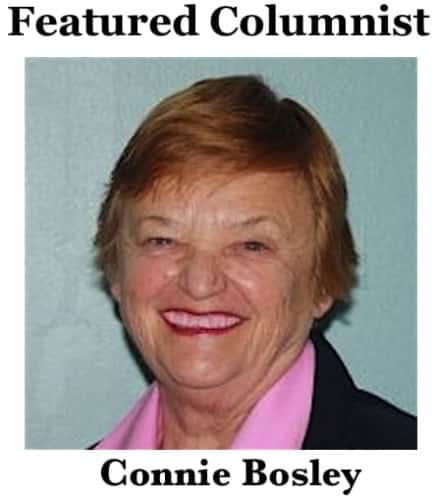 Editor’s Note: This is part of a new series on edCircuit. Connie Bosley is a professional writer with a Masters Degree in Education and a passion for EdTech and its role in the future of education. In this series, Connie talks with EdTech leaders to explore their world and the value they bring to learners.
 “Answerables itself is a school, a new version of a school, not the kind my grandfather envisioned in 2001,” said Mark. As a first-grade teacher, Wu, a SERT (Special Education Resource Teacher), saw firsthand that engagement was vital to students staying on task long enough to learn new material. Young students learn much easier through games.
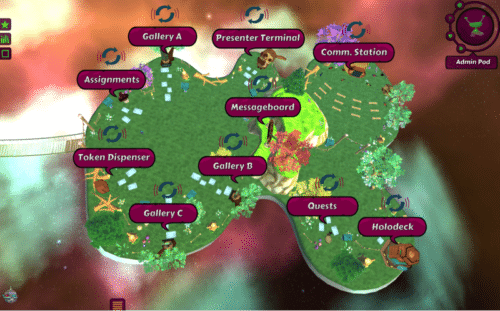 Mark and the future co-founder Peter were talking in a coffee shop one day when Mark asked, “Hey Buddy, do you want to jump ship, leave our comfy safe jobs as teacher and IT guy with guaranteed salaries and try creating this new learning game?” Peter said, “Yeah, let’s try it.” They started using the education fund left by Mark’s grandfather. “We took advantage of the opportunity to turn this new type of school into an innovative virtual learning system directed at early elementary-aged children, using the game format,” said Wu.
 Answerable was awarded for Social Networking and Communications -Standard for the 21st Century Learner in 2015 by the AASL (American Association of School Librarians). Since that time this unique learning system has begun to form partnerships with schools and other companies in the United States. Interested schools in California, Pennsylvania, New York and rural Kentucky have all been in contact with Answerables about their system.
 Mark has been working with diverse groups of students for more than 15 years as a classroom teacher, Special Education Resource Teacher, and school administrator. He has a wealth of experience teaching learning disabled children and supporting their parents and teachers.
 The education sector is famous for having many enthusiastic “one-offs,” or teachers who stand out from the rest in their tech and app use. School administrators often wonder how they can get “everybody else,” meaning all the other teachers in their school, to be the same.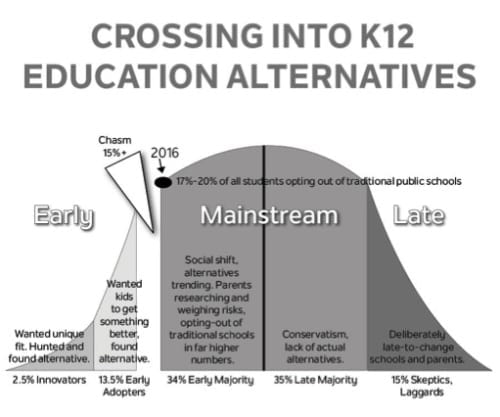
 We are likely in the stage of “crossing the chasm” as a society with education into a new digital reality. This is because once the early adopters and the early majority begin to transition to new technology or adopt change, a certain momentum creates inevitable for every other part of the market.
 Based on that data, the alternative shift is at least 20 percent, and indications are that it will continue to be pushed politically. These are also indicators that the technically sophisticated among us have allied with the monied interests to take advantage of the potential of digital learning, particularly items with consumer-like distributions.