Mathematics success for all students Including those who struggle
 By Dianne DeMille, Ph.D. and Jennifer Munoz
Research suggests some reasons students struggle to learn mathematics include: fast pace, reading difficulty, working memory, conceptual understanding, or misunderstanding.
Word problems or problem tasks have always been considered the most difficult part of teaching and learning mathematics at any grade level.
When I taught middle and high school math, I would ask my students, “What job will you have in the future where you will be handed a page full of computations to do or equations to solve?” Sometimes, they would respond with, “Maybe, a math teacher?” Then I’d ask, “Other than being a math teacher?” They were stumped. I would explain the reason we do several problems of similar type is to understand how to get solutions. However, we need to understand how to solve problems or tasks that represent what might occur in daily situations and problems that arise in specialty areas. This is where the mathematics we’re practicing connects to the “real world.”
Reading for comprehension, productive struggle, student reasoning articulation, along with organizing information to determine solution strategies are major components of solving mathematical problems or tasks.
A district-wide Special Education program for secondary mathematics of California Common Core Standards shows success with practical strategies that also work with ALL students. One of the strategies widely used in their program is the “Close Strategy,” often seen in English Language Arts and some other content areas.
While observing a special education class in Algebra, I saw the teacher using the same strategy I had used with all my students in regular math classes. I learned this is a strategy most teachers use, especially in elementary grades, to teach reading. It is the “Close Strategy” that I had never formally learned because it was not part of my training to teach math. We have students who usually had problems in math who are now experiencing mathematics success by using this strategy. As I taught high school students, even in the Honors classes, I used the same strategy.
 The Common Core State Standards for English Language Arts directs teachers to have students read informational text with attention to specific detail. Math problems and tasks should be considered informational text.
Professional Development for English Language Arts and other content areas are typically separated from mathematics. This situation does not facilitate a connection of strategies to mathematics. As teachers of mathematics, we often struggle for ways to support students in processing details and solving typical problems and tasks. There are many other strategies that could be adapted for teaching and learning mathematics.
Why not connect English Language Arts with Mathematics and other content areas? Especially when it comes to reading and writing across content. The “close Reading” strategy is just one strategy I have focused on here.
Teachers at all grade levels (K-12) can support their students by using the “Close Reading” strategy. It supports reading difficulties, reading comprehension, slower pace, and conceptual understanding that we know are reasons students struggle. Most problem tasks should be connected to how students read informational text in today’s world.
Have students follow these steps:
1. Read to get a sense of the problem or task.
2. Go back and read each phrase, stop, and verbalize what is meant by that part of the problem. As you read:
- Use “Close” strategies to identify key words, numbers, and questions.
- Use of color, boxes, circles, or some way to see the various types of information is important to share with students (these could the same as used in other content areas)
3. Connect the details, possibly with an equation or diagram – Students may want to create a key for organizing the information (see sample below)
4. Solve the problem
5. Check the solution in the original problem to be sure the question(s) is(are) answered.
All students at all grade levels need to understand this cognitive process. By slowing down and making sense of the steps as they go through a problem, students can be successful.
Marvin downloads music albums from an online company. He decides to subscribe to one that allows him to download up to 10 different albums each month for $35.00. If he wants to download more than 10 albums, he need to pay an additional charge. The first month, he downloaded 24 songs and was charged $84.00. How much did he pay for each additional album? The second month, he was charged $64.75 for 16 albums. Based on the rate he paid for each additional album, how much should he have been charged?
Here is a model of how to highlight or underline (we show red, blue, green and underline to represent the process – some find it useful to use a Smart Board or projector on a whiteboard to demonstrate)
- What questions are you asked? (green & underline)
- What are the numbers involved? (red)
- What key words will help you? (blue)
Use “Close” Strategy (Identification of key words may vary)
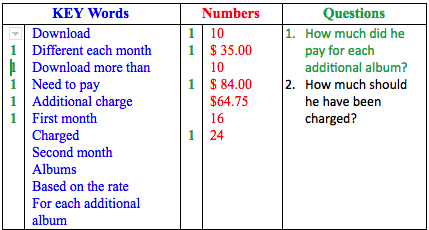
Marvin downloads music albums from an online company. He decides to subscribe to one that allows him to download up to 10 different albums each month for $35.00. If he wants to download more than 10 albums, he needs to pay an additional charge. The first month, he downloaded 24 songs and was charged $84.00. How much did he pay for each additional album? The second month, he was charged $64.75 for 16 albums. Based on the rate he paid for each additional album, how much should he have been charged?
Organize the information (Pictures and diagrams are useful. Some students may want to use a chart to organize the details)
Use arrows and descriptions to point out various parts of an equation. This will help students visualize how the equation should look and what each part of the equation relates to in the problem. Here is an example for this problem.
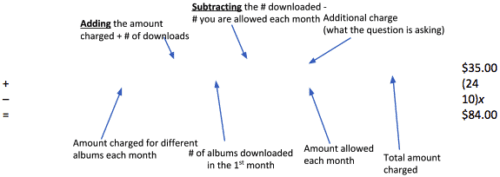
The next step is for students to solve the problem.
The following is a conversation I had with my grandson Timothy when he was in 3rd Grade. He called me for help on a problem his mother, my daughter, did not know how to explain. Timothy was in third grade. My daughter sent me a text with a picture of the problem like this one:
A number made up of the digits 4, 5, and 6 is subtracted from a number made up of the digits 0, 2, 8. The difference is 157. Write out the entire problem.
I asked Timothy to read it to me and was amazed at how well he could read. Then I asked, “Can you tell me what the problem is about?”
I asked him to circle, box, or underline key words, numbers, and the question. Here is an example with my color-coding. Students may identify differently – the important thing is to flush out the important information.
A number made up of the digits 4, 5, and 6 is subtracted from a number made up of the digits 0, 2, 8. The difference is 157. Write out the entire problem.
Timothy, “Something about two numbers and subtraction.”
I said, “You know what? Grandma doesn’t know where to start! I need to slow down and think about the sentences very carefully.”
So, then I asked him to read it again, but to slow down and think about what he was reading. I stopped him after he read “A number made up of the digits.” I asked him, so what is a “digit”? He correctly explained it to me.
Then, I asked him to continue reading. I stopped him again after reading “A number made up of the digits 4, 5, and 6 is subtracted from a number”. I said, “So, what does that part mean?”
Timothy said, “The digits 4, 5, and 6 make up a number and we are going to subtract it from something”
“Ok, now read the next part of the sentence”
Timothy, “a number made up of the digits 0, 2, 8.”
“So, what does that mean?”
Timothy answered, “There is a number made up of the digits 0, 2, and 8 and I’m going to subtract the other number from it.” “Ok, so now what are you going to do?
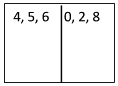 He wasn’t sure where to start. So, I suggested we organize the information. We got on FaceTime and I showed him what I wanted him to do. I took a piece of paper and drew a line down the middle to make two sections and shared my drawing. I asked him to make the same drawing and then asked him to write the digits at the top. Then I asked him to write the numbers he could make below the digits in each column. He listed all the numbers on the chart.
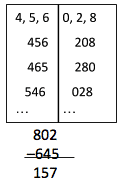 I asked, “Which number is subtracted from the other?” He pointed to the columns as he explained correctly. I said, “What will give us a difference of 157?”
He thought for a while and then tried subtracting a couple of numbers. I asked him, “What numbers can you subtract to get ‘7’ for the last digit?” This seemed to give him an idea and then he wrote:
He was so proud of himself and said “Now, I get it! It wasn’t so hard!”
This is the kind of response we want all students to express when we teach them to slow down and take their time. Students need to process every aspect of the problem to get to the result.
This process is not quick, but when they slow down and organize what they can, they can make sense out of the problem.
Author
Dr. Dianne DeMille has over 40 years in mathematics education. She was Co-PI for a National Science Foundation – Mathematics Science Partnership Grant (NSF-MSP) (2002-2014), appointed Conference Coordinator and member of the Board of Directors for the NCSM (2011-2015), named 2010/2011 Professional Woman of the Year, Innovative Educator with a Vision to Serve Underprivileged Communities by National Association of Professional Women, and served as one of eight expert panelist for the National Commission on Teaching and America’s Future report presented on June 24, 2011 at the US Congressional Briefing, STEM Teachers in Professional Learning Communities: A Knowledge Synthesis (Nov. 2010).
She has used her extensive experience to mentor administrators, coaches, teacher leaders, and teachers to enhance multi-sensory learning of mathematics for diverse populations. For resources by Dianne, please visit MyEdExpert.
Jennifer Munoz has taught Special Education high school courses for the over 6 years including English 10, Biology, Math for Living, and Integrated Math. Before teaching special education, she taught conversational English in China and Japan. She is currently serving as Department Chair at a Gold Ribbon Award high school for their inclusion program and was instrumental in writing the scope and sequence for the integrated special education curriculum for mathematics in her district.
Dianne DeMille, Ph.D. and Jennifer Munoz
JenDi Consultants and My Ed Expert: myedexpert.com
Further Reading
- edCircuit – Teaching for Understanding in Math
- The Atlantic – What Kids Should Know by the Time They’re Done With School
- The New York Times – Beyond ‘Hidden Figures’: Nurturing New Black and Latino Math Whizzes

 Gifted students often have a sense of humor many years beyond their tender age. They will find things funny that classmates will not, and not find things funny their classmates do. They have more of an adult sense of humor. This does not mean they like humor with foul language. It means they have a more sophisticated sense of what is funny. While a classmate might find humor in a poop joke, a gifted student may find a pun funny that other children do not understand. Sarcasm is a good indicator of being gifted as sarcasm is very abstract while most young children think in a very concrete manner.
  One of the biggest indicators of a gifted child is not that they are getting the correct answer all the time. It is that they are looking at the problem in an entirely different way. These are students who create their own math in order to solve a problem. It might not be as efficient as the way the rest of the class is doing it, but it makes sense to that child. Sometimes the most obvious answer is the least creative. Many gifted children use their creative abilities when providing an answer which makes it difficult in a classroom where there is only one correct answer. These students like to think which results in them seeing many possibilities.
 Some teachers think that a gifted child is one who is a compliant child who answers lots of questions in class, turns in assignments, gets good grades, and is the model student. This is not necessarily the gifted child. This is the bright child. There is a difference between these two. The biggest difference is that gifted students think more critically. If you ask an open-ended question, the bright child will usually give the most obvious, although correct answer. The gifted child may come up with a solution that even you did not think of. The gifted child might not be getting grades that are indicative of their abilities either because they are bored or they are so poorly organized they lose assignments.
 By Dawn Johnson Mitchell
 In the space between planning our PBL units of study and implementing them, we realized that we made a critical error. We assumed students possessed the soft skills we embedded in the processes and the products of our problem and project-based units of study. In our excitement to design compelling entry events and challenging driving questions, we assumed students were ready to utilize soft skills as tools for learning in the same way they could a tech device when given a QR code to a webmix. While we began our units with pre-assessments of students’ content skills and provided structured choices to help guide their academic inquiry we did not assess where our students were with soft skills.
  After we had assessed where students were with soft skills, we realized that in the same ways students had diverse experiences and strengths with the content, they also had different levels of capacity with project-based learning and/or other methods of student-driven, inquiry-based instruction. We realized that while we had done a commendable job of assigning collaboration in our PBL units, we had not accounted for the direct instruction and the subsequent and ongoing support for these soft skills.
  In our own inquiry into effective soft skill support, specifically with agency and collaboration, we discovered two student driven strategies that promote both independent task and time management as well as effective collaboration: group contracts and co-constructed rubrics.
 In restructuring her project based learning unit to provide time and thought to teaching soft skills that she wanted students to apply, Ms. Thomas reflected at the end of the unit on students’ growth and shared that while they had made gains in both cooperative learning and agency, they weren’t “there yet.” The biggest lesson we learned from our implementation of project based learning; specifically with soft skills is student independence and efficacy takes time. We acknowledge this with our more process driven STEM skills such as engineering and design and our product skills such as informational writing and the creation of multi-media presentations. When we applied this same gradual release of responsibility model to the teaching of soft skills, we allowed students to start where they were, accepting their approximations of the soft skills inherent in the unit knowing they would grow.
 When struggles arose, we learned to be transparent in our responses, letting them know it is acceptable and even expected to struggle with some components when working on a project. We learned to model and to support the seeking of new solutions, the revision process of trying a new approach, and the reflective process of considering what we learned from the struggles.
 The instructional coach, an expert educator and change agent, works directly with individual and small groups of teachers to improve teacher effectiveness by observing classroom instruction, teaching and modeling ways to successfully use research-based practices and techniques to transform classroom practice. Instructional coaches implement personalized professional development strategies to build teacher capacity, improve student engagement, and increase student achievement. Also, coaches support teachers and incorporate professional reflection techniques enabling instructors to carefully examine classroom practices and personal effectiveness.
 Many teachers feel more judged than supported in their instructional context. To combat this feeling of inadequacy, an effective instructional coach must be a skilled listener, observer, supporter and teacher who understands the nuances associated with specific grade level needs. Through keen observations and carefully listening to teachers, coaches gain insight into classroom practices and help reveal planning and instructional gaps.
 Using data and feedback, district and campus leaders establish vision and direction for overall school improvement. Anyone leading school improvement initiatives, such as instructional coaches, are generally guided by the system and campus leaders. Thus, leaders usually establish the instructional coach’s role and work scope to maintain clarity and understanding of expectations, while nurturing a collaborative culture for changing practice. Frequently, the campus leader, coach, and teachers communicate about student needs related to academic improvement.
 Reflection about teaching strategies and techniques enables deeper thinking about professional practice. For example, a coach might teach a model lesson while the teacher observes the process. Then, the teacher implements the lesson while the coach observes the teacher’s instruction.
 Implementing a coaching program in schools seems to be more prevalent in recent years. However, whether it is part-time or full-time, instituting a coaching program often creates a fundamental change in the way instruction is implemented and viewed throughout the school. In fact, some teachers welcome the opportunity for guidance, but others are much more reluctant to engaging in regular reflection and receiving systematic feedback.
 The purpose of implementing an instructional coaching program is to guide teachers to reach full potential. To reach individual potential, the coaching cycle begins with establishing goals aligned with personal needs, the needs of students, and vision of the school. Through this process, individual and small groups of teachers examine student data and dialogue with the coach, colleagues, and others to develop productive learning experiences. Next, teachers reflect on meeting personal goals and the action taken to modify instructional practice to achieve individual targets.
 Because teachers possess different skill sets, experiences and knowledge, a one-size-fits-all approach to coaching will not be successful. This leads to a fixed-mindset and can create frustration, which undermines the coaching process. As teachers undertake learning and implementing new strategies, reducing feelings of risk and failure facilitate positive perceptions and a growth mindset.
 Lack of voice and ownership in their professional learning practice often leaves teachers feeling isolated and alone. Also, ongoing focus on test scores leave teachers feeling locked into a slot on a data sheet resulting in teachers believing they alone, are responsible for student success. Further, teachers are left to their own devices for implementing new district initiatives, resulting in resentment or a lack of fidelity in implementation.
 They come in many shapes, sizes and colors. Some have experienced rich and interesting learning experiences at home, with movement, play, interactive language experiences, nature, safety, connection and high-quality family routines. Others have experienced less fortunate early childhood years, without secure attachments, safety and connection, good nutrition and rest, and without enriched learning opportunities. These different patterns account for some of the differences in readiness for school when children begin preschool or kindergarten.
 The National Assessment for Educational Progress has consistently found that about 34 percent of American students are at proficient reading levels by the beginning of fourth grade, leaving 66 percent reading at non-proficient levels as they move ahead into the upper grades. Poor kids do worse on average, with only 20 percent of children who are eligible for free or reduced lunch reading proficiently. In some poor, typically urban schools fewer than 10 percent are proficient in reading and math by fourth grade, and yet these kids are pushed forward by the demand of a one-size-fits-all educational model to work within a curriculum that was designed for kids who are fully proficient in the learning content and skills that were “covered” in previous school years.
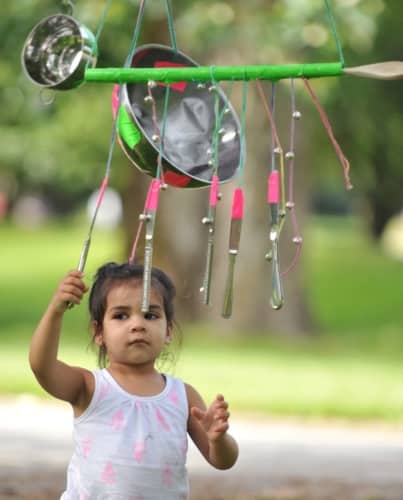 A competency based learning system is designed to embrace neurodiverse learners because neurodiversity is the norm. Any notion that all students of the same age have exactly the same learning needs should have been debunked long ago. During the early childhood learning years, it is especially important to avoid pushing children into patterns of frustration and failure from which they may never emerge.