

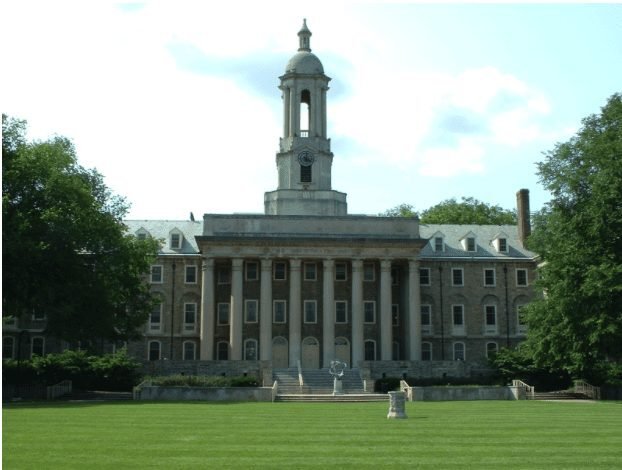

On October 19, 2016, faculty at 14 Pennsylvania state universities walked off the job in the first strike in the state system’s history. The InformED Report for November 7, 2016 opened with that strike and the deal that ended it on its third day. It then looked at a report showing that many states were still spending less on schools than before the Great Recession, and at the record high school graduation rate President Obama announced in October.
In this edition
- Thousands of faculty at 14 Pennsylvania state universities went on strike, the first walkout in the system’s nearly 34-year history, and reached a tentative contract two days later.
- At least 23 states were providing less general funding per student in 2016-17 than in 2008, according to the Center on Budget and Policy Priorities.
- The U.S. high school graduation rate reached a record 83.2 percent for the 2014-15 school year.
Pennsylvania’s state university faculty strike
Thousands of faculty members and coaches went on strike on Wednesday, October 19, at the 14 universities of the Pennsylvania State System of Higher Education. Erin McCann and Richard Pérez-Peña reported in The New York Times that it was the first walkout in the system’s nearly 34-year history. Their union, the Association of Pennsylvania State College and University Faculties, had been without a contract since June 30, 2015. The Times placed the strike in a wider pattern: that same year, faculty at California State University and the City University of New York had come within days or weeks of striking. “Labor issues are far more prominent on the radar screen of higher education than they were 10 or 20 years ago,” said Terry W. Hartle of the American Council on Education.
Students were divided. The Morning Call found Kutztown students on the picket lines and others simply confused. Liv Sun, a 19-year-old Kutztown sophomore and student organizer, said students were “against all the fundamental changes the state is trying to push through.” Others said they had been told to keep going to class with no answers about what would happen to their credits.
The strike was short. NPR’s Sonari Glinton reported that on Friday, October 21, the union and the state system reached a tentative three-year contract. It included pay increases and allowed the state to reduce health care costs, and the state withdrew proposals the union had opposed, including cutting adjunct wages and having graduate students teach more classes. “I wouldn’t say we got what we wanted,” said union president Kenneth Mash. The deal still had to be ratified by the union and the system’s board of governors.
States still spending less than before the recession
Emma Brown of The Washington Post reported on a study by the Center on Budget and Policy Priorities, which the Post described as a left-leaning think tank. By 2014, 35 states were spending less per student in total than they had in 2008. Looking at general or “formula” funding, the main form of state support for schools, at least 23 states were providing less per student in the 2016-17 school year than in 2008. “Public investment in K-12 schools,” said co-author Michael Leachman, “has declined dramatically in recent years” in too many states.
In a Huffington Post opinion column, Harlan Green drew a partisan conclusion from the same report. He noted its finding that eight states had cut general funding per student by about 10 percent or more, and that five of them, Arizona, Kansas, North Carolina, Oklahoma and Wisconsin, had enacted income tax rate cuts rather than restore school funding. Those cuts came as schools nationally had 1.1 million more K-12 students to educate.
The study’s numbers and the column’s argument are different kinds of evidence. The first is a survey of state budget documents. The second is an interpretation of why the budgets looked that way. For superintendents in the affected states, the numbers alone explained a great deal. When state formula aid falls behind enrollment and inflation, districts either raise local money or cut, and many of the cuts of 2008 had not been reversed eight years later.
A record high school graduation rate
On October 17, 2016, President Barack Obama visited Benjamin Banneker Academic High School in Washington, D.C., to announce that the U.S. high school graduation rate for 2014-15 had reached 83.2 percent, the highest on record. CNN’s Allie Malloy reported that, according to the National Center for Education Statistics, every group of students, by race, income and disability, had improved, though significant gaps remained between them. The Associated Press noted that the District of Columbia made the biggest one-year gain, seven percentage points, and that Banneker had graduated all of its seniors.
The good news came with a caution. The AP pointed out that the gains arrived against a backdrop of falling scores on national math and reading tests. Education Secretary John B. King Jr. acknowledged the concern: “A higher graduation rate is meaningful progress, but certainly we share the concern that we have more work to do to make sure every student graduates ready for what’s next.” Obama urged the students to fill out the FAFSA and told them they would need more than a diploma in a job market where machines could do repetitive work.
For high school leaders, the record was worth recognizing and worth testing. A graduation rate counts the students who finish; it says less about what they can do when they leave. Pairing graduation figures with evidence of readiness, such as course completion, college enrollment and remediation rates, gives a school a fuller picture of whether its gains are real.
Sources
- Erin McCann and Richard Pérez-Peña, “Faculty Members at 14 State Universities in Pennsylvania Go on Strike,” The New York Times, October 19, 2016.
- Jacqueline Palochko, Andrew Wagaman and Christina Tatu, “What students, faculty are saying about the state university strike,” The Morning Call, October 2016.
- Sonari Glinton, “Breakthrough In Strike By Pennsylvania Professors,” NPR, October 21, 2016.
- Emma Brown, “These states are spending less on education now than before the Great Recession,” The Washington Post, October 20, 2016.
- Harlan Green, “Greed Is Destroying K-12 Education System,” The Huffington Post, October 2016.
- Allie Malloy, “Obama highlights record high school graduation rate,” CNN Politics, October 17, 2016.
- The Associated Press, “High school graduation rate hits record high of 83.2 percent,” WTOP, October 2016.
About the InformED Report
The InformED Report is edCircuit’s short news program on education. This edition first ran on November 7, 2016. In 2026, edCircuit re-presented it with a new anchor and this full written account. Both report the stories as they stood on that date and link the original reporting, so readers can see exactly where each claim came from.
Subscribe to edCircuit to stay up to date on all of our shows, podcasts, news, and thought leadership articles.