
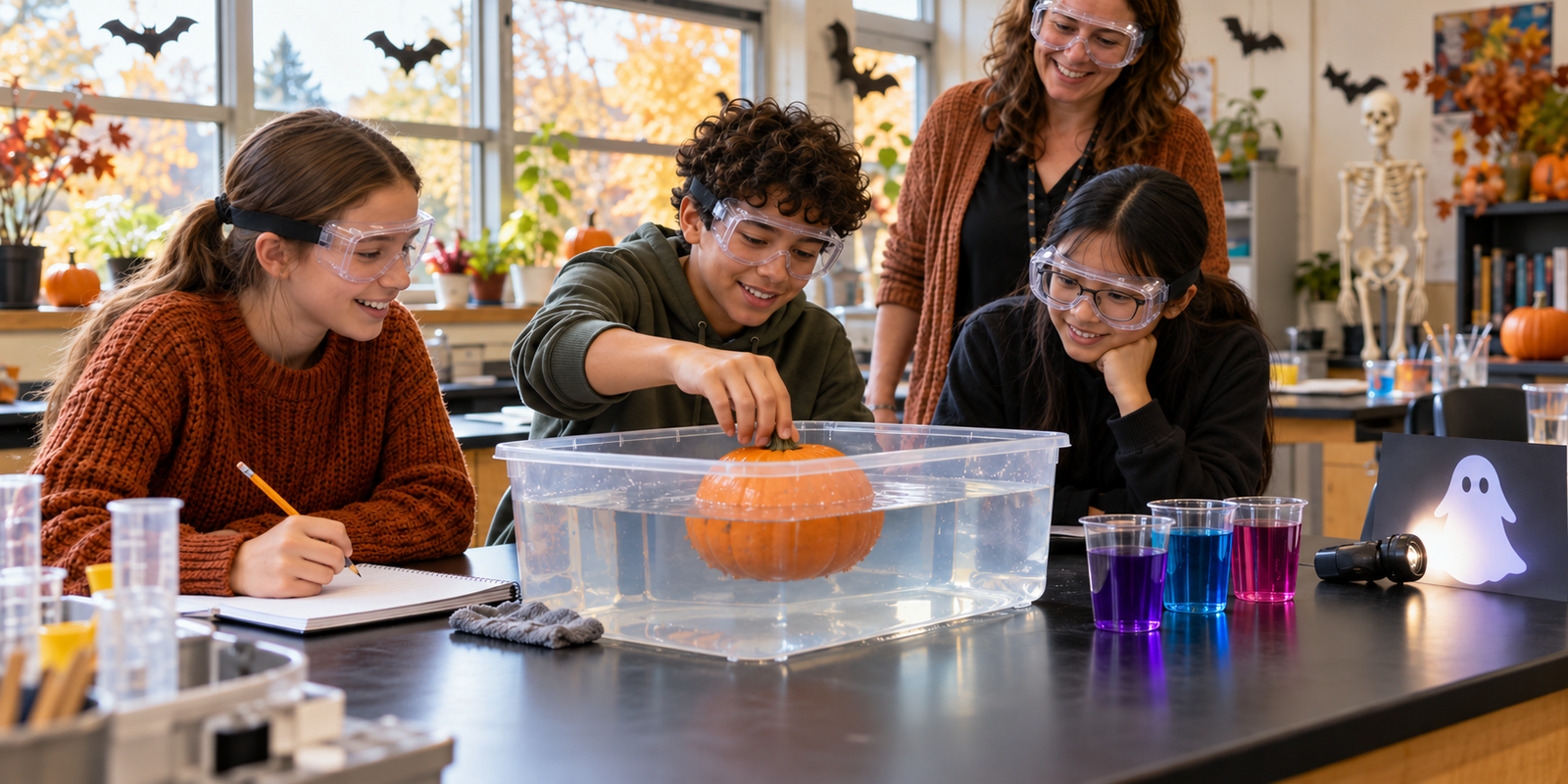
Halloween STEM activities don’t need a fog machine to get students’ attention. Put a pumpkin beside a tub of water and ask whether it will float. Give students a paper ghost and a flashlight and challenge them to make its shadow fill a wall. Suddenly, they have predictions to defend and measurements to make.
The holiday gives teachers familiar objects to work with; the science comes from what students do next. A good activity asks them to change one thing, record what happens, and explain the result. It also asks them to think about the setup. Where could water spill? What belongs in a “potion”? Which objects are safe to launch?
That last question deserves time in the lesson. The National Science Teaching Association recommends analyzing hazards, assessing risks, and choosing safety actions when planning Halloween lab activities. Students can help identify those choices before they begin. www.nsta.org
Will that pumpkin float?
Line up pumpkins of different sizes and let students pick the one they expect to sink. They can weigh each pumpkin, measure its circumference, record a prediction, and then test it in a sturdy tub of water. Does the heaviest one sink? How much of each pumpkin sits below the surface?
The result opens a discussion about density. A floating pumpkin displaces enough water to support its weight; its mass alone does not tell students whether it will float. Younger students can compare their predictions with what they saw. Older students can investigate why two pumpkins of similar mass sit at different depths and consider what measurements they would need to estimate each pumpkin’s total volume. The water displaced by a floating pumpkin measures only its submerged portion.
Keep the tub at a comfortable height, have students handle only pumpkins they can lift safely, and wipe up splashes as they happen. There is plenty to investigate without adding carving tools.
Make a potion that tells you something
Red cabbage juice looks like a Halloween ingredient, but its color change gives students evidence about acidity. Set out small, labeled samples of water, diluted lemon juice, vinegar, and baking soda solution. Students add each to a separate cup of indicator, record the color, and decide which samples produced similar results. If pH paper is available, older students can compare the two tests.
The useful question is not simply “What color did it turn?” Ask: Could two different liquids produce a similar color? What can this test tell us, and what can’t it tell us? The American Chemical Society’s red cabbage indicator activity provides the chemistry and an activity guide. www.acs.org
Choose and label the test liquids before class. Provide splash protection appropriate to the setup, skip bleach and unapproved cleaners, and make clear that nothing in the experiment is for tasting—even if it came from a kitchen. Students should clean their work areas and wash their hands afterward.
Make a ghost grow without touching it
Tape a white sheet to a wall. Give each group a cardstock ghost and an LED flashlight, then ask them to cast the largest shadow they can. Once they have a result, challenge them to repeat it. Where did they put the light, the ghost, and the wall?
Now students can move the ghost in measured steps while keeping the light and screen still. They trace the shadow at each position and compare its height and edges. Younger students can describe the pattern; older students can draw light paths to explain it. A second flashlight adds another question: what happens to the shadow when there are two sources of light?
Use LEDs in place of candles or hot bulbs. Secure cords, keep exits clear, and leave enough room light on for students to move safely. The room does not need to be pitch black for the experiment to work.
Give the Halloween Moon its real phase
Halloween art tends to show a full moon. The actual Moon may be in any phase, which makes a better question for students: Why does its appearance change at all?
With a fixed light representing the Sun, students hold small white balls representing the Moon and change their viewing positions. At each position, they sketch the lit portion they can see. They should be able to explain why the ball stays round while its visible bright portion changes. NASA’s Moon Phases lesson offers a fuller classroom procedure and teacher guidance. www.jpl.nasa.gov
Give students space to turn without bumping desks or one another. A cool LED light avoids a hot bulb; keep the light stable and out of students’ direct line of sight. For older classes, ask where this model oversimplifies the real Earth–Moon–Sun system.
Listen for a bat’s clues
Bats are everywhere in Halloween decorations, but how do they find their way? The National Park Service explains echolocation: bats emit high-frequency sounds and use the returning echoes to locate objects and prey. www.nps.gov
Play a recording or show a visualization of bat calls. Then, if the classroom has an ultrasonic distance sensor, place a cardboard obstacle at several measured distances and compare the sensor’s readings. Students can graph the results and ask what the device detects—and what information a bat would still need while flying after an insect. Without a sensor, a recorded echo demonstration can start the same conversation, as long as students understand it is only an analogy for part of echolocation.
There is no need to blindfold students or send anyone through an obstacle course. Keep the model stationary and play recordings at a comfortable volume.
Launch a very small “pumpkin”
A cotton ball colored orange is all the pumpkin this engineering challenge needs. Using craft sticks and rubber bands, students build a tabletop launcher and try to land their cotton ball in a marked zone. They test one change at a time—how far they press the arm down, for example—and measure three launches at each setting. Did the change improve distance, accuracy, or neither?
Science Buddies has a craft-stick catapult design that uses a cotton ball and explains why the projectile must stay soft and light. Establish a launch direction and a line for observers before testing begins. No candy, rocks, or miniature pumpkins go into the launcher, and students collect cotton balls only after launching stops. www.sciencebuddies.org
End with the evidence
After any of these activities, ask students for two short answers: What did the evidence show? What choice made the investigation safer or more reliable? A dry floor matters when students are carrying water. A labeled cup matters when they are comparing liquids. A cotton ball lets a team test a launcher repeatedly without firing a hard object across the room.
The activities still need to fit the students, the space, and school procedures. NSTA’s science activity safety checklist is a useful final check. Halloween supplies the setting; students do the science.
Subscribe to edCircuit to stay up to date on all of our shows, podcasts, news, and thought leadership articles.
Related reading
More on STEM and STEAM Education