

For decades, the default response to a student’s mounting absences was a letter. If the letter failed, a meeting. If the meeting failed, a formal hearing. The logic was compliance: escalate consequences until behavior changed. It rarely worked. And the escalation often never reached the families who needed help most: those experiencing housing instability, living in rural communities where mail runs slow, or juggling multiple jobs. Punishment was never going to bring students back.
California has now written that lesson into law. Since July 2025, Senate Bill 691 has required schools to strip the punitive language from initial truancy notices and replace it with offers of help: meetings with school staff, alternative programs, referrals to mental health and support services. On Jan. 1, 2026, Assembly Bill 461 repealed the Penal Code section that allowed the state to fine parents of chronically truant children up to $2,000 or jail them for up to a year. And under Education Code 48326, the California Department of Education must publish statewide guidance on reducing chronic absenteeism by the start of the 2026-27 school year, which is this summer. That guidance will include how to form school-site absence intervention teams that put attendance staff, counselors, health personnel, and community partners around the same table.
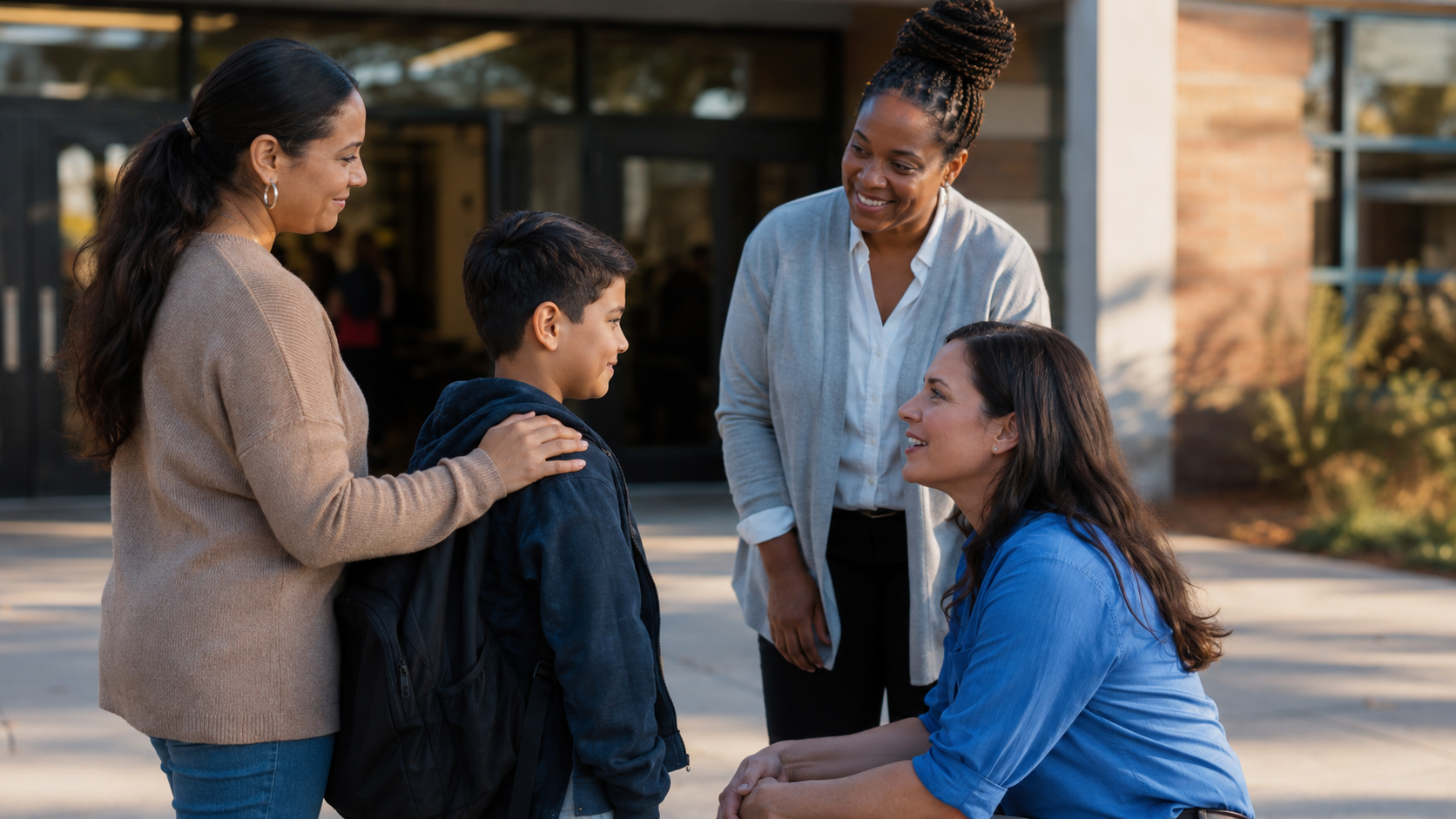
Taken together with California’s pledge to cut chronic absence in half by 2030, these laws mark the end of the compliance era. The harder question is what replaces it. The districts already making the most meaningful progress have an answer. They stopped escalating consequences and started building relationships with families: consistently, proactively, and at scale. Their results make the case that family engagement isn’t a supplement to attendance work. It is the intervention.
The message families never got
In Nuview Union School District in rural Riverside County, about 10% of students experience homelessness. Mail is unreliable. Formal hearing notices went unanswered, not out of defiance, but because they never arrived or arrived too late to matter. Chronic absenteeism climbed as high as 40 percent.
When Dr. Anny Iacono, the district’s director of special education and student services, supplemented letters with two-way text messages and emails, something unexpected happened. Families answered. Nearly all of them. Staff accustomed to silence suddenly had a hundred messages to answer, with many families responding to attendance outreach for the first time.
What the messages said mattered as much as how they were sent. A warm note telling a parent their child was missed that day communicated something no compliance letter could: that the child was valued.
Districtwide attendance rose from 92.7% to 94.9%. Every school improved. And parents began arriving at formal attendance review meetings, neither surprised nor defensive, because the school had already been talking with them for months.
A village, not a hearing
At Gerber Union Elementary School District and Mountain View School District in El Monte, the breakthrough came when attendance stopped being one person’s job. Under the old model, students slipped through the cracks not because no one cared, but because no one shared a full picture of what was happening, and no standing structure existed to act on it together.
Gerber built a weekly attendance team that brings together the assistant principal, counselor, family engagement liaison, wellness coach, secretary, and a county office SARB representative to review data tier by tier every Wednesday. Mountain View consolidated principals, community liaisons, and health clerks across eight campuses into a single shared system, so multiple adults were watching the same student at the same time. These teams look strikingly like the school-site absence intervention teams the state’s forthcoming guidance describes. They simply didn’t wait to be asked.
Families felt the difference immediately. Instead of hearing from one staff member about absences, they heard from a coordinated team with a different message. “Now you have a village behind a student, not just an individual who is hounding you down because you are not coming to school,” said Diego Reyes, Mountain View’s Student and Family Support Services Technician.
Both districts also invested in something that costs almost nothing: positive outreach. Celebratory messages to the families of students who attend consistently. Recognition for improvement. Some Mountain View students told staff they came to school hoping to receive an encouraging note from their principal, and some families called the office just to say thank you. At Gerber, the response was the same. “We get a lot of positive feedback when we send our Tier 1 messages out. Parents say, ‘Thank you so much. We’re trying really hard, we appreciate the recognition,’” said Vanessa Ortiz, the district’s assistant principal.
The results followed. Since launching weekly attendance meetings in February, Gerber has held daily attendance above 90%, up from a low of 84% in late January. Mountain View has sustained two consecutive years of districtwide gains across its eight schools.
What engagement at scale actually requires
The standing objection to relationship-based approaches is scale. A principal in a 300-student school can know every family personally. A district serving thousands of students in multiple languages cannot operate the same way.
What these districts demonstrate is that the infrastructure for family engagement at scale is buildable, but it requires deliberate design. Shared attendance data keeps multiple staff aligned on the same student. Communication in a family’s home language removes barriers that paper never addressed. A weekly team cadence keeps students from slipping through. And positive outreach, sent routinely rather than reactively, builds the goodwill that makes harder conversations possible. Families who only hear from school in moments of conflict arrive defensively. Families who have received recognition, encouragement, and useful information all year arrive as equal partners.
The common thread isn’t a program or a platform. It’s a set of choices: reaching families before the crisis, distributing responsibility across a team, leading with care alongside compliance, and connecting families to resources early enough to matter.
As Dr. Iacono’s team learned, districts can offer every intervention and wraparound service available, but none of it works if families never hear about it. Unified, accessible family engagement infrastructure is foundational to this work.
California’s new laws have settled the argument that chronic absenteeism is not a compliance problem. It is a connection problem. The state is giving districts a roadmap for what to start doing. Nuview, Gerber, and Mountain View are already showing it works.
Related reading
Subscribe to edCircuit to stay up to date on all of our shows, podcasts, news, and thought leadership articles.
More on Attendance and Absenteeism