
 EdCircuit Staff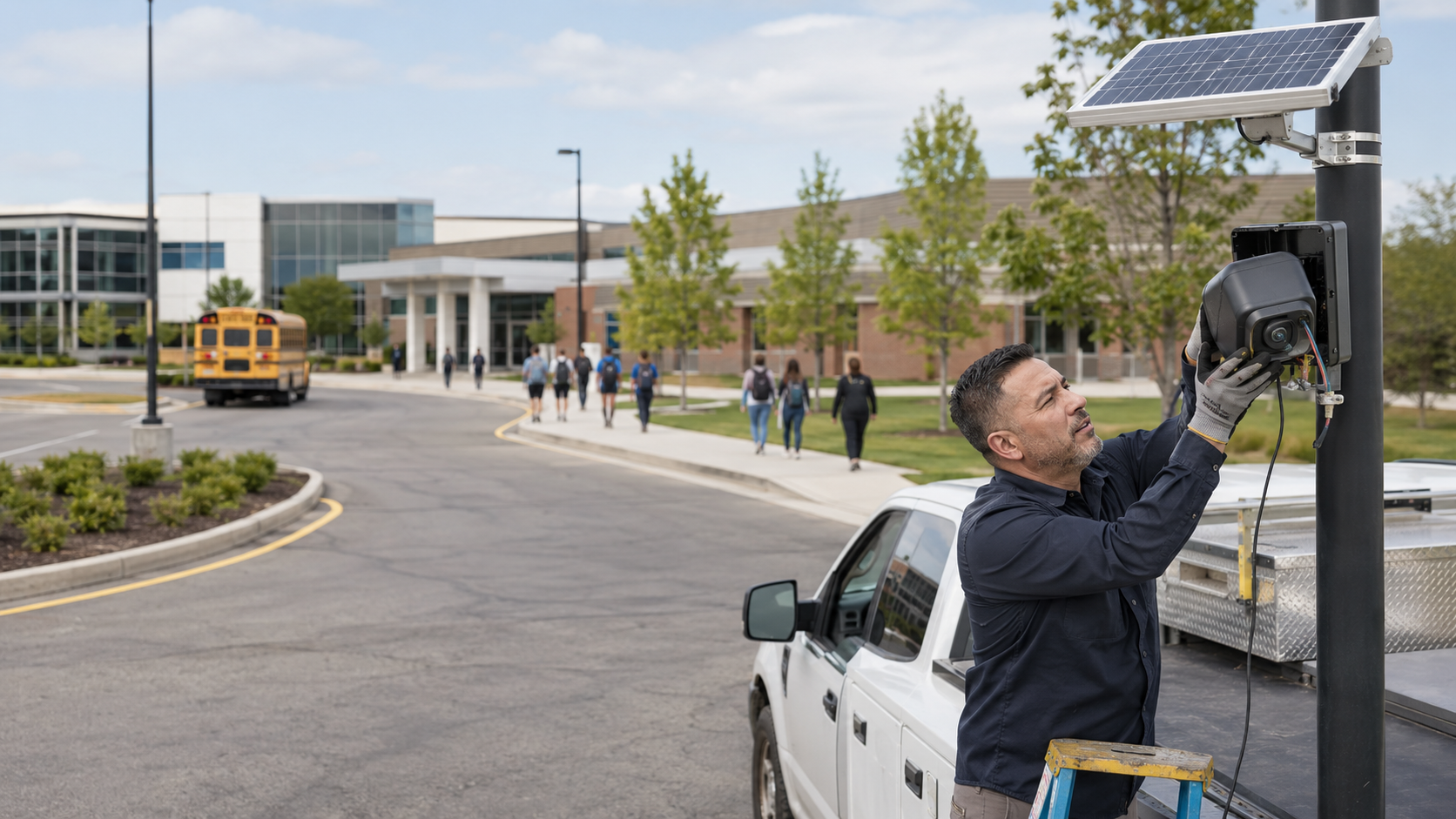
Flock cameras in schools are facing growing scrutiny as students return to class and communities ask more questions about privacy, data sharing and public oversight.
In August, edCircuit examined the growing use of Flock cameras in schools and the questions automatic license plate readers raise about safety, surveillance and access to vehicle information.
Since that article was published, several school systems have taken action.
Pflugerville Independent School District in Texas physically removed its cameras. Olentangy Local Schools in Ohio ended its agreement. Meanwhile, Clark County School District in Nevada paused its police department’s access to a regional Flock network while its newly appointed police chief reviews the program.
The beginning of the school year has also brought new student-led campaigns. High school students in Georgia and Colorado are asking their districts to remove Flock cameras from school property, while the University of Minnesota has agreed to remove one camera following community concerns.
These developments do not mean every school system will abandon automatic license plate readers. They do show that leaders are being asked to provide more than a general promise that the technology improves safety.
Communities want to know what the cameras have accomplished, who can search the information, where the data travels and whether the benefits justify collecting vehicle records from everyone who enters school property.
Pflugerville Removes Its School Cameras
On August 26, Pflugerville Independent School District announced that it was immediately suspending its use of Flock Safety cameras.
The district did not simply turn them off.
“All Flock Safety cameras on district property have been removed as of this morning,” PfISD said in its announcement.
The cameras had operated at district high schools and the Pfield athletic complex. According to the district, they provided real-time law enforcement alerts when a stolen vehicle or a vehicle on a watch list entered school property.
PfISD said its police department had been reviewing the system since Police Chief Tyler Smith was hired in December. The district ultimately followed the direction taken by the Pflugerville City Council and cited the community’s position on the issue.
The timing was important. One day earlier, the city council voted unanimously to end the city’s Flock agreement after concerns arose about outside searches involving its municipal camera network.
Public records discussed during the debate reportedly showed nearly 1.6 million searches by 459 outside organizations over approximately six months.
Those figures involved the city’s network, not the school district’s cameras. Still, the larger dispute placed the technology—and the question of who could reach the data—under closer local scrutiny.
PfISD maintained that its system was limited to license plate and vehicle information used to support campus safety. Its statement did not identify misuse by a district employee. Instead, the district said it listened to community concerns and decided that continued use was no longer appropriate.
Olentangy Ends Its Agreement With Little Public Discussion
Olentangy Local Schools in Central Ohio confirmed that it canceled its Flock contract sometime during the summer.
WOSU reported that the cameras were expected to be removed, but the district did not provide a detailed statement explaining its decision.
The lack of information leaves several questions unanswered. It is unclear when district leaders began reviewing the system, what evidence they considered or whether the cancellation was discussed publicly before it occurred.
Ending a surveillance program deserves transparency, but so does beginning one.
Families should not have to learn through a news report that a district collected license plate information or quietly discontinued the practice.
A public explanation does not need to disclose sensitive security procedures. It should identify the purpose of the system, how long it operated, the general rules governing access, whether information was shared and why district leaders decided to end it.
Back-to-School Pushback Expands
The recent district cancellations are now being followed by student-led campaigns in other parts of the country.
At Alpharetta High School in Georgia, seniors Aditya Manchanda and Henry Jones started a petition on September 1 asking Fulton County Schools to remove Flock cameras from their campus.
The cameras are positioned at school entrances and record vehicles entering and leaving the property. The students have raised concerns about privacy, cost and the potential reach of the information.
Their campaign is not limited to one building. The students hope the district will reconsider the cameras installed throughout Fulton County Schools.
According to Atlanta News First, the school board approved the system in 2022, and cameras are now installed at all 104 schools in the district. The original district-wide installation cost approximately $626,300.
Fulton County Schools is defending the program. The district says the cameras have supported safety investigations and that an audit process is in place to monitor their use.
School police also cited a specific result. Following a shooting outside Palmetto Elementary School, investigators reportedly used Flock information to help identify and locate a suspect within hours.
That example is important. Districts should be expected to present documented results when defending the technology, just as critics should be able to question whether those results justify continuous vehicle-data collection.
Students in Love-land, Colorado, are raising similar concerns. After five Flock cameras were installed at schools in his district, high school senior Gabe Sayer organized a petition and launched DeFlock Love-land, a student-led initiative calling on the school board and city council to remove the cameras.
A September report on student opposition cited an analysis of government procurement records indicating that Flock technology has been adopted by at least 100 school districts.
The back-to-school movement is not yet a nationwide wave of district cancellations. It is, however, producing new questions from students who are directly affected by surveillance systems installed around their schools.
Their involvement also raises a governance question: Should students be included when districts evaluate technology that records activity around campuses they enter every day?
Campus Concerns Extend Beyond K–12
The debate is also reaching higher education.
On September 11, the University of Minnesota announced that it would remove a recently installed Flock camera near its West Bank campus following concerns from a state lawmaker and community members.
The university said removing that camera was the appropriate step for supporting community trust while maintaining safety coverage.
The decision applies to one camera, not the university’s entire license plate reader system. The university reportedly operates at least 10 automatic license plate readers and maintains that the technology has helped recover stolen vehicles, locate missing people and identify suspects.
Even so, the decision demonstrates that camera placement matters. A school or university may decide that a system is justified in one location while determining that another location creates unnecessary concern or reaches beyond a clearly defined safety need.
A Pause Is Not the Same as Removing Cameras
Some recent headlines require a closer look.
Clark County School District in Nevada announced in August that its police department would pause its use of Flock while Police Chief Jeff Clark reviewed department procedures.
Unlike Pflugerville and Olentangy, Clark County did not own or operate Flock cameras on school property. Its police department had access to cameras maintained by other agencies and businesses throughout the Las Vegas Valley.
The Nevada Independent reported that the district had access to the network since at least August 2024. District police could use the system in assigned investigations, but the arrangement received broader attention only after public-records reporting disclosed it.
The district paused that access while the chief conducted his review. No cameras were removed from school grounds because the district did not maintain cameras there.
The Clark County situation raises a different concern: A district can participate in a large license plate surveillance network without installing a single reader on campus.
Reviews of school use should therefore examine both the cameras a district owns and the outside databases its employees can search.
Flock Announces New Safeguards
District decisions are unfolding as Flock Safety changes several of its policies.
On August 13, the company announced new privacy and accountability measures, including a recommended seven-day retention period rather than the previous 30-day default.
The distinctions matter for schools.
Flock later clarified that the new seven-day default applies only to new law-enforcement customers. Existing law-enforcement customers may keep locally approved retention periods, and private-sector customers retain the terms established for their accounts.
Multifactor authentication applies to all Flock users. However, several other announced protections—including required case codes, misuse detection and automatic lockouts—are primarily designed for law-enforcement customers. Some of those requirements are scheduled to take effect by the end of 2026.
District leaders should not assume that a company-wide announcement automatically changed their local settings.
They should determine how their accounts are classified and verify the retention period, sharing permissions, user access and auditing requirements that apply to their systems.
A safeguard only protects information when it applies to the account, is configured correctly and is regularly reviewed.
The Debate Reaches Congress
The debate is no longer limited to individual cities and school boards.
On September 15, a bipartisan pair of federal lawmakers announced the proposed No FLOCK Act.
The proposal would pressure states to limit automatic license plate readers to specific purposes, including identifying stolen vehicles, finding missing or endangered people, locating vehicles registered to people with felony warrants and investigating vehicles connected to felony offenses.
States that failed to establish those restrictions could eventually risk losing a portion of their federal transportation funding.
The proposal is not law, and its future in Congress is uncertain. Its introduction nevertheless demonstrates how quickly questions about license plate readers have moved from local contract discussions to the national policy debate.
What Districts Should Review Before Renewing
The recent cancellations, reviews and student campaigns give school boards a practical reason to revisit existing agreements before they renew automatically.
District leaders should be prepared to answer five questions:
What documented safety results has the system produced?
Leaders should know how many alerts led to verified threats, recovered vehicles, completed investigations, located missing people or other meaningful outcomes.
Who can search the information?
The answer should include district employees, school police, local law enforcement, partner agencies and anyone with access through a shared network.
How long is the information retained?
Districts should verify the actual setting governing their account rather than rely on a vendor’s general recommendation.
What happens when information is exported?
Downloads, screenshots, reports and records transferred into investigative files may remain after the original data is deleted.
Has the community been told how the system works?
Families and students should be able to find a plain-language policy explaining why the cameras are used, what they collect, who has access and how concerns can be reported.
These questions do not predetermine the outcome.
One district may decide that the cameras have helped address specific safety problems and should remain. Another may conclude that conventional security cameras, staffing, access controls, lighting or other measures are a better investment.
What matters is that the decision is based on evidence and made in public.
The Burden Is on the District
Automatic license plate readers can provide useful information following a theft, threat, missing-person report or other serious incident. That capability has not disappeared because several districts canceled their contracts.
But usefulness alone is not enough.
Pflugerville removed its cameras after listening to community concerns. Olentangy canceled its contract with little public explanation. Clark County paused access to a regional network while its police chief conducted a review.
Students in Alpharetta and Love-land are now asking their districts to reconsider the technology, while the University of Minnesota has agreed to remove one camera following questions about its location and reach.
These cases leave school districts with a straightforward obligation: If they collect or search vehicle information, they must be able to explain why.
If a district decides to keep Flock cameras, it should publish the rules, limit access, review every sharing arrangement and report whether the system is delivering meaningful results.
If leaders cannot demonstrate that the cameras are addressing a clearly defined school safety problem, removal may be the more responsible decision.
Subscribe to edCircuit to stay up to date on all of our shows, podcasts, news and thought leadership articles.