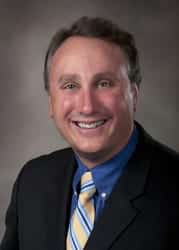

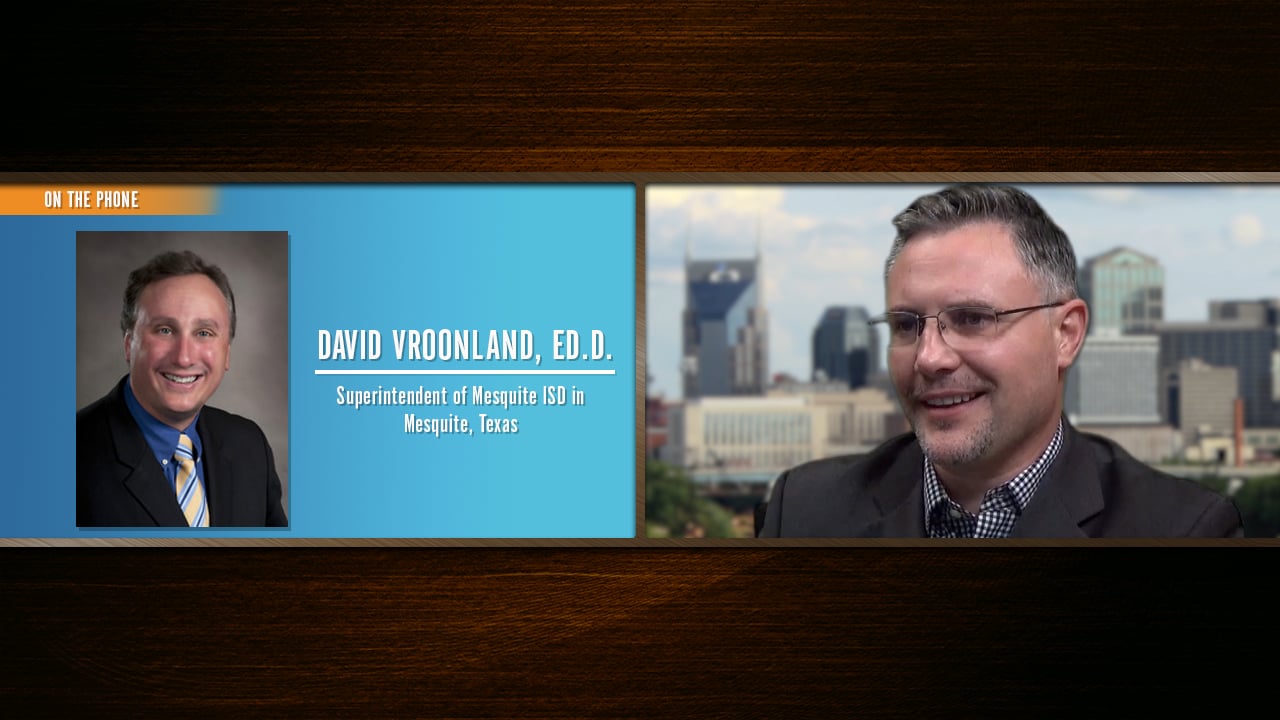
In this 2017 CoffeED interview, Dr. David Vroonland, superintendent of Mesquite Independent School District near Dallas, talks about growing up in foster care, the adults and teachers who made a difference in those years, and why Vroonland wants communities to hold schools accountable locally. The section below sets out the federal rules for students in foster care and what schools can do, with figures from national sources.
by edCircuit Staff

Unfortunately, David’s story is not unique. There are many children today going down similar paths to David’s on their journey to growing up. Even years later, there remains the reality that for most of them, the only constant will be public school.
David’s tale is a powerful one, but what is most remarkable is how his situation pushed him into a career in education. What started out as a teaching stint eventually steered into administration, something he never dreamed of as a kid.
Interview Transcript
edCircuit: David, I sat in the room at TPAC (Texas Performance Assessment Consortium) in Texas earlier this summer and you really jumped out, not only because of your level of participation, but the passion with which you communicated the needs around community-based accountability systems and the impact on students, parents, and school leaders.
I want to start with the passion side of this. Let’s talk about your story and what led you to be the leader of a district. I won’t give the punch line but I heard some of your backstory in the meeting that you invited me to following that TPAC meeting.
Tell me a little bit about your background and how you think that played a role in where you are today in Mesquite.
David Vroonland: As I’ve shared with a lot of folks, my background is not a typical one. Sadly and unfortunately, we see a lot of people, children especially, who share some commonality with my experience. I’ll start with what that experience looked like.
That’s a lot of disruption in a young man’s life and a lot of instability that has to be filled somehow. Even in that unique experience, I was so blessed because three things filled my life that made such a huge impact on my ability to be who I am today.
One is that you have someone who loves you. I had the good fortune, even in that setting, of having parents, each and every time, who loved me. But more than that, with that much instability, you need people in your community to express love for people like that. And they do that in a variety of ways.
I had the good fortune of having teachers, ministers, and community members who loved me. I still reflect on a Christmas Day of people bringing Christmas toys into my home when I was about six or seven years old. I was astonished that these men did this, and they didn’t even know me.
That was such a huge impact in my life because it was an expression of love for a young person. And it’s been in my mind ever since. I don’t believe it will ever go away. It’s one of those things that has dictated the direction of my life.
The other thing is that you have to have a belief in something that is larger than yourself. Certainly, that can be faith-based, and I believe it is. For me, it definitely is.
It also has to be based in principles. These principles are things that provide parameters for young people to live within. One of the things that I struggled with regarding schools lately is that because of accountability, we’ve moved away from one of the key elements of schooling.
Thomas Jefferson said it this way, “The purpose of a general education is to enable every man to determine for himself that which will secure or endanger their freedom.”
Those principles of life are key and we need to understand those things. I had the good fortune of having both faith experiences that allow that to occur. I learned some really important principles to life. But also in education. In the education setting, I learned how to work with people, how to respect others, and how to respect people’s way of thinking. Those are things that I think had disappeared due, in large parts, to accountability ─ which I’ll talk about in a little bit.
Lastly, most importantly, you have to have a public education system. I had a pretty difficult start in life and it led me down the pathway of education. I had no desire to be an administrator. I wasn’t the least bit interested in that but I was passionate about the education of young people. I’m absolutely passionate.

My pathway ended up in the U.S. suburbs a lot. But I felt like I would love an opportunity to be in a district with more of an urban setting just to really bear some of my thoughts in those environments. We do have a different treatment of kids in suburbia versus kids in urban settings. I think it’s based on our preconceived notions of what urban kids can do over what suburban kids can do. I just don’t buy into those notions. I wanted an opportunity to come in and have high impact in a larger urban district.
edCircuit: Based on your background and the way in which you entered this world, I’m wondering about the impact of that sense of community that you almost had to embrace ─ noting the story of Christmas when you were six or seven. I wish that we could identify the power of community engagement when we think about the ways in which we can personalize learning experiences for young people who are in urban, rural, suburban settings in a manner that gives them purpose and meaning when they walk through the doors of their given school. That they are engaged because they feel loved. And that we are thinking about learning in that regard. It’s not like a coach talking X’s and O’s or scores but it’s about the participation.
In sports, they talk about the glue guy on the roster, that individual who may not be the most talented but there’s something about their personality and the way in which they engage that heightens the experience for everybody.
I think we could probably look at that in the way in which we personalize learning and think about the ways in which you, as a young person, would want to be engaged to further support your own social-emotional learning through what most would call a “potentially turbulent” start to your own life.
DV: It’s interesting that you noted that. I appreciate that. I hadn’t thought about it quite that way. But the community in everything we do is vital. In our district, we have an initiative called “Read Play Talk.” It’s to really get into homes and to engage parents in the learning of their children ages zero (birth) to three. Then, we have our own pre-K initiative to get all kids on grade-level reading by third grade. We also have the advanced academic program.
But it all starts with community engagement. It’s not the school. The school has its role but it is really the community engaging in its own people.
What’s been really exciting about this is you’re seeing it being embraced in Mesquite ISD. Read Play Talk is being embraced by the social services network. You’re seeing it being embraced by businesses. You’re seeing it being embraced by hospitals, by the city. Everybody is embracing it and doing their part around Read Play Talk.
What I love about it is it’s not a strategy driven by the school district. Rather, the school district is setting the vision for the community and the community is designing its own strategies to have their role in ensuring that kids can read on grade level before they enter our schools.

One of my concerns about accountability is that it takes that away. The way the accountability systems are structured, it becomes about the state. And I don’t have a disrespect for the state. I don’t want anyone to misinterpret what I’m saying, but we need to embrace it locally. We need to hold ourselves accountable to our children and to our communities, and the state’s role in that should be relatively limited.
So that’s why I’m not a big proponent of the current system, amongst other reasons.
edCircuit: Let’s close with this, Dave. If you were to write the moral of your education story, what would it be and what can we take from it? Not just as gentlemen like you and me who work in education but just as community members. What is the power of education on a young person’s trajectory in life?
DV: This is not to create sympathy for myself, but I want to paint a picture. You’re nine or almost ten years old and you’re leaving a family you’ve been with for seven years. You have two paper grocery bags filled with all your possessions and you’re in a back seat of a car and you’re leaving that home and you’re being driven to a new home a hundred miles away with a new family, new expectations, new name, new friends, and a new school.
One of the key sustaining pieces to this child’s life in that situation is the public school. I still remember Dr. Gerlitz. And this was years later. I think I was in eighth-grade science class. I still remember Dr. Gerlitz and many of my elementary teachers as well but Dr. Gerlitz strikes a point that is essential to this.

An expression that I love is the ability to share joy in that classroom. That’s one of the things I want to see brought back ─ this sense of joy and happiness in learning ─ because it helps kids connect in a way that testing them simply doesn’t. There are all sorts of evidence around this.
For me, I think that’s the moral of the story. You can impact lives ─ even substantially disrupted lives ─ by caring deeply about them and having joy in what you do in that classroom.
- Education Week – What Is the Future of Individualized Education Programs?
- The New York Times – 1 in 7 New York City Elementary Students Will Be Homeless, Report Says
- CBS Denver – Foster Care Teens Celebrate Graduation
Students in foster care: what schools are required to do and what the data show
David Vroonland describes moving between families several times in the first ten years of life, and Vroonland names stable schooling and caring adults as the constants in that period. Vroonland’s account reflects a situation that many schools still meet. This section explains how many students are in foster care, the federal rules that govern their schooling, and what the available data say about their school outcomes. Readers who are affected personally can ask a school counsellor, the district’s foster care point of contact or the child’s caseworker for help.
How many children are in foster care
According to USAFacts, which draws on the federal Adoption and Foster Care Analysis and Reporting System, 343,077 children were in foster care on the last day of the 2023 fiscal year, and an estimated 527,180 passed through the system during 2023. The number has fallen each year since 2018. In 2018, The 74 reported more than 430,000 children in care, about 260,000 of them school-age.
What federal law requires of schools
The Fostering Connections to Success and Increasing Adoptions Act of 2008 first required child welfare agencies to work with schools so that children could stay in their school of origin when that is in their best interest. The Every Student Succeeds Act (ESSA), passed in December 2015, added matching duties for education agencies from December 10, 2016. A Nebraska Department of Education summary quotes the law, 20 U.S.C. 6311(g)(1)(E) and 6312(c)(5), and sets out these points:
- A child in foster care stays in the school of origin unless a decision is made that this is not in the child’s best interest. The decision must consider all factors, including the appropriateness of the current setting and the distance to the school where the child was enrolled at placement.
- If the child should move, the child is enrolled immediately in the new school, even without the records normally required, and the new school promptly contacts the last school for records.
- Education agencies and child welfare agencies each designate a point of contact where the other agency asks them to.
- Each school district develops written procedures with the child welfare agency on how transportation to the school of origin will be provided, arranged and funded for as long as the child is in care. Transportation cost must not be a factor in the best-interest decision.
- State and local report cards must report achievement and graduation rates for students in foster care as a separate group.
What the data show
The 74, reporting in 2018, quotes outcome figures from state agencies and advocacy groups. Colorado’s four-year graduation rate for students in foster care was 24 percent in 2017, and Washington State’s five-year rate was 49 percent compared with 82 percent for all students. The article also reports, citing the American Bar Association, that each school change costs a student roughly four to six months of learning, and that about a third of students in foster care change schools at least five times before adulthood. These are older figures from particular states and sources, and the same article notes that most states did not share education data with child welfare agencies at that time, so outcome data were often missing. The new report-card requirement was meant to close that gap, and readers should check their own state’s report card for current numbers.
What this means for a school
- Name a point of contact for students in foster care, publish the name, and make sure the child welfare agency knows it.
- Agree on the best-interest process with the agency before it is needed, including who attends and how decisions are written down.
- Put the transportation procedure in writing and test it with a real case.
- Enrol quickly and request records at once, so that a student is in class while paperwork catches up.
- Look at attendance, credits and discipline for these students each term, with the privacy rules your state requires.
The original interview in this context
Vroonland says three things filled those years: a person who loved the child, a belief larger than oneself, and a public education system. Vroonland also describes the district’s Read Play Talk early literacy initiative, which engages families from birth to age three. The law above gives schools the means to provide continuity, and Vroonland’s account describes the personal side of why continuity matters. Vroonland’s views on state accountability systems are Vroonland’s own, and readers can weigh them against the report-card requirements described here.
Related reading
More on Diversity, Equity, Inclusion