
Remote Learning, Online Learning and Connected Districts: Wendy Oliver and Jeff McCoy
Wendy Oliver explains why remote learning differs from online learning, and Jeff McCoy describes how Greenville County Schools kept students connected.


Wendy Oliver on remote learning vs online learning and what parents should look for, and Jeff McCoy on how Greenville kept students connected.
By May 2020, families and districts had spent two months improvising, and attention was turning to the fall. This episode of edCircuit’s Education Today podcast, presented by Soundtrap for Education, brought together two perspectives on what digital learning demands. Dr. Wendy Oliver, chief learning officer for EdisonLearning and author of Not Your Mama’s Education: What You Need to Know as a Parent About Your Child’s Digital Education, explained the difference between remote learning and online learning, and what parents and administrators need to understand about each. Jeff McCoy, associate superintendent of academics for Greenville County Schools, South Carolina’s largest district with about 77,000 students, described how his district kept students connected and planned for an uncertain school year.
 Education TodayS1E6 - "Not Your Mama's" Strategies for Connected Leadership & LearningPlay episode: S1E6 - "Not Your Mama's" Strategies for Connected Leadership & Learning (30 minutes 41 seconds)Follow on SpotifyApple
A book for parents, written before the pandemic
Oliver published her book in October 2019 as a passion project. After years in digital education, she felt educators had not done a good job of telling parents how to help their children as learning moved online, and she counted herself among them. One example is homework. Many parents grew up with textbooks that showed worked examples, so they could help with math by following the example. When a child simply logs on, a parent may have nothing to work from. When schools closed, the book suddenly had a much larger audience, and Oliver began receiving requests to speak to whole faculties and administrative teams.
Remote learning vs online learning: not the same thing
Oliver drew a sharp line between families who choose online learning and families who are moved to remote learning because they have to. Much of what happened during the closures, she said, was remote learning: teachers who had not been trained or prepared, teaching through screens. Online learning uses curriculum and materials built by instructional designers around specific methodologies. Remote learning often cannot match that quality, she explained, because “teachers are taught to teach, not to create and design curriculum.” Administrators planning for the fall, she said, need to design with families in mind as clients, because many parents now judged their district by what they saw on a computer screen.
Sequence, personalization and assessment
In well-designed online curriculum, Oliver said, the traditional fixed sequence of lessons can give way to personalized paths. Early in her career she worked with Tennessee’s state assessment division, and she sees assessment and online learning as closely linked. Using data on student performance, adaptive systems can change the order of learning so not every child has to move from point A to point Z. That matters, she said, because students would return in the fall with very different levels of learning, and many had not had access at all.
She does not see assessment itself as the problem. “Assessment is not the bad guy,” she said, though she criticized the politics and funding consequences attached to it. Her example: a student struggling to divide fractions may never have learned to multiply them. A teacher with 30 or 35 students may not spot that, but an online system using benchmarks can, and can reteach the missing skill.
What parents should look for
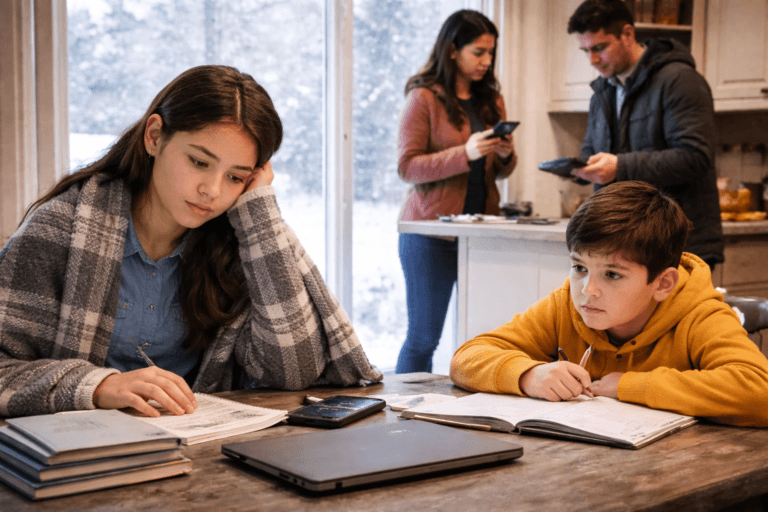
As the parent of a second grader, Oliver understood the stress of working from home while helping with school. Her advice was to remember that remote teaching was new for many teachers, who were trying their hardest, and to communicate whenever expectations were unclear. If a child has a meltdown, she said, do not force them to continue that day. Parents should look for engagement: is the child applying learning to the real world, moving forward and interacting with classmates digitally? The best remote classroom, she said, looks as close as possible to a traditional classroom, only at a distance.
Two days to change everything
McCoy, who has spent more than 20 years in Greenville County Schools, said stability made the crisis easier: he already had a team he trusted. South Carolina’s governor announced school closures on a Sunday, and the district had two days to move to e-learning, with paper packets for students in kindergarten through second grade who did not have devices. Parents were very supportive, he said, though “education fatigue” grew as the closures went on, and the district tried to lighten the load while keeping students learning.
The district had spent two years rolling out social-emotional learning before the pandemic. A member of McCoy’s team opened every weekly Zoom meeting with an SEL activity for his 30-person staff, and the district was building SEL into its online professional development for teachers. Greenville also has mental health counselors in every school, and they received permission to continue services with students remotely.
Wi-Fi on school buses
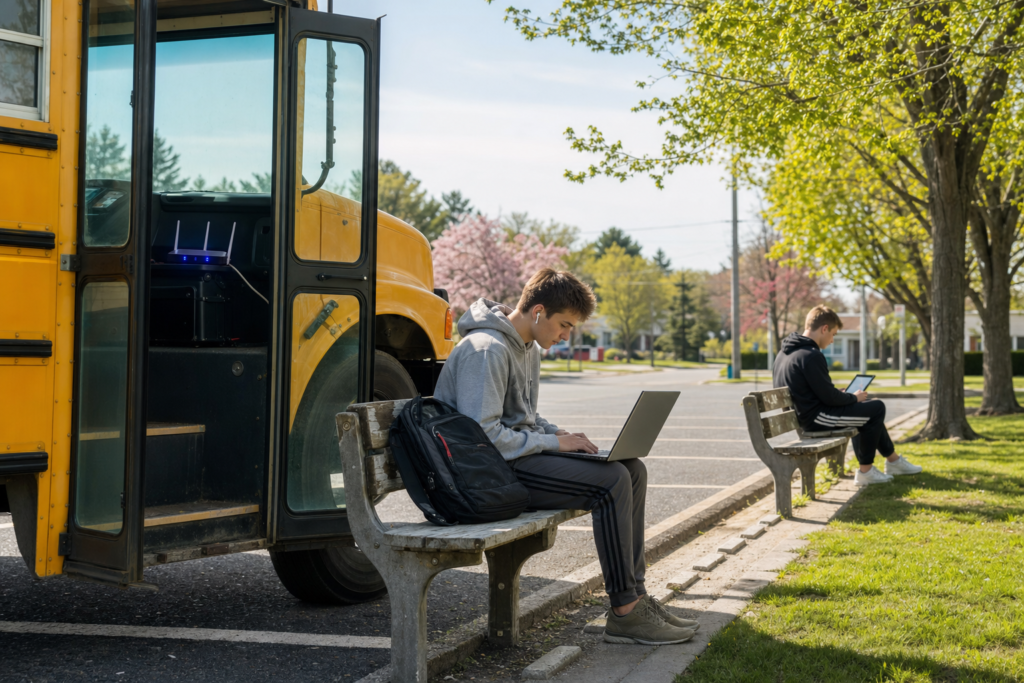
Greenville already had a device program for grades 3 through 12 and was considering extending it to the youngest grades. To get students online, the district opened Wi-Fi in school parking lots and used the Wi-Fi it had installed on school buses about two years earlier. Several hundred buses were delivering meals across the county, and each sat at its stop for about three hours, so students could connect nearby. The district also worked with local businesses to park buses or add hotspots at their locations. Two weeks before the recording, McCoy said, 98.5 percent of the district’s roughly 58,000 students in grades 3 through 12 had connected to its network at least once a week. The goal for the next year was internet access at home for every student.
“We’ve been preparing for this for 10 years,” McCoy said. “We just didn’t know what we were preparing for.” Because the district was strongly focused on technology and its teachers were comfortable with it, the transition went relatively smoothly. Teachers still needed training on video meetings, and hundreds continued to attend online professional development. The main lesson was the need for more structure. Some teachers met their classes by video every day, while some students reported never meeting their teachers online, and the district wanted a more equitable experience for every child.
Planning for every scenario
For the fall, Greenville was considering a modified schedule in which half of students attend on alternating days, preparing for full e-learning if required, and designing schedules that would let schools move in and out of remote learning in waves. Districts, McCoy said, need those contingency plans well before August.
The district’s On Track initiative, a community collaborative led with partners including United Way and the Hollingsworth Foundation, built an early warning system around attendance, behavior and course progress. Teams meet weekly to review students who show risk factors, create intervention plans, assign mentors and check progress through the year, while community partners provide services the schools cannot, including telemedicine in pilot schools, mental health support and food. The closures slowed that work, McCoy said, but teachers meeting students online could still flag a child who seemed off track.
On assessment, McCoy said the district’s benchmark assessments predict end-of-year test scores with high accuracy. He argued that some accountability is necessary to make sure every child receives an equitable education, but that it does not have to mean high-stakes standardized tests. There is, he said, a middle ground.
Listen to the full conversation in the player above, or find every episode on the Education Today show page.
Subscribe to edCircuit to stay up to date on all of our shows, podcasts, news, and thought leadership articles.
Related reading
More on Online Learning