



 Kris Howatt
Strong communication drives the relationship between Gresham-Barlow administration and the district school board
The communication and interaction between a district school board and school-level leaders sometimes receives less attention than other areas of education administration. How a school board deciphers policy and disseminates that information to school leadership is a critical element to ensuring programs are developed that provide equitable access and opportunity for all students.
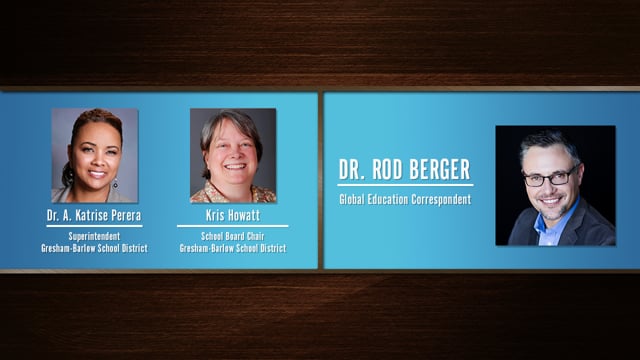
The Gresham-Barlow School District in Oregon is an excellent example of a successful relationship between a school board and administration. Board Chair Kris Howatt and the superintendent, Dr. A. Katrise Perera, have found a way to communicate seamlessly so the district realizes the best outcomes.
When driving budget needs, Howatt points to the importance of being steeped in policy understanding. “Our board does a very good job of reviewing policy, understanding it, and understanding our role. Policy very much directs budget. Those are the two areas that we’re continually looking at to see if there was something we may have missed the first time through as possible hidden bias, something that we weren’t looking at before. Whether or not it is a gender or socio-economic status, when we’re not seeing growth for our students, we have to ask: Are we doing something in policy because it is the way we’ve always done it?”
School boards make sure the basics of district operations are met in such a way that brings opportunities for teachers and administrators to move forward successfully. Twenty years ago, policy was rather dry but as Howatt explains, “Now we are making sure that it lives and breathes so people can follow it as well.” For the board, it means deliberate action with revisions and not a “one time and done” approach. Howatt adds, ” We continue to look at it every time something comes up ─ budget issues, opportunities, how we’re making sure that all students have access in a way that makes sense for their education success.”
When Dr. Perera arrived at Gresham-Barlow, she wanted to get to know her school board and make sure that they stood behind the words that were being spoken. She quickly realized their dedication was genuine: “I found out my board not only takes responsibility but also acts as a rallying cry. First, within the district to help galvanize the actions in different sectors, and then throughout our district by keeping an equity lens on the work that we’re doing.”
It’s one of the challenges purposely extended to a superintendent ─ to create an effective system and instruction that focuses on student achievement. Dr. Perera emphasizes, “We must ensure that we’re allocating resources appropriately, watching our return on investment, using good key indicators of success or performance that allows us to engage our community around providing real access and opportunities for our students.”
There are local, regional and national implications of policy for all districts throughout the country. Howatt finds that the same conversations are taking place among school board members in all regions of the U.S. She emphasizes, “Unless board members are deliberate about what they’re doing, things do not change.” There is an age element to school board representation that offers an interesting look into how boards take action. According to Howatt, “Most people get on the school board at the end of their career ─ after they’ve retired when they have more free time. They’re coming into a school board in their late sixties, seventies, and not really looking to make change. But recently, Howatt has seen a shift toward younger people getting more involved. As Howatt explains, “By ‘younger,’ I mean 35 to 40 which is still, for school board service, young. And it’s bringing a fresh view.”
Rounding out the relationship between the school board and administration, Dr. Perera believes that professional development plays an important role. Along with ensuring that there is a supportive workplace for staff that is propped up by ongoing professional development, she sees the importance of bringing PD to the school board. When budgets get tight, professional development is often one of the first things to go, which is a mistake.
Howatt adds, “The Gresham-Barlow District has been very good in supporting professional development for the board. The support of the district is very important.” Other districts often do not support spending money for the school board to get professional development, and Howatt feels it’s a shame: “Without professional development, without the ability to go to conferences, trainings, or collaborative meetings, the board doesn’t know the questions to ask or understand the data that’s being given.”
All of it goes hand-in-hand to make sure that when things need to change, the school board is part of the process and not a stumbling block to progress because of miscommunication or misunderstandings. Dr. Perera, Howatt and the rest of the Gresham-Barlow leadership are showing they understand the big picture elements involved and the importance of informed communication to achieve all learning goals.
- The Outlook – Gresham youths ‘step up, speak out’ during summit
- ACT – Guest Blog: I am not supposed to be here…
- The Oregonian – Gresham-Barlow: School Guide


