



 EdCircuit Staff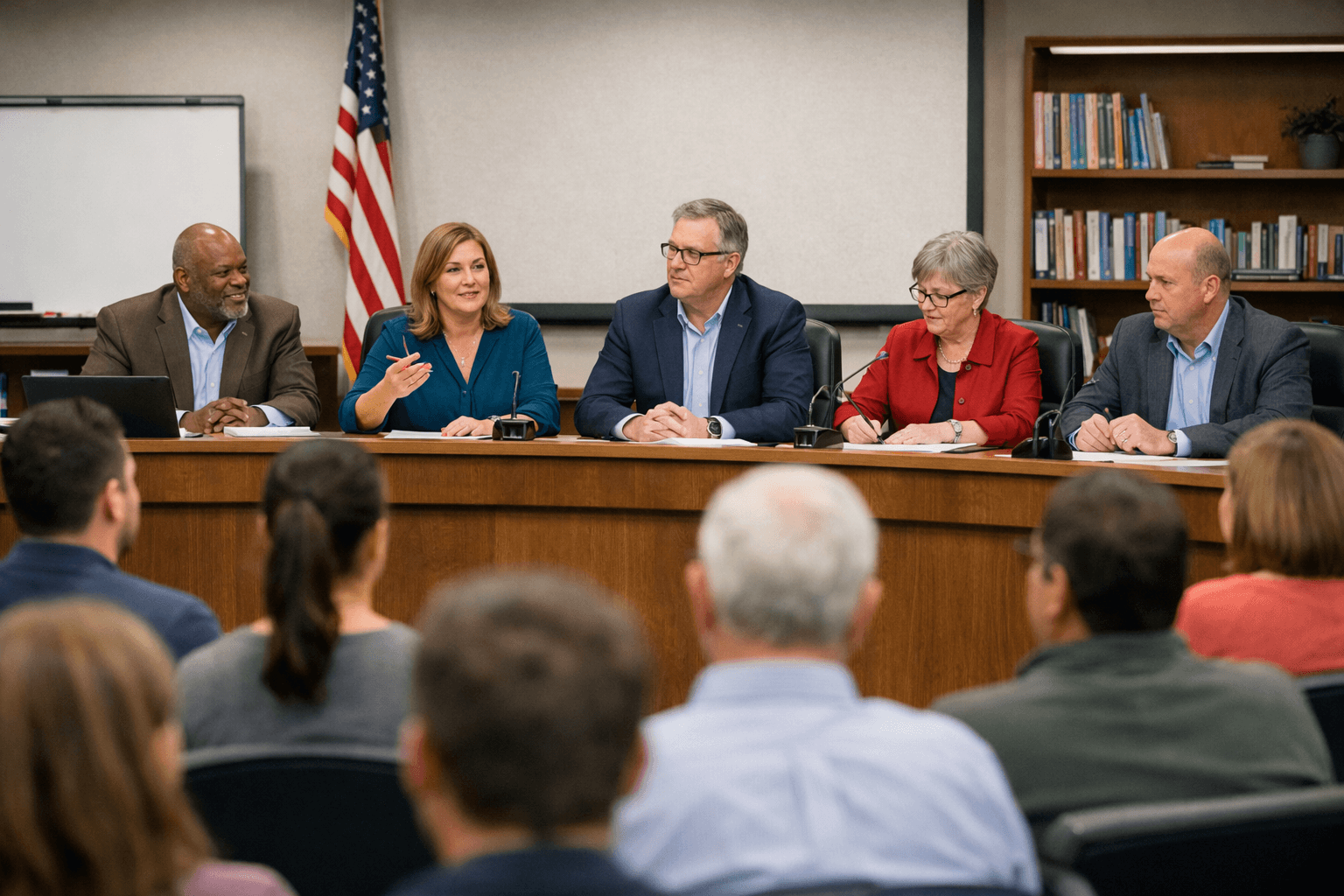
A school board, also called a board of education, is the elected or appointed group that governs a public school district. It hires the superintendent, adopts the budget, sets policy and answers to the community for how the district performs. Teachers and principals are the most visible people in a school system, but many of the decisions that shape their work start at the school board’s table.
There are a great many of these boards. The U.S. Census Bureau counted 12,546 independent school district governments in 2025, and 13,853 public school systems in all, each governed by a board or, in a few states, by a city or county government. This article explains what a school board does, how members are chosen, what they cannot do, and how families can take part.
What does a school board do?
A school board governs; it does not manage. Its job is to set the district’s direction, adopt policies, approve the budget, hire and evaluate the superintendent, and monitor whether students are learning. The superintendent and staff then run the schools day to day. State law spells out the board’s powers. Texas, for example, directs its boards to adopt goals for the district, hold the superintendent accountable for results, adopt an annual budget and set a tax rate each year.
Setting vision and policy
Boards adopt the policies that guide everything from graduation requirements and student discipline to how the district buys technology. They review data on achievement, attendance and graduation, and adjust priorities when the results fall short.
Hiring the superintendent
The most consequential decision most boards make is choosing a superintendent, the district’s chief executive. The board sets expectations for the job, evaluates the superintendent’s performance and, when necessary, replaces them. The relationship between the two largely decides how well policy becomes practice.
Overseeing the budget
Each year the board reviews and approves a budget that pays for staff, programs, transportation, technology and buildings, drawn from local taxes and state and federal money. Board members approve major purchases and monitor spending through the year. edCircuit looked at this part of the job in School Board Procurement Oversight in 2026.
What school board members cannot do
An individual board member has no authority alone. The board acts only as a body, by majority vote in a public meeting. Texas law states it plainly: unless the board authorizes it, a member may not act on the board’s behalf individually. That is why a parent who brings a problem to one board member is usually directed to the superintendent or to the board as a whole, and why board members are not supposed to direct teachers or principals themselves.
How are school board members chosen?
Most school boards are elected by local voters, and some are appointed. Big cities show the range. Chicago swore in its first-ever elected board members in January 2025, alongside members appointed by the mayor, on the way to a fully elected board by 2027. In Boston, unlike nearly every other Massachusetts district, all school committee members are appointed by the mayor.
School board races are often low-key. In Ballotpedia’s review of 2025 elections across 187 districts in 29 states, 84 percent of incumbents who ran won, and 36 percent of seats were uncontested. Board members themselves come from many backgrounds. In a 2026 survey of 478 board members by the EdWeek Research Center, about 40 percent were retired and 44 percent had never worked in K–12 education.
Are school board members paid?
Usually very little, and in many states not at all. At least 13 states bar school board members from being paid, Education Week found. Texas law says trustees serve without compensation. Where pay is allowed, it is typically small; Michigan allows $30 per meeting. A few large districts pay more: Los Angeles board members can earn $125,000 a year.
School board meetings and public comment
School boards do their business in public. State open meetings laws require boards to deliberate and vote in meetings the public can attend. Ohio’s law, for example, declares that all meetings of public bodies are open to the public, allows closed executive sessions only for limited purposes such as personnel matters and pending litigation, and makes any formal action invalid unless it is taken in an open meeting.
Most boards also set aside time for public comment. Rules vary by state. Texas requires boards to let members of the public speak on agenda items, allows reasonable time limits and bars boards from prohibiting public criticism. In other states, public comment is a matter of board policy, often limited to two or three minutes per speaker after signing in. Families who want to speak should check the board’s posted rules and agenda before the meeting.
Why school boards matter
School boards are one of the most local forms of government in the country, and their decisions reach every classroom: who leads the district, how money is spent, what programs are offered and how buildings are maintained. Families can shape those decisions by attending meetings, speaking during public comment, contacting the board as a whole, and voting in school board elections. A community that understands what its school board can and cannot do is better prepared to hold it accountable and to help it succeed.
Related reading
Subscribe to edCircuit to stay up to date on all of our shows, podcasts, news, and thought leadership articles.
More on Education Policy and Government


