
 EdCircuit Staff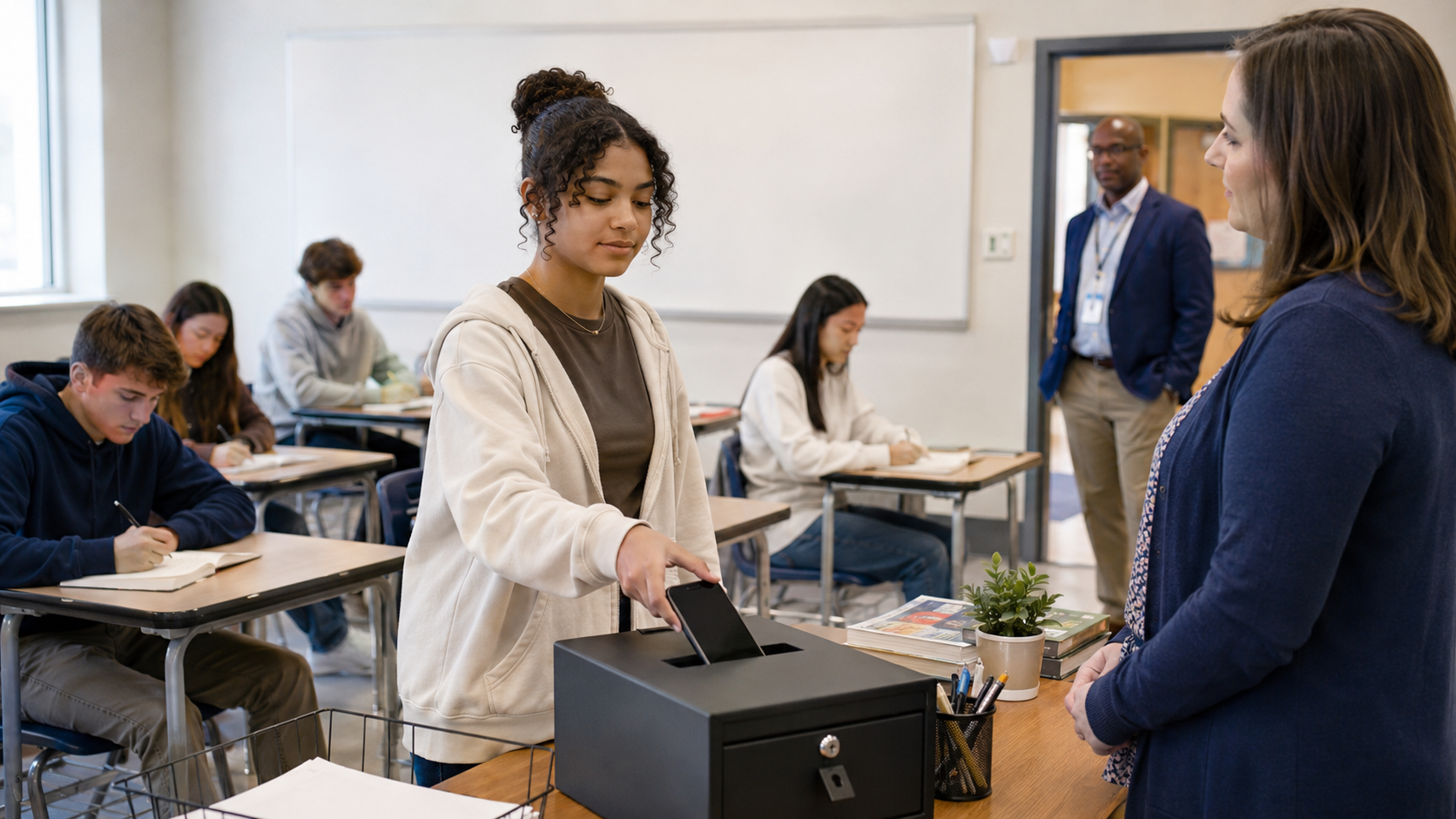
School cell phone bans become real the first time a student refuses to put a device away. Writing the policy and choosing a storage system are important, but neither answers the question facing a teacher in that moment: What happens next?
The response can determine whether the rule becomes a normal part of the school day or another recurring confrontation between students and adults.
Strong enforcement is not necessarily severe. It is predictable. Students know what is expected, adults respond in roughly the same way, and administrators step in before a disagreement over a phone consumes the class. Families understand when they will be contacted, how a confiscated device will be handled, and why refusing a staff direction is different from an initial violation.
That may sound straightforward. In practice, it is where many phone policies are tested.
When the rule meets resistance
Richmond Public Schools began enforcing its districtwide bell-to-bell policy in January 2025, several months before a Virginia law made smart-device restrictions mandatory. A Richmond school that adopted restrictions early is now looking back on the experience, offering other districts a view of what happens after the first announcements and objections have passed.
By April 2026, Richmond reported that 95.83% of its buildings were strictly enforcing the policy. The figure, included in a district implementation review, suggests that the rule had moved beyond policy language and into the daily operation of most schools.
Consistency matters because students quickly identify differences between adults. If one teacher allows phones between assignments, another confiscates them immediately, and a third avoids the issue, the rule becomes negotiable. The adults who follow it may appear unusually strict even when they are doing exactly what the district requires.
Consistency does not mean treating every incident the same. A first grader whose smartwatch rings and a high school student recording a fight have not committed equivalent violations. A phone vibrating inside a backpack may call for a reminder. A student repeatedly filming classmates in a restroom presents a different safety and privacy concern.
Districts have to define those differences before employees face them. They also need to settle the smaller questions students are likely to test. Does one earbud count as unauthorized use? What if a student checks the time on a smartwatch? Can a student retrieve a phone before leaving for an appointment? At what point does the teacher stop addressing the issue and call an administrator?
Richmond’s approach includes staff training on confiscation, device handling, documentation, family notification, de-escalation and conflict resolution. Its public guidance identifies the steps employees should follow when a device is collected and when a student refuses to surrender it.
That training matters. A policy designed to recover instructional time can easily consume it if every violation becomes a public argument. Once a student refuses a clear direction, teachers need a way to transfer the problem to an administrator while instruction continues.
A violation is not the same as defiance
The most workable policies distinguish among an initial violation, repeated unauthorized use, refusal to follow a staff direction and harmful conduct involving a device.
Richmond uses a tiered response. A first violation brings a verbal warning and documentation. A second may bring a written warning, family contact and temporary confiscation. Continued violations can lead to a restorative-room assignment or other disciplinary action. Misuse involving cheating, cyberbullying or illegal activity can move directly to a stronger response.
Salina Public Schools in Kansas has adopted a similar progression under the state’s new bell-to-bell law. According to the district’s family guidance, a phone found in a student’s possession is confiscated and returned after school. A second violation requires a parent or guardian to retrieve it. Additional violations—or refusing to give the phone to a staff member—can lead to consequences up to suspension for open defiance.
The wording is important. The possible suspension is connected to repeated noncompliance or refusal, not simply to the sight of a phone.
New York drew that distinction in state law. A student cannot be suspended solely for violating a district’s phone policy. New York City schools may use family conferences, classroom removal or confiscation as progressive interventions, but repeated refusal to surrender or store a device may result in suspension. The city’s guidance also prohibits schools from lowering a student’s grade because of a phone violation.
These policies are not identical, but they share an important principle: the purpose is to improve learning, not remove students from it. Suspension may become necessary when behavior escalates, but it should not be the routine mechanism that makes the ban function.
The first weeks of implementation are especially important. Students should be shown where phones go, how approved access works, and when devices may be retrieved. Staff should use the same short response when correcting an ordinary violation. A student reaching instinctively for a phone does not always need an office referral. The first direction can be calm and direct: the phone must be stored now.
The consequence changes when the behavior continues.
Confiscation can create a second problem
Taking a phone may end the immediate violation, but it creates a chain of responsibility for the school.
Richmond instructs employees to place a collected device in a secure classroom or office location and document the student’s name, date, time, device type, and reason for confiscation. The family is notified, and the return process depends on whether the incident is a first or repeated violation.
That record protects both the student and the employee. It matters when a device is reported missing, damaged or returned to the wrong person. It also allows administrators to determine whether a later incident is truly a second or third violation.
An unlocked desk drawer is not a confiscation system. Neither is moving phones among several adults without documenting who has them. Schools need to identify who may collect a device, where it will be secured, who records its return, and how ownership will be verified. The process must also account for early dismissals and claims of damage.
Kansas law states that schools and their employees are not liable for the damage or storage of personal devices brought to school. Districts elsewhere should not assume they have the same protection. Their procedures must reflect state law, insurance requirements, and any employee agreements governing responsibility for student property.
Requiring a caregiver to retrieve a phone can be an effective consequence, but it may also create an unequal burden. Some parents can leave work and reach the school quickly. Others cannot. Districts may need an alternative, such as secure overnight storage or return during a scheduled conference, so that the consequence does not depend on a family’s transportation or job flexibility.
Teachers need backup, not another mandate
Phone policies often weaken when the district’s expectations become an individual teacher’s daily burden.
A teacher may face dozens of small decisions: whether a device is visible, whether an earbud is connected to a personal phone, whether a student has an approved exception, and whether stopping the lesson will cause a larger disruption. If administrative support is slow or inconsistent, staff may decide that reporting violations is not worth the lost time.
School leaders should be visible during arrival, passing periods, lunch, and dismissal, when phone use is most likely. They should also establish a quick response when a student refuses a direction. Teachers should not have to choose between continuing the lesson and enforcing district policy.
The same guidance must reach substitute teachers, coaches, bus drivers, support staff and employees supervising field trips. New York City requires schools sharing a campus to coordinate their policies, reducing the possibility that students in the same building will encounter different rules.
Adult behavior matters, too. A phone-free expectation becomes harder to defend when employees regularly use personal devices in front of students for non-school purposes. Districts do not need identical rules for adults and children, but their professional expectations should support the reason the policy exists.
Exceptions and emergency access must work in real time
Medical, disability, language, and caregiving exceptions are necessary. Poorly designed exceptions, however, can create new enforcement problems.
A student who uses a phone to monitor blood glucose should not have to explain a medical condition whenever a different adult sees the device. A multilingual learner should not lose an approved translation tool because a substitute teacher was unaware of the plan. A student caregiver may need time-sensitive access without disclosing a private family situation to classmates.
Schools need a discreet way to verify authorization. That might be a notation in the student information system, a pass or direct notification to the employees who need to know. The record should identify when access is permitted and whom staff should contact with questions without revealing more information than necessary.
The approval process must also move quickly. If it takes weeks, students may be disciplined while documentation is still pending. Families should know before the school year who can approve an exception, what information is required and where questions should be directed.
Emergency access presents a different challenge. New York requires districts to provide at least one way for families to contact students during the day and permits device use during an emergency. Kansas does not provide a general emergency exception for personal phones. Salina directs families to call the school office and relies on its district communication platform for campuswide updates.
Either model depends on preparation. Families need the correct phone number and a realistic understanding of how quickly a message will reach a student. Schools need current emergency contacts, translation support and accessible phones students can use when necessary.
The procedure should also address lockdowns and evacuations. Students and families need to know whether stored phones remain in place, may be retrieved under staff direction or stay inaccessible while the district communicates through its emergency system. That decision should come from the safety plan—not from hundreds of students acting independently.
Families have a role in everyday enforcement as well. A text from a parent may feel different from a social media alert, but it still prompts the student to reach for the device. Schools should ask caregivers to use the approved communication route and stop expecting immediate replies during the school day.
Data can reveal whether enforcement is working
A phone policy may appear neutral while producing very different disciplinary outcomes across schools or student groups.
Beginning in September 2026, New York districts must publish annual reports containing non-identifiable demographic data on phone-policy discipline and an analysis of disparities. If statistically significant differences appear, the district must publish a plan to address them.
Other states may not require that level of reporting, but districts should still examine who is being disciplined, where violations occur and what consequences follow. First-time violations should be separated from repeated use and refusal. Confiscation, classroom removal and suspension should not be combined into one broad total. Mistaken referrals involving approved exceptions should also be reviewed.
The numbers need context. A school reporting very few violations may have excellent compliance—or inconsistent enforcement. A building with unusually high confiscation totals may need clearer routines or more administrative coverage in common areas. If one student group receives a disproportionate share of defiance referrals, leaders need to determine whether the problem is student behavior, adult discretion or both.
Early reports provide reasons for cautious optimism. Richmond has described better focus and engagement, along with fewer incidents involving bullying and hostile group chats. Spokane Public Schools reported that lunchtime behavior referrals fell 36% in 2024–25 and failure-to-cooperate cases declined by approximately 22%.
Those figures do not prove that phone restrictions alone caused the changes. Spokane introduced its policy alongside Engage IRL, an initiative connecting more students with clubs, sports and other in-person activities. That broader effort points to an important lesson: taking away the phone is only part of the work. Schools also need to rebuild the activities, relationships and routines that fill the space it occupied.
The goal is fewer confrontations
District leaders should review implementation after the opening weeks and again at the end of each quarter. Staff, students and families can identify the problems that policy language misses: delayed office messages, inconsistent enforcement, unclear exceptions, return lines at dismissal or too many referrals coming from one location.
Adjusting those procedures does not weaken the ban. It is how the ban becomes workable.
A large number of confiscations may show that adults are enforcing the rule, but it does not necessarily show that the policy is succeeding. Over time, success should look quieter: fewer reminders, fewer arguments, fewer devices collected and fewer students removed from instruction.
The strongest enforcement system is not the one that produces the harshest consequence. It is the one that makes the consequence less necessary.
Subscribe to edCircuit to stay up to date on all of our shows, podcasts, news, and thought leadership articles.