

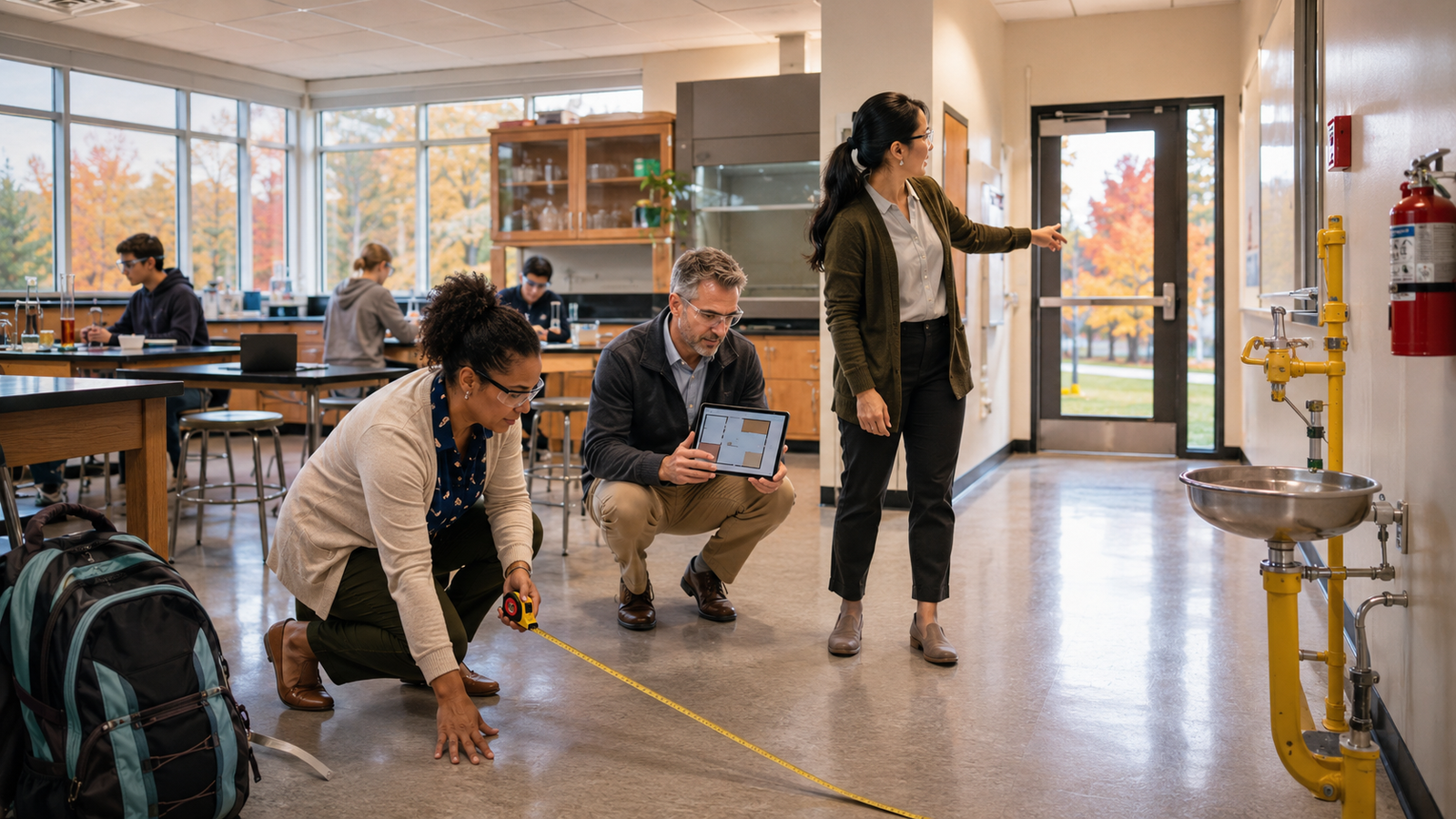
School duty of care is easy to discuss in August. Classrooms are organized, training has just been completed, and safety procedures are fresh in everyone’s mind.
By late October, school looks different.
An extra desk has been squeezed into a crowded classroom. Boxes are sitting near an exit until someone finds time to move them. A popular lab course has more students than expected. Staff members have adjusted procedures to keep up with the pace of the day.
That does not necessarily mean anyone has been careless. It means the opening-day plan has met the reality of an operating school.
October is an ideal time to look again. Schools have had several weeks to see where students gather, which transitions become congested, how classrooms are actually being used, and whether staff members can carry out safety procedures under everyday conditions.
The question is no longer whether the school was ready on opening day.
Is it still ready now?
When the Plan on Paper Meets the School Day
Duty of care generally refers to the responsibility to take reasonable precautions against foreseeable harm. The exact legal requirements vary by state and circumstance, but the everyday expectation is easier to understand: notice risks, respond appropriately, and do not leave known concerns unresolved.
That responsibility cannot rest on one teacher or one department. As edCircuit previously examined, school duty of care is a district-wide responsibility. Teachers may be the first to notice a concern, but department chairs, principals, facilities personnel, district administrators, and school boards all have a role in addressing it.
It also follows students beyond their assigned classrooms. Hallways, cafeterias, buses, athletic facilities, field trips, performances, and after-school programs all bring different supervision and safety challenges. Our earlier look at duty of care beyond the classroom showed why the less-structured parts of the day often deserve more attention.
By this point in the school year, those gaps are becoming visible.
A hallway supervision plan may assign an adult to the right location, but can that person see the corner where students regularly gather? An evacuation map may show a clear route, but is that path still open after the room has been rearranged? A safety procedure may have been covered during staff orientation, but do new employees know what to do without searching through a handbook?
Policies provide direction. Daily conditions reveal whether that direction is working.
Start With the Room
One of the most useful places to begin an October review is inside the classrooms and laboratories students use every day.
Schedules change after the year begins. Students transfer into courses, class sections are combined, and popular electives grow. At the same time, projects, equipment, storage containers, and additional furniture begin taking up space.
A room that worked well in August may feel very different with 30 students, 30 backpacks, and several weeks of accumulated materials.
In a traditional classroom, crowding can restrict movement and make supervision more difficult. In a science lab, makerspace, art room, or career and technical education space, the concern becomes more serious. Students may be working near chemicals, glassware, flames, tools, machinery, or hot surfaces. A few additional bodies can change how safely an activity can be conducted.
Science Safety provides a free Occupancy Load Calculator that teachers, department chairs, principals, and facilities teams can use as a starting point. Users enter the room’s dimensions or total floor area and select the appropriate occupant-load factor for the space. The calculator then provides an estimated occupant load based on NFPA guidelines.
That result should begin a conversation, not end one.
The calculator does not replace an evaluation by a local fire marshal, building official, or other authority having jurisdiction. Local codes, fixed equipment, room configuration, exits, and the way the space is used can all affect a final determination.
There is also an important difference between a room’s calculated occupant load and the number of students who can safely participate in a specific activity.
A classroom may fall within its occupancy limit and still be a poor setting for a complex laboratory investigation. Students conducting an experiment need room to work, move, respond to spills, reach safety equipment, and exit in an emergency. The teacher also needs a clear line of sight and enough space to intervene.
A capacity number should never be treated as automatic permission to fill a room to that number regardless of the activity.
As edCircuit previously reported in its examination of overcrowding and classroom safety, space affects more than comfort. It can influence supervision, movement, emergency response, and the teacher’s ability to manage foreseeable risks.
What Should Schools Look for Now?
A midsemester safety check does not require a new committee or a binder full of forms. Start by walking through the building while classes and activities are taking place.
Can everyone get out?
Do not rely only on the evacuation diagram. Look at the actual path students would take from their desks, lab stations, or work areas.
OSHA workplace standards require employee exit routes to remain free and unobstructed. The practical lesson for schools is clear: an emergency route is only useful when people can reach and move through it.
Look for furniture, equipment, backpacks, stored materials, and ongoing projects that could slow an evacuation. Pay particular attention to rooms that have been rearranged since the beginning of the year.
Can the teacher see what students are doing?
Adult presence and effective supervision are not always the same thing.
Tall equipment, storage cabinets, crowded workstations, and awkward room layouts can create blind spots. Noise and student movement can make those problems worse.
The issue is especially important in hands-on courses. Teachers need to recognize unsafe behavior early enough to prevent an incident, not simply respond after one occurs.
Can emergency equipment be reached immediately?
Eyewashes, safety showers, fire extinguishers, spill supplies, first-aid materials, emergency shutoffs, and communication devices should be visible and accessible.
Over time, temporary storage has a habit of becoming permanent. A cart parked “just for today” can remain in front of a shutoff for weeks.
Our coverage of school science lab fires showed how an incident lasting only seconds can disrupt instruction for days. Emergency preparation cannot depend on someone moving a box or locating a piece of equipment after the alarm sounds.
Do staff members remember the procedure?
Ask a few straightforward questions.
How would you report a safety concern? What would you do during a chemical spill? How would you account for a student who was outside the classroom when an emergency began? Who contacts the office, nurse, or emergency responders?
The U.S. Department of Education recommends that school emergency operations plans be reviewed regularly and supported by training and exercises. That review matters because a written procedure can feel very different when staff members must use it under pressure.
As edCircuit noted in its article on school lockdown duty of care, preparation depends on people understanding their responsibilities before an emergency occurs.
What have employees already noticed?
Teachers, custodians, aides, coaches, and support staff often see developing problems before they appear in an incident report.
They know which exit is regularly blocked, which hallway becomes difficult to manage, which class has outgrown its space, and which piece of equipment is unreliable.
Ask them.
More importantly, make sure they know where to report a concern and what follow-up to expect. Inviting feedback accomplishes little when reports disappear into an inbox.
Teachers Should Speak Up—And Leaders Must Respond
Teachers are closest to classroom conditions, but they should not be expected to solve scheduling, staffing, facility, or building-code concerns on their own.
When a teacher believes a room is overcrowded or an activity cannot be completed safely, the concern should be documented and shared through an established process. The occupancy calculator can support that discussion by providing a consistent starting point.
Department chairs can compare conditions across classrooms. Principals can review schedules, enrollment, and room assignments. Facilities personnel can examine exits, ventilation, emergency equipment, and physical layout. District leaders can determine whether the concern reflects a larger pattern.
This is not about finding someone to blame for a crowded room or a blocked pathway. It is about getting useful information to the people who have the authority to make a change.
Take a Second Look
By October 23, schools no longer need to guess how their safety plans will work. They have weeks of evidence.
They know which rooms are crowded. They know where students gather. They know which procedures are being followed and which ones have quietly drifted. They may also know about concerns that have been reported but not yet resolved.
Now is the time to use that information.
A short building walk, a conversation with staff, and an occupancy calculation will not answer every safety question. They can uncover the issue that everyone has learned to work around and that no one should continue ignoring.
Duty of care is not demonstrated by how carefully a plan was written before school opened. It is demonstrated by what a school does after real conditions show that the plan needs to change.
Subscribe to edCircuit to stay up to date on all of our shows, podcasts, news, and thought leadership articles.
Related reading
More on School Safety