edCircuit
  • Start Here
    • Login
    • Register
    • Subscribe
    • Submit a Press release
    • Advertise or Sponsor
    • Contribute
    • Get Interviewed
  • On The Wire
  • K-12 Education
    • All K-12
    • K-12 Teachers
    • Teaching Strategies
    • Special Education and IEPs
    • Dyslexia
    • Gifted and Advanced Learning
    • Early Childhood, Pre-K and Kindergarten
    • School Calendar
    • Tutoring and Homework Help
    • Attendance and Absenteeism
    • After-School Programs
    • School Counselors
    • Homeschooling
    • School Models
    • Teacher Retention
    • Parents
    • Students
  • Teaching and Learning
    • Literacy and Reading
    • Math Education
    • Civics and History Education
    • Financial Literacy
    • Assessment and Testing
    • Curriculum and Instruction
    • Personalized Learning
    • Project-Based Learning
    • Social-Emotional Learning
    • Executive Function
    • Creativity
    • Diversity, Equity, Inclusion
  • Professional Development
    • All Professional Development
    • Educators
    • Administrators
    • edLeaders
  • Higher Education
    • All Higher Education
    • College Admissions
    • Career and Technical Education (CTE)
    • Graduation
    • FAFSA and Financial Aid
    • Student Loans
  • Artificial Intelligence
  • Cybersecurity
  • School Safety
    • All School Safety
    • Science and Lab Safety
    • School Design and Facilities
    • Bullying
    • Duty of Care and School Liability
  • Continuing Education
    • All Continuing Education
    • Online Certificate Programs
    • Teaching Jobs and Careers
    • Teacher Appreciation
  • Education Policy and Government
    • All Education Policy
    • Department of Education
    • School Choice
    • Global
    • Advocates
  • EdTech
    • All EdTech
    • Online Learning
    • Hybrid and Remote Learning
    • Augmented and Virtual Reality
    • ESports
    • Gamification and Game-Based Learning
    • Digital Citizenship
    • EdTech Entrepreneurs
    • Market Trends
    • Future of Education
  • STEM and STEAM Education
  • Media
    • EDU Shows
    • EDU Podcasts
    • Education Industry Guides and Reports
  • About edCircuit
Saturday, October 17 2026 - Welcome
  • LOGIN
Home Tags Posts tagged with "EcoRise"
Tag:

EcoRise

Close photo of green grass
HiddenK-12

EcoRise’s 2016-17 Impact Report Shows Positive Education and Environmental Outcomes

by EdCircuit Staff October 18, 2017
written by EdCircuit Staff 4 minutes read

Highlighting successful student innovations

Report demonstrates EcoRise’s success in supporting student-driven sustainability solutions.

October 18, 2017

Austin, TX―EcoRise, the school-based non-profit curriculum organization inspiring a new generation of leaders to design a sustainable future for all, has released its 2016-17 Impact Report, which highlights some of the most successful student innovations supported by its program and provides statistics demonstrating the overall national impact of its work. The report demonstrates that 75 student projects were funded by more than $31,000 in EcoRise micro-grants; that student innovations created positive environmental outcomes, with significant water, waste, and energy savings; that seven in 10 students in EcoRise classrooms adopted new green habits; and much more.

“The results in this year’s EcoRise Impact Report demonstrate that student-driven sustainability solutions are already changing the world,” said Gina LaMotte, EcoRise founder and executive director. “When sustainability education is implemented as part of a standards-aligned curriculum and teachers receive ongoing professional learning opportunities, the sky is the limit for student innovation and achievement.”

The three major components of the EcoRise program are its standards-aligned STEM curriculum, the Student Innovation Fund, which provides micro-grants to students to support the implementation of their sustainability solutions, and teacher professional development. The Impact Report demonstrates significant achievements in each of these areas during the 2016-17 school year.

Standards-Aligned Curriculum

EcoRise has created and helps K-12 schools implement a STEM-based curriculum that challenges students to investigate local sustainability problems and invent real-world solutions. Through project-based activities, design labs, and campus eco-audits, teachers become equipped with the strategies and resources to catalyze student innovation. 90 percent of teachers report that EcoRise expands their teaching practice and 89 percent report that the program empowers them to be a more effective environmental educator. Teachers also report positive student outcomes:

  • 96 percent of teachers report that EcoRise fosters student eco-literacy.
  • 93 percent report that students’ 21st-century skills are improved.
  • 85 percent report that EcoRise creates a more authentic learning experience for their students.

Student Innovation Fund

After students conduct a campus-wide eco-audit and capture environmental data, they have the opportunity to apply for a micro-grant to implement their solution. This year, the Student Innovation Fund supported 75 projects with more than $31,000 in micro-grants. These projects directly engaged 53,374 students and helped districts save almost $67,000. The environmental impact of these 75 projects was immense:

  • abstract plant458,385 gallons of water were saved, the equivalent of filling more than 9,100 bathtubs.
  • 1,594,655 pounds of waste ―close to 40,000 full trash bags’ worth―was diverted.
  • 29,826-kilowatt hours of energy was conserved, which is enough to fully charge 2.5 million iPads®.

Teacher Professional Development

EcoRise delivers year-round online and face-to-face training to support and inspire ongoing success. Flexible resources and real-time support are two important factors in achieving lasting student growth and true campus sustainability. In 2016-17, 512 teachers at 253 schools participated in more than 2,100 hours of professional development. These teachers reach 23,000 students in their classrooms.

To build on the successes highlighted in 2016-17, EcoRise has announced plans to continue championing transformative K-12 sustainability education by scaling its impact tenfold by 2020, forging partnerships for global programming, expanding its Student Innovation Fund across the U.S., and building a network of teacher ambassadors. To download and view the full EcoRise 2016-17 Impact Report, which includes more data and examples of school success stories, visit this page. To learn more about the EcoRise mission, school-based program, and individual curriculum resources, visit ecorise.org.

About EcoRise

EcoRise develops the next generation of creative problem solvers by enlivening conventional classrooms with academically-aligned K-12 curriculum that introduce students to environmental literacy, social innovation and hands-on design skills. Green professionals serve as guest speakers and project mentors to help students solve real-world sustainability challenges concerning energy, water, waste, transportation, air quality, food and public spaces. The program focuses on enhancing STEM education, promoting sustainability, introducing students to green careers, and helping students develop 21st-century skills.

Further Reading

  1. Ventura County Star – Eco-tip: Local schools teach environmental lessons
  2. edCircuit – Six Teachers Honored as EcoRise Teacher Ambassadors
  3. The Austin Chronicle – Allan Rising

October 18, 2017 0 comments
0 FacebookTwitterPinterestLinkedinWhatsappCopy LinkEmail
An open hand holding a small Earth globe with a butterfly resting on top, bright green leaves softly blurred in the sunny background
K-12 TeachersHiddenTeacher AppreciationK-12

Six Teachers Honored as EcoRise Teacher Ambassadors

by EdCircuit Staff September 19, 2017
written by EdCircuit Staff 3 minutes read

Each educator has demonstrated leadership in teaching sustainability, design innovation, and social entrepreneurship

EcoRise Youth InnovationsSeptember 19, 2017

Austin, TX―EcoRise, the school-based curriculum organization inspiring a new generation of leaders to design a sustainable future for all, has announced the selection of six outstanding educators for its 2017-18 Teacher Ambassador Program. The new ambassadors are a diverse group of educators, teaching different subjects and grade levels, but each has demonstrated leadership in sustainability education. This group’s involvement in the ambassador program will run through August 2018, during which time they will benefit from several exclusive opportunities, including professional development training, priority access to new pilot programs and initiatives, and the chance to present at conferences on behalf of EcoRise.  

“Working closely with teachers who are not only skilled in teaching sustainability, but who can match their skill with an enduring passion for developing the next generation of problem solvers and leaders, is core to the mission of EcoRise,” said Gina LaMotte, Founder and Executive Director of EcoRise. “We are delighted to welcome our new class of Teacher Ambassadors, whose achievements in their classrooms have impressed and inspired the EcoRise team, and whose work over the next year will be a critical part of our continued progress toward a reality where sustainability, design innovation, and social entrepreneurship are recognized as essential elements in schools across the nation.”

Each Teacher Ambassador is an experienced EcoRise teacher who has demonstrated a strong interest in and commitment to the EcoRise mission and core values of being leading-edge, building camaraderie, embracing integrity, practicing resilience, and cultivating gratitude. The 2017-18 EcoRise Teacher Ambassadors are:

• Kate Hoffner―3rd-grade social studies and language arts teacher, Hill Elementary School, Austin, Tex.

• Denise Ortiz―11th and 12th grade AP environmental science and aquatic science teacher, New Braunfels High School, New Braunfels, Tex.

• Andrea Tole―6th-grade science teacher, Covington Middle School Fine Arts Academy, Austin, Tex.

• Dina Tucker―Sustainability Coordinator, 11th grade honors biology and AP environmental science teacher, St. Andrew’s Episcopal School, Austin, Tex.

• Ed Yoo―11th grade honors chemistry and 12th grade AP biology teacher, Codman Academy Charter Public School, Dorchester, Mass.

• Mary Ann Settlemyer―STEAM and Outdoor Education Specialist, Centreville Elementary School, Centreville, Va.

leaf and sunThe ambassadors will have their accomplishments highlighted across EcoRise digital platforms, including the EcoRise website, social media, and e-newsletters. Throughout their year in the program, they will have an important role in attending and presenting at conferences with the goal of recruiting and training new teachers to deliver sustainability education. They will provide valuable ongoing feedback to the EcoRise staff that will drive improvements to EcoRise’s curriculum and school-based program.

To learn more about the EcoRise mission, school-based program, and its impact on student success, visit ecorise.org.

About EcoRise

EcoRise develops the next generation of creative problem solvers by enlivening conventional classrooms with academically-aligned K-12 curriculum that introduce students to environmental literacy, social innovation and hands-on design skills.

Green professionals serve as guest speakers and project mentors to help students solve real-world sustainability challenges concerning energy, water, waste, transportation, air quality, food and public spaces. The program focuses on enhancing STEM education, promoting sustainability, introducing students to green careers, and helping students develop 21st-century skills.

Further Reading

  1. Forbes – School District Sustainability: Saving ‘Green’ By Going Green
  2. The Austin Chronicle – Allan Rising
  3. Ventura County Star – Eco-tip: Local schools teach environmental lessons

September 19, 2017 0 comments
0 FacebookTwitterPinterestLinkedinWhatsappCopy LinkEmail
A single soft white feather lying on a black background, fine wisps lit by gentle side light, close up
EducatorsK-12 TeachersProject-Based LearningCreativitySTEM and STEAM EducationK-12

Soft Skills Are Anything But Soft

by Dawn J. Mitchell July 27, 2017
written by Dawn J. Mitchell 10 minutes read

Four Ways to Provide Support for 21st Century Problem Solving Skills

boat wheel

Ms. Thomas, having recently participated in a project-based learning cohort created by Furman University’s Riley Institute in partnership with her local school district, left the professional development energized by the promise of student-driven, inquiry-based learning.  She held in her hands a fully developed, integrated unit plan she created including essential components of student choice, sustained inquiry, authentic products, and a real world audience.  She felt ready to inspire and engage her fourth-grade students in researching and designing solutions to shoreline erosion on South Carolina’s coast and Barrier Islands.  Effective Plan…Excited Teacher…Engaging STEM Challenge… project-based learning (PBL) Process…everything points to success, right?   

Well, Ms. Thomas, like the rest of the teachers in our cohort, believed strongly in the progressive-based teaching structures that put students in the driver’s seat.  However, when our students took the wheel, they struggled, not with the standards-driven content or the student choice and voice, but with the soft skills needed to collaborate and communicate and to apply critical thinking skills inherent in PBL. At our next PBL support group (a.k.a. graduate class meeting) when teachers shared where everyone was with their implementation, Ms. Thomas spoke for the group when she said, “You know I thought the hard part was the planning of our PBL unit. Nope. The struggle is real when you begin to implement it with students.”  Does this sound familiar? We realized in our discussions related to time management, agency, communicating, and especially collaboration that these soft skills were anything but soft.  

Each one of us represented in our PBL cohort all agreed whole-heartedly that we wanted the 4 C’s―Communication, Collaboration, Creativity, and Critical Thinking―to be part of the processes and products of our instruction because we know these soft skills are essential to student-driven instruction.  We are not alone in valuing these life skills that are hard to measure but necessary for success.  Research conducted all the way back in 1918 by Harvard University, the Carnegie Foundation and Stanford Research Center concluded that 85 percent of job success comes from having well-developed soft skills and people skills while a mere 15 percent of job success was attributed to technical skills and knowledge. So why are these skills still often underappreciated?

Our specific struggle was not in recognizing the value of soft skills, but in learning how to support their growth in our students.  After analyzing teacher self-assessments related to their implementation of project based learning as well as their written reflections, it was clear the majority of our cohort wanted and needed support with soft skills within our units of study.   We focused our inquiry and efforts on strategic support of soft skills within our PBL/STEM units of study.  Through our work, we identified four understandings that guide our instruction of soft skills.   

1.) Don’t Assume Soft Skills… Assess Where Students Are  

In the space between planning our PBL units of study and implementing them, we realized that we made a critical error.  We assumed students possessed the soft skills we embedded in the processes and the products of our problem and project-based units of study.  In our excitement to design compelling entry events and challenging driving questions, we assumed students were ready to utilize soft skills as tools for learning in the same way they could a tech device when given a QR code to a webmix.  While we began our units with pre-assessments of students’ content skills and provided structured choices to help guide their academic inquiry we did not assess where our students were with soft skills.  

While we believed in the progressive tenets of PBL and had whole-heartedly answered yes when asked, “Can our students do this?” we realized that we hadn’t asked the critical question: “Are our students ready for this?” In researching support for soft skills, we learned from the book Setting the Standard for Project-Based Learning and realized that we needed to begin our unit with this critical question. Taking time to assess students and/or having students self-assess can be helpful to determine if students are ready for the types and levels of soft skill applications you have designed for them within your units of study.  

We found the collaboration, critical friends, and teamwork rubrics provided by the Buck Institute for Education (BIE) and the agency rubrics provided by New Tech Network to be very helpful resources for not only assessing soft skills, but also for teaching them.  These rubrics provide concise, objective terminology that helped us to define clearly the soft skills we want to foster while also providing a continuum that allowed for growth.

2.) Don’t Assign Collaboration… Apply With Intentional Instruction

goal letters skyAfter we had assessed where students were with soft skills, we realized that in the same ways students had diverse experiences and strengths with the content, they also had different levels of capacity with project-based learning and/or other methods of student-driven, inquiry-based instruction.  We realized that while we had done a commendable job of assigning collaboration in our PBL units, we had not accounted for the direct instruction and the subsequent and ongoing support for these soft skills.  

Another book we learned from is Steven Zemelman’s From Inquiry to Action. We learned the importance of identifying the “Need to Knows” in our academic work, investing time and thought into considering what literacy skills students would need support in for their research and even what tech support they may need to create their final products. We had not taken the time to identify what soft skills students would need to know in order to be successful.  We realized that in order to teach students to work together effectively we needed to identify the skills that are part of effective, collaborative work.  

As we named these soft skills, we began to consider specific ways we could teach them explicitly and consistently.  Ms. Thomas identified the following collaborative skills students needed support with to be successful in her unit: active listening during the sharing of ideas, respect for others’ viewpoints, the art of compromise, and making decisions through a consensus process.  She decided she wanted to teach these skills through a workshop structure where she provided modeling and a demonstration in a mini-lesson, followed by students having time to practice in a short collaborative activity before applying in the context of their PBL unit.

A little later in the unit, Ms. Thomas knew she wanted students to provide each other with the opportunity to engage in critique and revision of their group work.  Instead of assigning the Critical Friends protocol she wanted students to use, she spent time teaching students how to give and receive feedback, which ensured students understood the procedures and saw the value in the process from the demonstration before they implemented it with efficacy.

3.) Don’t Impose Accountability– Foster Agreements

target acceptIn our own inquiry into effective soft skill support, specifically with agency and collaboration, we discovered two student driven strategies that promote both independent task and time management as well as effective collaboration:  group contracts and co-constructed rubrics.

In traditional models of instruction, the teacher typically defines the expectations for the product outcomes and/or processes, creates clear criteria and assigns scores based completion at the level on the continuum.  With project-based learning, instead of imposing this accountability on to students and expecting them to comply immediately, we wanted to provide students with the opportunity to apply what they were learning about collaboration through the creation of their own group contracts.

We learned that engaging in honest conversations with students about challenges that occur when working with a team, then providing support for how students can overcome them, helps inform what they include on group contracts and ensures students have ownership over them. (These ideas came from Setting the Standard for Project-Based Learning by Larmer, Mergendoller, and Boss)

Paul Curtis, Director of District Development at New Tech Network explains the benefits of student created group contracts in a blog post called Easing the Pain of Student Collaboration: “Whether you provide a template or let the students create one from scratch, the contract should reflect the best thinking of the team. It is important that the task of creating a team contract not feel like an arbitrary or perfunctory task. Rather, students should know that they are in charge of defining how their group will work together and they can agree to add whatever they feel is necessary to achieve success.”

Inspired by Paul’s suggestions in his blog post and by the examples and implementation video from New Tech’s website, we were able to teach students how to develop a plan to complete their project components, equitably dividing their tasks and agreeing upon some group norms.

We then applied this same process of co-constructing agreements to our culminating project assessments.  Having our expected standards-aligned course outcomes in mind from our unit planning, teachers created detailed project rubrics.  Instead of giving those to students, expecting them to understand what they hadn’t yet experienced or learned at the beginning of the unit, we worked to build understanding and foster ownership through co-constructing the project rubric with students.

This allowed us to agree upon set expectations of what students’ final projects must have, but also allow for student innovation and creativity by engaging in a conversation about what the project could have.  In the classes where teachers in our cohort implemented the co-constructed rubric, there was less confusion about the project expectations and increased understanding about where opportunities for student choice existed.

4.) Don’t Be Afraid of Approximations– Acknowledge Growth Takes Time

clockIn restructuring her project based learning unit to provide time and thought to teaching soft skills that she wanted students to apply, Ms. Thomas reflected at the end of the unit on students’ growth and shared that while they had made gains in both cooperative learning and agency, they weren’t “there yet.”  The biggest lesson we learned from our implementation of project based learning; specifically with soft skills is student independence and efficacy takes time.   We acknowledge this with our more process driven STEM skills such as engineering and design and our product skills such as informational writing and the creation of multi-media presentations.  When we applied this same gradual release of responsibility model to the teaching of soft skills, we allowed students to start where they were, accepting their approximations of the soft skills inherent in the unit knowing they would grow.

This approach aligns with what we know about the development of executive functioning.  As Suzie Boss and Jane Krauss write in Thinking Through Project-Based Learning, “Being able to set goals, manage time, check our impulses, and monitor our own actions are traits we often associate with high-functioning adults.  But we don’t develop them automatically.” We learned to support the development of soft skills through intentional practice with “mini PBL” projects such as a one-day STEM challenge or a one-week problem based learning opportunity that allowed for low stakes team-building activities to practice effective collaboration.

flowers growingWhen struggles arose, we learned to be transparent in our responses, letting them know it is acceptable and even expected to struggle with some components when working on a project.  We learned to model and to support the seeking of new solutions, the revision process of trying a new approach, and the reflective process of considering what we learned from the struggles.  

During our cohort, our teachers realized that while PBL planning was an important part of our professional development, the most valuable part came from the support teachers received during the implementation.  While the “struggle was real” with putting the PBL plan into practice with soft skill application, we realized that they were only “hard” because we did not teach them or support their growth as part of our unit.  Project-based learning provides students with opportunities to practice and develop these relevant skills that will serve them throughout their lives.

Further Reading

  1. TeachThought Podcast – Sustainability and Project-Based Learning
  2. edCircuit – Can Project Based Learning Move the Needle?
  3. Edutopia – PBL and STEAM Education: A Natural Fit
July 27, 2017 0 comments
0 FacebookTwitterPinterestLinkedinWhatsappCopy LinkEmail
Two business hands shaking in front of a split background, smokestack factory on one side and green forest on the other, soft daylight
edLeadersAdministratorsSTEM and STEAM EducationSchool Design and FacilitiesK-12

The Green Effect: Teaching Students To Build A Sustainable World

by Nik Kaestner May 16, 2017
written by Nik Kaestner 9 minutes read

Play video: CoffeED Nik Kaestner (8 minutes 30 seconds)8:30

CoffeED Nik Kaestner8 min 30 sedCircuit on Vimeo

A lasting Green impact is only possible if sustainability is fully integrated into the everyday activities of students

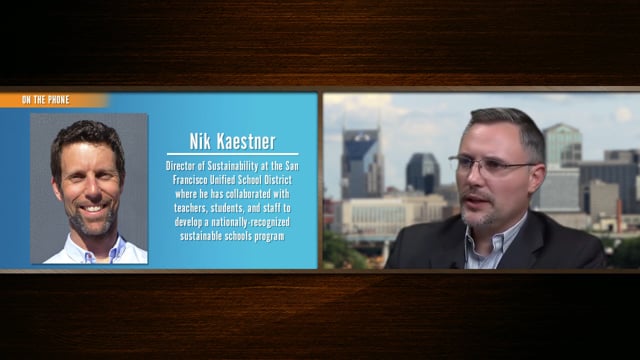
Continuing the much deserved focus on Earth Month, I reached out to Nik Kaestner, Director of Sustainability at San Francisco Unified School District. We had the opportunity to discuss the nationally recognized sustainability project he currently runs. In many respects, Kaestner is heading up a testing ground for environmental policies that will eventually make their way across the country. San Francisco has built a reputation for its environmentally friendly approach, but it takes leadership like Kaestner to make it succeed and become nationally influential.

Kaestner recognizes that schools have a unique platform to teach students both impactful and critical environmental decisions that will carry forward throughout a lifetime. Environmental choices made as adults have their cognitive and behavioral beginnings in early childhood. Students participating in sustainable schools have an additional opportunity to inform and influence parents of environmentally conscious activity. A lasting impact is only possible if sustainability is fully integrated into the everyday activities of students.

It all starts with adopting curriculum that that will integrate environmental sustainability. The new science standards make it easier to push forward environmental themes because context is now encouraged over rote memory. In order for mainstream national impact to take place, Kaestner sees a method similar to the California Energy and the Environment Initiatives. If a set of lesson plans with sustainable themes could be inserted into already established curricula then the approach could be maintained at the national level.

It’s becoming clear that education leaders are more positioned now than ever before to have a major impact in shaping our national environmental awareness.

Interview

Dr. Berger: It’s really compelling when we look at sustainability and we integrate that into the education equation. A lot of people think about San Francisco as being much more progressive than the majority of the country. From your perspective, where is San Francisco with regards to sustainability and how it ties in education?

Nik Kaestner: From a sustainability perspective, I think we would be on the progressive end of the spectrum. Our city has a lot of policies that are kind of first in the state. California is leading in many respects, so we think of ourselves as a testing ground for some of the environmental policies that will eventually make their way across the country.

In terms of education, it’s kind of a mixed bag. San Franciscois one of the best performing large school districts in the state, if not the best performing large school district.

But the problem is, we do have a disparity between our low-income and high-income students, and that’s something we’ve been working on for a long time. On the state level, we don’t have as much funding as some other states have on a per-student basis.

DB: Tell us where you think we can go when we look at the environment and integrating that into curriculum and the everyday practices within a school district. What can we learn from what you’re doing and how much further can we push the needle?

NK: I think the important aspect here is that schools have the opportunity to educate students who will eventually be making the same decisions that we’re trying to make today: Where should I get my power from? What kind of vehicle should I drive? Should I update my home or not?

For students to understand the ecological basis behind the sustainability principles is really critical if they’re going to respond to public education campaigns in the future.

Then students will go home and explain some of these concepts to their parents and encourage their parents to recycle, buy green energy, or switch to electric vehicles.

They have a lot of power now but, more importantly, they will be the consumers of the future; and the choices they make at that point are paramount.

DB: One of the things that is globally accepted in education is the slow adoption rate of the educators that have to implement new programs and technologies. That can be what holds us up from moving as quickly as we might like because of the nuances involved in supporting educators.

Are we doing a good job, and where can we improve in supporting teachers in classrooms who are building in environmental and ecological curriculum? How can we improve the everyday practice that students are experiencing so the adoption can speed up and it can be more second nature for both the educator and the district?

NK: That’s a very good question and I don’t think there’s a simple answer. Some of the ways we’re trying to do that include adopting a curriculum that will integrate environmental sustainability into everyday teaching practices and into the content that’s being taught to students. The new national science standards make that easier because the focus in not as much on rote memorization but on using context to teach science.

It’s also important to have outside partners like we have in Education Outside that provide outdoor educators who teach our students in the outdoor classrooms on a regular basis.

The other part is to turn new buildings into living laboratories. As we “green” our buildings, we shouldn’t just do it behind the scenes, but we should put plaques on the walls that explain the new efficient air-conditioning system or that explains the solar energy that’s being produced on the roof.

DB: Can we avoid what has happened to subjects that people may not consider core subjects? We’ve seen what has happened notoriously with arts in U.S. education.

Is there a way that we can integrate in the type of curriculum, the type of approach you’re talking about, so that it is mainstream, so that it’s not just seen at certain events or in certain districts but it’s something that, whether it’s in San Francisco or it’s in Des Moines, Iowa, it’s just a part of the fabric of our education. So we think sustainably about the next generation and what they’re going to do with the planet that they inhabit?

NK: On a national level, I think that would be quite difficult because the hallmark of the new science standards is flexibility and without some kind of a mandate requiring certain curricula to be included in science curriculum, each state is going to make its own decisions. I’m sure that each local entity will also color exactly what is taught in the schools.

A while back California required the energy and the environment initiative which provided a set of lesson plans that could easily be inserted in place of existing lessons. Teachers would teach the same concepts but they would allow an environmental issue to be the context within which that lesson was taught. If we had a similar set of lessons available on a national scale, we could make it easy for teachers who are motivated to include that kind of content, to essentially plug and play instead of having to create stuff on their own.

DB: Do you find that your position at the district is one that is unique or do you see others like you in districts around the U.S.? If so, is there a way to communicate and share best practices?

NK: When I started in 2008, I was probably one of the only sustainability directors in school districts although I’m sure I was not the first. But I just came back two weeks ago from a national conference, the Sustainability Leaders’ Summit that was put on by the U.S. Green Building Council, this time it was in Atlanta. There were about 50 or more practitioners from school districts all over the country. Some were sustainability directors. Some had other job titles but considered sustainability to be part of their scope of work. And they’ve been meeting regularly now for, at least, five or six years to share best practices and to do exactly what you’re talking about. So there is hope.

One of the interesting things I noticed about the conference, though, is that we did not have representatives from Seattle; Portland, or Los Angeles, even though I know there’s great sustainability work going on there. Hopefully, those cities will ramp it up and join the collaborative so that their ideas can be shared with other cities in the country.

DB: Tell me a little bit about your path. Did you start out knowing that this is what you wanted to do professionally? And what can we learn about the moral of your professional path and story so that we can ignite the flame in younger folks who are thinking about what they want to do post-college when they are looking at careers?

NK: I started as a high school science teacher. I had a passion for the environment. My parents used to take me to national parks in our little VW bus.

I ended up teaching science for several years and then I realized that the environment was really what I was interested in and I included some environmental concepts in my own teaching.

But when my wife went to grad school on the East Coast, when I moved up there I decided that was my opportunity to switch into the environmental field.

At that time, I learned everything on my own. Nowadays, there are a lot more programs and fellowships available that allow student from a variety of backgrounds to immerse themselves in environmental sustainability work either at a public agency or in a private company. I think that’s a great way to get started and get their feet wet, so to speak, in the process of doing actual sustainability work on a day-to-day basis.

DB: I think what you’re doing in San Francisco is fantastic and it’s, obviously, a beacon for many people to look out for as they’re trying to build out their sustainability departments in districts across the U.S.

  1. SF Beautiful – Interview – Nik Kaestner
  2. Center for Ecoliteracy – Ecoliteracy for All in San Francisco
  3. My Statesman – Group aims to mold next generation of environmentalists

Related reading

  • Spearheads of Sustainability in Schools
  • Empowering Students to Drive Sustainability District-Wide
May 16, 2017 0 comments
0 FacebookTwitterPinterestLinkedinWhatsappCopy LinkEmail
A crumpled paper globe balanced above an open hand against a dark green chalkboard with chalk drawings of airplanes, soft light
On the WireDiversity, Equity, Inclusion

Destination: Green Schools!

by Sarayu Adeni April 14, 2017
written by Sarayu Adeni 5 minutes read

Sustainability Partnership Between EcoRise and Southwest Airlines Takes Off Across America


by Sarayu Adeni

What if young students, leading corporations, and the communities around them united to reach the green future we all want? One small non-profit organization from Texas, EcoRise Youth Innovations, is soaring to new heights this spring with the support of Southwest Airlines. Here’s how they’re empowering a new generation of green leaders across the world.

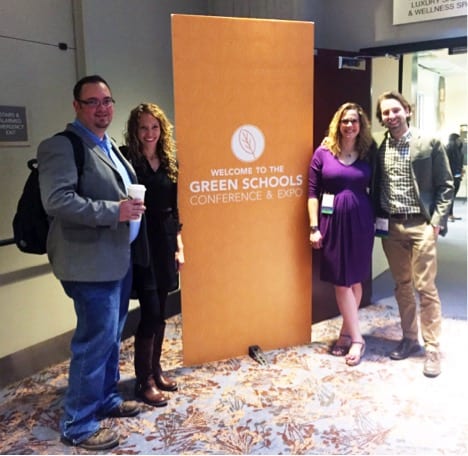
EcoRise participates in the 2017 Green Schools National Conference and Expo in Atlanta, Georgia. (left to right) Richard Kincaid (EcoRise Chief Innovation Officer), Darien Clary (Austin ISD Sustainability Manager), Tabitha Yeager (EcoRise Teacher Ambassador), Jon Stott (EcoRise Deputy Director) [PHOTO CREDIT: EcoRise)

Speaking in one of EcoRise’s five presentations was Tabitha Yeager, a Career and Technical Education teacher at Dighton Rehoboth Regional High School in Massachusetts. Her practical session on how to engage students in improving public spaces drew from her two years of success working with EcoRise.

“My students loved the opportunity to be outside, to be hands on, the ownership of the project to make their mark on the campus,” Yeager said of their campus garden project. “With a little bit of problem solving and brainstorming, we managed to make it something that everyone felt involved in.”

Yeager, an EcoRise Teacher Ambassador, was recently awarded $492,000 towards a campus Green Innovation Center by Massachusetts Governor Charlie Baker in recognition of her accomplishments.

Participating teachers were especially inspired to learn about building outside collaboration for students’ in-class work. “We left the presentation with a lot of great ideas we can implement,” said Meghan McCloskey, a teacher at Springdale Park Elementary, Atlanta Public Schools. But the presentation also appealed to broader audiences, including a number of green STEM professionals. “I loved the level of participant engagement,” said Rebecca Bryant, a LEED Accredited Professional at Water Shed Architects. “This was absolutely the best presentation of the conference.”

Other partners in the movement for a more sustainable world spoke up too – from success story-sharing by Codman Academy Charter School in Boston, MA to profile-raising on social platforms by MindRocket Media Group, to a policy making session with the Austin Independent School District.

EcoRiseEcoRise’s Deputy Director Jon Stott co-led a conference session with Darien Clary, Austin ISD’s Sustainability Manager. They offered do-it-yourself advice – and themselves as a joint case study – in building a wide-reaching sustainability strategy through cross-sector collaborations. EcoRise’s programs, they explained, address students’ and teachers’ engagement in forming and executing Austin ISD’s district-level green policies. When a group of kids conducting eco-audits call out as a problem on campus – be it poor recycling systems, inefficient water supply, food waste, or a lack of local biodiversity – Austin ISD officials and city leaders take note.

Step Three: Join hands across sectors for the long-term

Another session pointed out the relevant need for activating entrepreneurial sustainability in Career Technical Education (CTE). EcoRise’s Chief Innovation Officer Richard Kincaid, along with Ismail Ocasio, Manager of Curriculum and Workforce Development for CTE at NYC Department of Education, and Mark Swiger, CEO and Founder of ReGen Creative Strategies, spoke about groundbreaking work at the state, district and school levels.

Southwest Airlines’ support enabled EcoRise teachers, administrators, and program staff to come together in Atlanta to share best practices with a national audience. Like EcoRise, Southwest Airlines has pledged itself to redesigning for increased sustainability, in both air transportation and corporate social responsibility. With an established reputation in healthy business culture and improving community impact, Southwest has most notably converted its entire ground services fleet to electric vehicles, leads the industry in low-carbon renewable jet fuel usage, opened a LEED Silver Certified Training and Operational Support facility, and articulates the Southwest commitment to a triple-bottom-line approach through its corporate Environmental Policy.

Whether you’re a teacher, corporate leader, city planner, green professional, or an engaged citizen, support EcoRise in empowering a new generation of green leaders. After all, the next big plan to unite people, planet and profit could begin with one idea from a sustainability-savvy student asking: “What if?”

Further Reading

  1. The Red & Black – Green Building Rack Up Green Savings For UGA
  2. Education Week – Environmental Education at the Local, National, and Global Level
  3. Austin American Statesman – Group aims to mold next generation of environmentalists
April 14, 2017 1 comment
0 FacebookTwitterPinterestLinkedinWhatsappCopy LinkEmail
Green plant in clear glass cup
EdTech EntrepreneursHiddenK-12

Are Education Startups The New Dot Com?

by Rod Berger February 10, 2017
written by Rod Berger 9 minutes read

The growth of venture capital funding in the education market

By Dr. Berger

The amount of education startups is now increasing at an exponential rate. At the same time, the amount of venture funding for education businesses is at an all-time high. In some ways, the rise of education startups resembles the dot-com boom of the late 1990s, however, the successive crash of the dot-com craze may not be inevitable for the EdCo boom.

Even though many investors and VC firms are lining up with wallets in hand, there are a substantial number who have real-world experience in the education biz. By putting skin in the game, they are offering business acumen and support services that fledgling enterprises need in order to stay afloat and succeed.

The Education Investor

Namit Bhatia is an education investor in Atlanta. He is a Georgia Institute of Technology grad with further degrees from Georgia State University. Bhatia started in the technology field as an analyst, but had the entrepreneurial bug and lead a succession of successful technology startups before entering EdTech in 2011.

In addition to creating web and app based engagement platforms for many of the world’s education associations and school districts through Crescerance, his MAD Learn program is helping schools around the world to teach children application development. Bhatia is also an active investor in EdTech. He looks for key indicators when he invests, but says he invests in people, not companies.

“The first thing I ask is what is their vision for the company,” said Bhatia. “How will it help learners? What will their role be in the coming education landscape? Then I look at the passion of the individual. Why are they doing this? What lead them to make this decision? Next, I look at the team they have assembled. Does everyone share in their vision? If everything adds up on the personal side, we do a market analysis including the competitive landscape and what it will take to bring it to market.  If the need is there, and they have a good grasp on the future of education, we can generally figure out the rest. Education is a very long-term business.

The buying cycle is extremely long, and you need to know the intricacies of the education buyer. Sometimes it takes five years just to gain traction. Return on investment can take even longer. The founder having sufficient grit and resilience to live and continue to learn through this period of limited success is what makes or breaks education technology companies. Sniffing out this grit in the founder through his or her passion is a paramount investment criteria all EdTech investors look for.”

From Startup To Success

Michael Toth is the founder and CEO of Learning Sciences International, iObservation, and the Learning Sciences Marzano Center for Teacher and Leader Evaluation. Learning Sciences International is one of the most influential publishers in the education space.

In addition, they work with school districts to create a culture of rigorous instruction focused on successful classroom learning, affirmed through human-centered research, metrics, and programs that revitalize classroom instruction and student learning. Toth is successful by anyone’s standards, but began as an Ed startup. He remembers the early days, and what he was thinking when he decided to launch his company.

“I was a grant director around research and development of technologies to enhance professional development and to transfer learning and practice,” Toth said.

“The university started a small business incubator encouraging faculty to start a business and we spun out a small group of our R and D team. We had a few contracts to help us do that and we were well positioned, the Pennsylvania Department of Education had a need for an online platform to deliver professional development for teacher certification to meet a new requirement. So we got our start as the statewide provider for that system using our core competencies of technology and professional development.”

You have to have a core competency and there has to be a market need. Identifying a market need is the hardest thing for an entrepreneur. You may have a great idea, but you need to get to know the education space, talking with educators, and attempting to figure out what their struggle is. Then you can bring your skill set to come up with a solution, and to gauge whether other people will want that solution.

K-12 public education is highly regulated, so it doesn’t function under normal market conditions. You need to understand the regulatory space; there’s a high threshold of domain knowledge to break into it. But it’s a place where you can really do good work. Any entrepreneur coming into this space must have a passion for helping kids. If you have only a passion for revenue, it probably won’t play out very well.

The situation at the university was changing. We were kind of working for ourselves anyway, but it was a lot more risk to be on the private sector side. We were very mission-oriented. I’m not sure there is a bigger gamble than launching a startup. But there is a point when you just have to do it. You’ll work harder than you ever thought possible. It is consuming. But you have to align what you are passionate about with your core competency, and find a solution for a market need. If you can make that alignment between passion, competency, and solutions, the time is right any time.”

EdCo Up-And-Commers

EcoRise Youth Innovations is a newer EdCo startup that is now gaining significant traction. Gina LaMotte is their CEO and Founder. She is a social entrepreneur who is passionate about unlocking the power and potential of young people as leaders, innovators and visionaries. To say she started her company on a wing and a prayer is a slight exaggeration. It took her eight months to afford the wing.

Prior to EcoRise, LaMotte spent ten years working with innovative educational programs serving youth in Brazil, India, Nepal and Guatemala, as well as Harlem, New York, and Taos, New Mexico. In 2004, she moved to Austin, Texas and pioneered a robust summer and after-school program at a Title One middle school. She also built and led a youth cultural exchange program to Rio de Janeiro, Brazil, and served as a facilitator and counselor at the Global Youth Peace Summit.

While in graduate school at the University of Texas at Austin, LaMotte studied sustainable development and social entrepreneurship. She had the chops for the business, but taking off was a challenge. “I had spent months vetting the idea of EcoRise with hundreds of stakeholders, from students to school administrators, to business and sustainability leaders,” said LaMotte. “I would hold “venture launch meetings” with 20-30 community members in a public library. There was absolutely no security or assurance that the business was going to work, but there was a clear need and enthusiasm in the community – and my own drive to give it a shot.”

LaMotte continued “We didn’t receive any funding until eight months after we’d launched our program. At that point, we were basically running on the fumes of passion and hundreds of volunteer hours. Receiving our first grant was like being handed a tall glass of water after miles of running in the hot sun. It felt like a godsend, a nourishing relief.”

What Do The Buyers Think?

Ann Clark is superintendent of Charlotte-Mecklenburg Schools, a particularly large school district of more than 145,000 students. Clark brings a deep institutional knowledge to her role as superintendent of Charlotte-Mecklenburg Schools. As the district chief decision-maker, she is often faced with large purchasing decisions for technology or curriculum – many are from young, innovative companies that offer a seemingly better solution to the school system’s challenges. Clark views the question of doing business with technology companies with a careful lens. “It’s not just a question of having a better mousetrap. Buying new technology or curriculum on a district-wide basis is only a piece of the puzzle,” said Clark.

“Implementation is where the rubber meets the road. Is the company going to remain solvent for the next five to 10 years while we are using their product? What type of support do they offer? Is professional development needed? Do they understand our challenges? Does the new product replace an existing product, or is it something that will take additional time and resources from our educators? And most importantly, will the company be a true partnership with our district?

Companies don’t really compete on price, or at least not only on price. They compete on reputation and the ability to understand the value we place on a partnership. If they are introducing a totally new product, they may be competing for the limited time in our school day. There is a lot at stake for us when we make a district-wide decision.”

Boom Or Bust?

With thousands of new EdCo startups and tens of billions freely flowing into their coffers, it seems like the EdCo boom may have nowhere to go but bust. But education is on the cusp of some very profound changes. K-12 is in the midst of a technology revolution. True personalized learning, served up in a competency model with interactive features and virtual reality formats are offering our students learning opportunities that were unheard of five years ago.

Higher Education is experiencing its own disruption. With a reorganization of the way higher education is perceived, purchased and delivered, it will demand a fortune in new products and services as well. As is, education is a trillion-dollar industry. With all the changes, a few tens of billions in new swag may be just about right.

Check out education news makers, like Sir Ken Robinson, who are changing our perspective on education. Education thought leadership and immigration politics with Lincoln’s Dr. Steve Joel.

• This post was originally published on Forbes.

Further Reading

  1. The New York Times – After Belt Tightening, Venture Capitalists See More Promise in 2017
  2. Bloomberg – Who Gets Venture Capital Funding?
  3. The Boston Globe – MIT launches venture capital fund


February 10, 2017 2 comments
0 FacebookTwitterPinterestLinkedinWhatsappCopy LinkEmail

Participate

  • Contribute
  • Sponsor
  • Submit Release
  • Subscribe
  • Get Interviewed

We value your privacy

We use cookies to enhance your browsing experience, serve personalized ads or content, and analyze our traffic. By clicking "Accept All", you consent to our use of cookies.

Customize
  • Needed for the site to work: signing in, the cart, your consent choice. Always on.

    8 cookies
    • ss_consent 1 yearYour cookie choice on this site, so you are not asked again.
    • wordpress_logged_in_* 2 days, or 14 days with "remember me"Keeps you signed in as you move between pages.
    • wordpress_sec_* 2 days, or 14 days with "remember me"The secure half of your sign-in.
    • wordpress_test_cookie SessionChecks that your browser accepts cookies when you sign in.
    • wp-settings-* 1 yearYour display settings when signed in.
    • wp_woocommerce_session_* 2 daysYour shopping session: the cart and the checkout.
    • woocommerce_cart_hash SessionTells the site whether your cart has changed.
    • woocommerce_items_in_cart SessionWhether your cart holds anything.
  • Remembers choices you make, such as a language or a region, and supports features like live chat.

    1 cookie
    • woocommerce_recently_viewed SessionThe products you looked at, so the site can show them again.
  • Helps us understand how visitors use the site: which pages are read, and for how long.

    2 cookies
    • _ga 2 yearsGoogle Analytics: tells one visitor from another. Set only after you allow analytics.
    • _ga_* 2 yearsGoogle Analytics: keeps your session state. Set only after you allow analytics.
  • Measures how fast pages load so we can make them faster.

  • Used to show you content and offers that match your interests, on this site and elsewhere.

    1 cookie
    • sbjs_* SessionWooCommerce order attribution: where you came from, so a purchase can be credited to the campaign or site that sent you.

Your browser asks us not to sell or share your information (Global Privacy Control), so advertising cookies stay off.

Do not sell or share my personal information

Some cookies from other companies help show you offers on other sites. Tick the box and save your preference to opt out of that sharing; untick it to opt back in at any time.

Your browser sends Global Privacy Control, so this preference is set for you and cannot be changed here.

Sign In

Keep me signed in until I sign out

Forgot your password?

Password Recovery

A new password will be emailed to you.

Have received a new password? Login here

Shopping Cart

Close

No products in the cart.

Close
-
00:00
00:00

Queue

Update Required Flash plugin
-
00:00
00:00

Your cart (items: 0)

Products in cart

Product Details Total
Subtotal $0.00
Shipping and discounts calculated at checkout.
View cart
Go to checkout

Your shopping cart is empty

Return to shop

Notifications