During the late 1600s, several physicists were working on understanding and defining motion and forces. The concept of universal gravitation had not arisen yet – smaller bodies falling toward Earth were considered to be under the influence of a different kind of force compared to the interaction between planetary bodies.
Newton who had been experimenting with motion initially hypothesized that two bodies of different mass attached to a pendulum would have a different number of oscillations in the same time period. But when he actually ran the experiment with different materials like gold, lead or glass he
always got the same number of oscillations.
That’s when it hit him that this situation is similar to how planets revolve around the sun.
As Westfall writes, “Then he realized that an analogous experiment was being carried out constantly in the heavens. If the planets obey Kepler’s third law, the sun must attract them in exact proportion to their quantities of matter.” Discovering this analogical connection eventually paved the way for the theory of universal gravitation.
Scientific Discovery
Analogical reasoning is at the root of many scientific discoveries. For instance, early geneticists compared genes to beads on a string which helped them understand how traits are passed along. While this simple analogy couldn’t explain everything, it did suggest possible mechanisms for inherited traits.
Making analogies is important not just in science, but is fundamental to cognition and creativity, and applicable in almost every field be it mathematics or literature. As scientists explain, “The recall of memories based on current impressions, the understanding of a new situation in terms of a familiar one, the creation of abstract concepts, or the ability to learn from quite restricted sets of examples are most likely based on analogy-making. Especially, analogical reasoning allows for the introduction of new ideas into a domain and thereby provides an explanation of human creativity.”
So what exactly does analogical reasoning involve?
Underlying analogical thinking are three mental processes –
- Retrieval (with a current topic in working memory, a person may be reminded of an analogous situation in long-term memory)
- Mapping (aligning the two situations on the relational structure and projecting inferences)
- Evaluation (judging the analogy and inferences)
Viewed from this lens, analogies can be thought of as extended metaphors. A key part of analogies is to create deeper structural alignment between two concepts so that meaningful predictions can be made after the mapping phase.
Analogical Reasoning & Literature
While rudimentary analogical thinking develops as early as 3 years of age, research shows that elementary students need more structured guidance in making relational comparisons. One approach to help students develop this ability comes from a writing technique that Leo Tolstoy accidentally hit upon.
In the early 1860s, when Tolstoy was teaching writing to children of Russian peasants, he decided to bring more creativity into the exercise. He asked his students to write a story on the proverb, “He eats with your spoon and then puts your eyes out with the handle.”
After some initial hesitation, his students approached the challenge with unexpected enthusiasm and produced a much better composition than the one Tolstoy had himself written. Tolstoy commented on the quality of his students’ work in an article with, “Every unprejudiced man with any feeling for art and nationality, on reading this first page written by me, and the following pages of the story written by the scholars themselves, will distinguish this page from all the others, like a fly in milk, it is so artificial, so false, and written in such a wretched style.”
Tapping into motivations
While Tolstoy was simply trying to motivate his students to write with more vigor and authenticity, he accidentally introduced his students to analogical reasoning. To do this exercise, his students had to first abstract the meaning of the proverb, or find the relational structure of the proverb, and then construct a story around it in a way that the relational mapping is maintained.
So for your next writing assignment for students, consider using Tolstoy’s technique to spice things up. Not only will it lead to more creative ideas, it will also strengthen the underlying cognitive skill of analogical reasoning!
.Further Reading
- edCircuit – Articles by Dr. Pronita Mehrotra
- Scholastic – Abstract Thinking Skills in Kindergarten
- Nat’l Assoc for Gifted Children – Developing creative thinking skills through art

 There is a myth that surrounds the gifted child. That they are super smart, that they can figure out anything, that they have all the answers. The problem with these representations is that giftedness becomes like a gimmick, so when we are faced with a real gifted child, we expect them to do unrealistic, amazing things like some sort of parlor trick.
  Many gifted children are more mature than other kids their age. That does not mean though they are ready to have mature conversations that children a few years older than them are having. Emotionally they are still the age on their birth certificate. They might be able to talk about quantum physics but still throw a fit when things do not go their way. No matter how smart they appear to be, it is important not to forget they are children.
  Those who have taught gifted children for any amount of time recognize that some of their students have certain quirks. This could be such things as a lack of social awareness, a tendency toward perfectionism, becoming stressed about seemingly small things, worrying about problems halfway across the globe, or the overexcitabilities talked about in chapter 1. If you are going to teach gifted children, it just becomes standard practice that you learn to accept these quirks as a part of doing business. These quirks can sometimes make a child stand out from the rest of the class, especially if she is in a regular education classroom. These quirks become more the norm in a program will all gifted children because more children have them, so it does not stand out so much.
 Like their colleagues, both Lance and Sam have used programs and apps like
 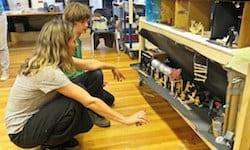 Sam adds, “There was a focus for technology in the classroom, but we learned that with the tools we needed better ways to give the kids the personalized learning they needed. We were concerned with finding those moments of time to use that device as a way to move student learning forward and not sticking the kid on the device for an hour and calling that ‘class time.’” Sam says the solution was to trust the teachers. The idea is to give them ample professional development and technology to help them move the needle and then let the teachers make the decisions about students on an individual basis in a classroom devoted to personalized learning.

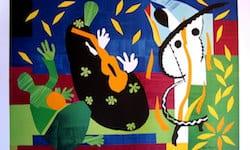 Through the years, I often heard the call of the paints, brushes, and canvases. I wanted to express myself, but I criticized my self-expression before it was even a pencil sketch. “You can’t paint that. You can’t think that. You can’t feel that. You can’t. You can’t.
  I think one of the biggest obstacles as educators and parents is getting over the idea that taking care of ourselves is in some way selfish. It’s not. Giving our souls time and space to
 Gabriel Carrillo has been listening to podcasts for a long time. Between comedy, sports, professional development, and food podcasts, he’s a fan of diverse subjects and genres. But as an educator as well as an edtech specialist and guru, he’s always found consistently good and knowledgeable podcasts about education technology to be few and far between. After pondering his options for far too long, with his wife’s encouragement, he decided to plunge into the world of podcasting. But, his wife first asked the all-important question: “What’s different about you? What’s YOUR spin?”
 Gabriel will be talking about the steps and strategies he used to build a successful podcast, among other topics, in his presentations at the 2019
 Even though those are also “what” questions, notice that they require thinking. Once students have correctly guessed the location of the partner classroom, do additional research, focusing on making connections to each student’s life. Then, ask students to create a web showing the connections they have with the other location. For example, you may have a student who has visited the partner location, or one who saw a kangaroo in a whale (which connects to the classroom in Australia). Share with the partner classroom and have those students add to the web.
  Vicki also uses maps with her students in a different ways. Students can take Google Maps and identify points on a map, such as Napoleon’s March. They can also create their own maps with 360 degree cameras. For example, if you are teaching the Civil War, and your school is located near a historic battlefield, students can visit the landmark, take their own videos and either embed the views in google maps, or they can identify and video what they consider to be the most important part of the battle. As a part of the final product, students justify why their location is most important, and provide appropriate links to other resources that support their position. As Vicki points out, creating maps not only requires students to show an understanding of content and technology, it “uses computation and sequential thinking which pushes you higher.”