
Universal Design for Learning (UDL) truly supports personalized learning

by Martin McKay
Personalized learning has been a much-discussed topic in education for the last few years. The term is everywhere. And it’s very persuasive. It hopes to address learner variability and to make education more accessible for different learners. But, there’s nothing new about personalized learning, either as an aspiration or a practice. It’s an approach that’s as old as the hills.
Understanding Universal Design for Learning
Over the last couple of years, it has become well recognized by US educators that Universal Design for Learning (UDL) is the perfect pedagogical approach that truly supports the idea of personalized learning.
“Universal Design for Learning (UDL) is a framework to improve and optimize teaching and learning for all people based on scientific insights into how humans learn.”
www.cast.org
You can determine each learner’s needs by using the principles of UDL to understand their strengths, challenges, aptitudes, interests, talents, and aspirations. UDL has often been connected to special educational needs, but it is a framework that applies to ALL learners who have variability in their learning. UDL helps teachers understand all the learners in their classroom. Every student brings something different and has different strengths.
New Tools for Variability
 As UDL tells us, when we are designing for student variability, it is important to provide students with a few ways to demonstrate their knowledge and keep the lesson or content interesting for everyone. New technologies have revolutionized how students learn and allow for that multiple means of expression. Portable, personal laptops like Chromebooks or Surface Pros with stylus and touch interfaces, great computing power, and cloud connectivity make it possible to tailor learning to personal interests and needs, even allowing for 1:1 initiatives where each student has their own device to support their learning.
In the past few years, students can now turn in homework that includes photos, video, audio, animations, interactive graphics, smart maps, and presentations.
Having and using technology in teaching and learning isn’t enough though. Making the most of technology requires a methodical and principled approach, one that turns the aspirations of personalized learning into an effective practice of personalized learning. Universal Design for Learning makes that practice possible.
Strategies to Address Learner Variability
 Providing the tools, diverse activities and scaffolded content to meet each learner’s unique needs can feel daunting. It’s important to start small with one new practice or strategy and then build on that. There are a number of tools that teachers can explore that can help to address learner variability. Here are just a couple of examples:
- Collaborate – Some days we work better together. Get students to work together on Google Slides or Microsoft PowerPoint. Maybe one works on content, and one on design if that is where their strengths lie.
- Sketchnoting – Some students can adopt visual note-taking to support information recall and build understanding. The new stylus and touch devices are great for this.
- Overcoming Shyness – Use the comments stream inside Google Docs or Word to converse with shy students privately.
- Audio recording – Kids can practice and demonstrate oral reading fluency by attaching an audio recording to a turned in homework.
- Text-to-Speech -Some students may feel more comfortable hearing passages of text read aloud
Meeting Students Where They Are
 Personalizing instruction and the use of technology in the classroom does not mean there is less of a place for teacher-led instruction. It also doesn’t mean that teachers need to spend endless time after school each day creating an individualized lesson for each and every student in the class. It’s all about meeting students in the spaces where they are and helping them grow by providing diverse ways for them to engage in learning, process content, and show their understanding.
Every child’s different, with their own star qualities, strengths, challenges and learning styles. Their needs are vast, and there are a multitude of ways teachers can meet those needs effectively in class as well as for independent study and learning at home.
Want to Learn More?
Listen to Martin McKay CTO and founder of Texthelp along with special guest Kathleen McClaskey, founder of Make Learning Personal; co-founder of Personalize Learning, LLC; co-author of Make Learning Personal and How to Personalize Learning in a pre-recorded session on How to Personalize Learning and Maximize Achievement for All Students.
Author Martin McKay founded Texthelp in 1996 to help people with communication difficulties. What started as a company focused on people with profound Speech and Dexterity Disabilities has become a world-leading Education Technology company providing easy-to-use and useful software tools that help everyone read, write, and communicate with clarity in education, at work and in life.
Over that time he has built, led and directed a team of engineers to deliver technology that is used by millions of people every day around the world. He regards himself as incredibly fortunate to work in a sector that has such a positive impact on society using technologies that are so fun and compelling with work with. Martin is currently serving in an advisory capacity on the Universal Design for Learning council in the US.
Most importantly of all, Martin and Texthelp believe that everyone’s entitled to the best possible learning and language support on their own personal journey – from literacy to life.
Follow Martin on Twitter.
Further Reading
- Andover Townsman – First half of school year marked by innovation, teamwork
- EdSurge – Where Does Personalized Learning End and Special Education Begin?
- PRWeb – Learnosity Welcomes Desmos, TextHelp, and GeoGebra to its Global Partner Network

 It’s true that many at-risk students struggle to meet academic expectations, but it’s lesser known that external factors – such as discipline issues, structure at home and socioeconomic status – are often at the root of this issue. To address this gap, many schools leverage funding programs such as Title I Part A, which provide more attention to at-risk learners and are designed to keep students from falling behind.
  Within the Howe school district, a bus ride can last almost an hour or more. Since many students lack Wi-Fi access at home, connected school buses offer the opportunity to learn, study and complete homework while on the bus – all thanks to Internet access. Howe implemented Wi-Fi and GPS enabled busses, increasing equal access to education, and a better use of student time. In addition, connected buses, especially with video, improve student safety and well-being.
 A public funding partner can be especially useful here in identifying smart and unforeseen ways to utilize Title I Part A funding. For example, within the first step, it’s crucial not to leave dollars on the table, or to continue prior habits – school districts often look to past years for inspiration, and can overlook new types of technology.
 Some of the benefits we’ve seen when it comes to innovative Title I Part A funding include access to online college courses, “office hours” with teachers, mentoring with advanced students and dual-enrollment. To make this happen, school districts must begin to understand their needs, their funding options and how Title I Part A funding aligns with their challenges.
 Feedback and data over the past few years have indicated that teachers are tired of going to professional development sessions where they’re receiving repeat trainings on something they already know, or where they feel the content being delivered is far beyond their current level of understanding. For example, one middle school teacher said, “I would like professional development to be customized and personalized to what I teach … direct examples of how to embed technology into my lesson to maximize learning in my classroom.” Another said, “I want somebody right beside me to hold my hand. Because it just gives you confidence.” Many of their experiences have perpetuated a distaste of technology professional development, leading to low levels of teacher self-efficacy when
 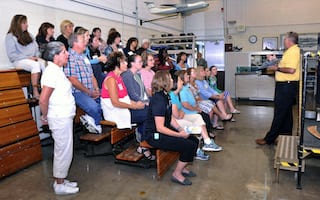 When I’m planning to deliver support in specific topics, it’s critical that I meet the teachers where they are. To do this, my paradigm and core beliefs about adult learning have to align with what teachers in my trainings tell me. My professional development focus this year is training teachers to integrate
  It was obvious to me that it was grossly inappropriate to design one session and expect it to fit the needs of every adult learner who would encounter it. Before going into a session to work with teachers, I would ask them to self-assess what they thought their current level of ability was with regard to a topic for technology integration in their classrooms.
 This kind of mastery grouping was critical for two reasons. First, teachers had the control to determine which session was right for them. This accountability and ownership of their learning seemed to make the time more valuable to them. Second, I was able to begin a professional learning design that targeted those three groups and would gradually increase the current level of skill for all teachers — regardless of the group they associated with — in a way that was developmentally appropriate based on how they gauged their understanding.
 In the midst of this critical conversation, something magical happened. Through this communication, I worked with teachers to establish whether training occurred in small groups, with individuals paired with their own technology coach, or within breakout sessions of different topics based on ability and interest. It is from this point in the training that we (digital learning facilitators) worked to deliver the content teachers had specifically asked for in the way they requested for us to teach it.
 The change you see isn’t in what we need as learners. The change becomes how we have to begin self-managing those needs as adults and be able to recognize what we need to be successful. It has been my complete honor to begin a journey in helping teachers realize these things about themselves, establish what they need to be better learners, and inspire them to embrace opportunities for growth. It hasn’t been easy, but it has been worthwhile and meaningful. Why, you might say? Because when a teacher tells you, their mentor or coach, that you have changed their life, it does nothing short of change yours.
 Dr. Karri Adams serves as a Digital Learning Facilitator for
 Hired as a teacher in the
  But the parents are of key importance. “I keep telling them, ‘Think of it as a triangle ─ student, school, home,’” he says. “If the home piece is not strong and they are not part of the process, you’re going to see me calling them more frequently.” Rafael and his team at Grapevine Elementary are finding the balance between the technology, the support for that technology, and what the technology can do in the classroom as the change agent in student learning. “You have to find that balance,” Rafael says. “And, of course, informing our parents about those programs because for them to be successful, all those programs have to have that continuity at home.”
 Rafael Olavide was born in Madrid, Spain, he moved to the United States in 1993, where he started working in education as a bilingual aide in the classroom while attending school at the

 Recently, school dances have become a thing of the past. Why is that so? Part of it has to do with lack of student interest in actually interacting with others outside of a screen, an issue that needs to be fixed regardless, or we will all be walking around like zombies with no communication skills. Another reason is that teachers and administrators do not want to plan school dances because in the past they have been a lot of work. Finally, with greater parent involvement, schools have come under fire for disciplining students who do not abide by school rules for behavior at these types of events. The combination of decreased student interest, difficulty planning, and greater risks for behavioral challenges, it would seem that the era of the school dance is dying. But, should this continue?
 Bringing dances back to life requires a change to how they are run. Currently, dance planning is stuck in the stone age of binders with past information, cash boxes, selling tickets at lunch, and paper permission slips. Neither students nor parents operate like that anymore. Being on their phones for several hours a day, students want to purchase tickets online, and parents want to receive forms to sign via email.
  Fundraising money from dance ticket sales getting lost or stolen
 Suicide is now the second-leading cause of death for 15- to 24-year-olds, according to the Centers for Disease Control and Prevention (CDC), after accidents. In June 2016, the CDC reported that teenage suicide had replaced homicide as the second leading cause of teenage death. Almost as many teens die from suicide as the fourth through the tenth leading causes of death combined.
 In the next 24 hours, 1,439 teens will attempt suicide. As many as 250,000 adolescents made a serious unsuccessful effort to kill themselves in 2017.
  Overdose by over-the-counter, prescription, and non-prescription medicine is a very common method for attempting and completing suicide. Carefully monitor all medications in your home. Be aware that teens will “trade” different prescription medications at school and carry them (or store them) in their locker or backpack.
 Mr. Franklin P. Schargel is an author, consultant and Senior Managing Associate of the School Success Network, an educational consulting organization interested in Improving School Performance and Increasing School Graduates. He is also the