Gisèle Huff learned to ask “why“ instead of “how“ Part Two of a Two-Part Interview
This is the second part of the two-part interview I recently did with Gisèle Huff. In this installment, she talks about the areas of focus that effectively bring about large-scale changes to education. Changes that will help education adapt to the developments of the modern world.
Gisèle also describes personal transformations that influenced key areas of her life. She points to how a businessman who worked with her at the Jaquelin Hume Foundation in San Francisco changed her approach to work by asking the second question. She was always prepared for the first question, which is either a “what” or “how,” but she wasn’t prepared for the second question, which is the “why” question.
 “It became my first question to everybody I talk to,” she says. “Because there are so many different circumstances and people talk to me about all kind of things, that when they finish talking, I ask them the second question; and the second question can be best described as the ‘why.’
“Why? Not what you’re doing, not how you’re doing it ─ but why are you doing it? It is so informative. You learn so much from that.
“It’s an easy thing to do, but it is amazingly useful. And every time you get an answer, it goes into your long-term memory and becomes part of your pattern of thinking. So, the next time you see something like that, you know that there is a second answer and you can help people see their way. You collect more and more information as you go along.”
Gisèle’s passion for her work and the future of America come through in this interview. She is an inspiration. We can all undoubtedly benefit from her wisdom and incredible insight.
About Gisèle Huff
 Dr. Gisèle Huff is the executive director of the Jaquelin Hume Foundation in San Francisco. After a decade in the business world, she earned a Ph.D. in political science, with a concentration in political philosophy, at Columbia University. She has taught at Golden Gate University, San Francisco University High School and Dominican College.
While at University High School, she served as the director of development for twelve years. She currently serves as a member of the Board of Directors of iNACOL and as a member of the Board of Directors of The Learning Accelerator. She was a founding member and served as chairman of the Board of Directors of the Clayton Christensen Institute for Disruptive Innovation, as chairman of the Board of Directors of the Center for Education Reform, and as a member of the Board of Directors of the State Policy Network.
She is a member of the Advisory Board for Harvard University’s Program on Education Policy and served as a member of the advisory committee for the National Charter School Research Project at the Center on Reinventing Public Education, and of the Executive Committee of the Digital Learning Council.
Author
Dr. Berger is an educator and former school administrator. His video interview work and conversational podcasts have been featured in various media outlets. He often hosts education panel discussions and develops strategic content. As an academic Dr. Berger is a guest lecturer at Vanderbilt University’s Owen Graduate School of Management. A former assistant principal, he has been an adjunct undergraduate professor and developer of online college courses. He is a passionate Detroit sports fan who has also adopted Nashville sports teams as his own.
- Inside Philanthropy – What Is This Donors’ Collaborative Doing to Shape K-12 Education in New York?
- Forbes – Chinese Philanthropist Awards The Biggest Education Prizes Ever
- Rolling Stone – Jeff Bezos, Amazon and Why ‘Charity’ Is the Wrong Solution

 Programming covers a broad range of activities, including analysis, problem-solving, algorithm generation, the application of computer science concepts, and testing. Meanwhile, coding is the implementation of programming: writing the actual code to execute tasks.
 It’s imperative for parents to help spark their daughters’ ongoing interest in technology. Parents should help them cultivate the necessary skills and mindset to think like technologists. This will prepare them to navigate a world of constant and rapid technological development and be conscious consumers of technology.
 Encourage girls to disassemble things, especially old electronic devices. We often include classes about technology systems in our programs during which students ages 7-12 rip apart old laptops. This is a revelation for many of our female students since many of them have never done something like this.
  Register them in computer science or programming activities, either alone or with a friend. Until computer science education becomes part of formal school curriculum, girls will continue to be under-represented in technology education. Exposure and experience in predominantly-male learning environments will provide them with resilience, perseverance and inspiration to create more diverse, inclusive technology teams.
 Fazreen Razeek from
 When I am sitting and flipping through the television channels, there are a few things that cause me to pause. One is the movie A Few Good Men. I always stop when I come across a baseball game too. The third thing that will make me stop and pay attention is the show The Joy of Painting. And not only will I stop and watch for a few minutes, I will sit and watch transfixed until the painting is done a half hour later. My wife often times comes downstairs and finds me in a zombie-like state, staring at the screen.
  He didn’t always seem to have an exact plan when he was painting. Sure, he knew he was doing a landscape of a mountain or a sunset, but he always allowed himself some wiggle room should he make a mistake. He would say “we don’t really know where this goes and I’m not sure we care.” I would be amazed by the fact that he would make an askew paint line, a blotch, or a discoloration, and turn it into something beautiful like a mountain, a cloud, or his favorite, a tree. He actually revelled in mistakes because they were just an opportunity to create something else. He once said “ever make mistakes in life? Let’s make them birds. Yeah, they’re birds now.” He encouraged these happy accidents because that was where most of the best work was done. He would tell the audience “don’t be afraid to go out on a limb because that’s where the fruit is.”
 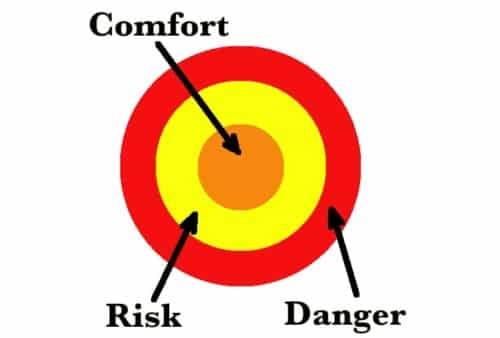 By allowing students the chance to revise their work, they are going to be more willing to take risks and try new things. This is where the greatest learning takes place. I have used this visual in a couple of my books, but it does an effective job of showing where the optimum learning takes place:
 There are those who will argue that by allowing students to rework their mistakes, you are just teaching them not to try their best the first time. That in real life, you sometimes only get one shot and children need to learn this in school. But isn’t the point of school that the student learns it? Not that they got it correct the first time?
 The process of learning something new requires a lot of effort. Just watch a baby learning to take her first steps or remember how hard it was to learn to play a musical instrument or learn a second language. Why would anyone desire to continue doing something that is so hard? The rewards that accompany success provide motivation. Without these rewards, people become discouraged and disengaged. At this point, the desire to continue learning stops, and may not rekindle without external intervention. Over the past 30 years, the gaming industry has developed many ingenious researched-based strategies that keep gamers engaged. “Game players regularly exhibit persistence, risk-taking, attention to detail and problem solving, all behaviors that ideally would be regularly demonstrated in school.” (The Education Arcade at MIT, 2012) The desire to spend the time and effort to complete another few exercises is frequently what separates students who pass from those who fail. So, what are some of these factors that spur motivation?
 How is motivation a strength of staged learning?
 Jim Britt graduated from the
 As our grade numbers went from single to double digits, we watched in horror as the
  We have watched attempts to co-opt this student movement by older people with ulterior motives. Nonetheless, we support these students’ activism in the face of such fierce resistance.
 In 1970, after 28 adult US National Guardsmen fired over 60 rounds in less than 15 seconds, killing four students as they protested the Vietnam War, 4 million students from around the country refused to attend school in resistance and solidarity.
 Collectively Authored By:
 However, what if you want inspiring pedagogy and amazing student outcomes, but don’t have the ability to create a state-of-the-art school building to house it?
  As enrollment grew, we had to accommodate a variety of different student needs and skill levels. Because of this, the administration felt it was time to rethink the instructional model. Administration asked the question “is fully virtual the best solution for our students or is there another way to meet students’ needs for nontraditional education while better supporting them?”
  To help parents effectively support their child during virtual learning days, we created several training opportunities. In addition to successful learning coaches mentoring new families, parents participate in a Jump Start Week where they practice correspondence with their learning coach mentors and their child’s teachers, and they attend a half-day onsite orientation to overview policies and procedures. Learning coaches who have children in grades K–8 also have the option of attending a monthly learning coach academy.
  Teacher-Teacher relationships
 Parent-Parent