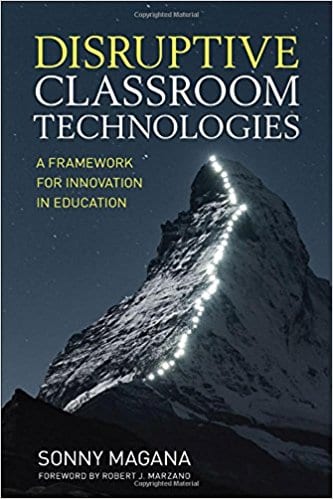
A Framework for Innovation in Education by Sonny Magana – A Book Review
Reviewed by Sarah Ambrose
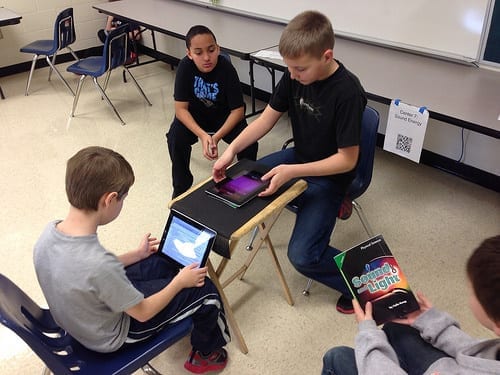 Let us imagine for a moment the following scenario: students buzzing around a classroom, out of their seats, sending messages to one another, talking and bouncing from one computer to the next. In one corner of the room, a few students sit huddled and whispering. As the clock ticks by, the students begin to open tablets and click on what appears to be a game. The teacher moves around the room — occasionally commenting — but doesn’t appear to do much teaching. One student calls out, “we’ve got it!” The classroom applauds and all the students join together in a victory dance. The teacher sends out a quick email, and 15 minutes later an announcement is made over the intercom. “Starting next month, Miss Wilson’s 6th grade classroom will be designing the lunch menu.” You hear cheering from adjoining classes and the students in Miss Wilson’s class are all beaming.
What just happened was transcendent education: students were enabled to utilize technology disruptively to solve a “wicked” (in this case school-wide) problem. What was that wicked problem? The students were concerned about overall health outcomes, not only for themselves, but for 6th graders across the state of Mississippi. Earlier that year, the 6th graders hypothesized a multifaceted solution involving creating a garden, networking with local farms, researching low-cost foods with high nutritional value, and enabling a means of polling students throughout the system on what they like to eat and why. They also linked up with the school administrators to talk about cost and design recipes. It turns out the recipes are more cost-effective than the statewide school food, and would enable a health revolution for students. Unfortunately, this is just a made-up story.
Fortunately – as argued by Sonny Magana – success stories like the previous description are quite possible. But how? In short: a major disruption to the way we utilize technology in the classroom! In the case of Miss Wilson’s classroom, the disruptive technology source was the Internet, the form of collaboration around technology and supporting systems. This is but one example of the T3 “Framework for Innovation in Education” provided by Magana: a new taxonomy not only  useful for enabling the use of technology in the classroom but in learning how to transcend educational settings and affect positive societal and practical change.
In Disruptive Classroom Technologies, Sonny Magana explains exactly how to make what seems like an unbelievable classroom scenario and outcome entirely achievable, and he does so through examples of small incremental change. Magana’s T3 Framework is hierarchical. All teachers begin with T1 and move methodically through to T3. We love the fact that Magana makes sure that each teacher – no matter where they are in their careers – can affect change for themselves and for their students through the use of disruptively thinking about tech in the classroom.
The first tier is T1. When students and teachers engage with T1-type education technologies, Magana explains that tasks are translated from an analog setting to a digital setting. This is the most rudimentary use of technology – “the digital worksheet.” Teachers may email parents, and students may switch from pen and paper to fingers and keyboard. In a sense, the T1 technology serves to speed up processes and minimize error, but remains limited at this initial stage.
“This is primarily how educational technology tools are used in schools and may contribute to why we have not seen systemic transformational use of technology in the process of teaching and learning.”
T2 is a lot more exciting and is defined as “transformational.” Transformation is a higher level of learning where the result is a growth-mindset for students who produce, contribute to, and track their learning processes. T2 is made possible through educational technologies such as Screencastify, EduCreations, YouTube, Google Docs and others.
“Students use technology not only to experience new knowledge but to apply that knowledge in the production of an authentic digital artifact that represents what students know and how they came to know it.”
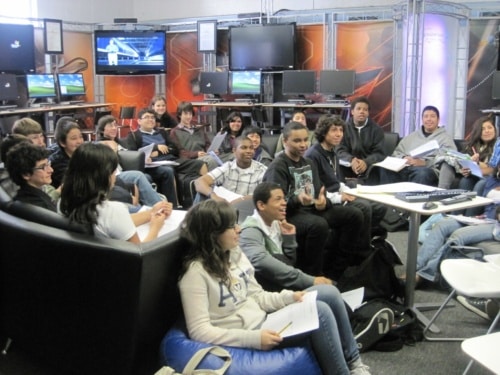 The final tier, T3, is illustrated at the beginning of this book review, and will vary depending entirely on your students’ passions. At this stage, educational technologies enable a form of transcendence, where students’ passions, will, grit and positive social economy meld together to solve the world’s “wicked” problems. The final product is not a classroom of students who ace tests and gain acceptance into good colleges. The final product is a more well-connected social network of learners who continue to “…imagine, to dream up scenarios of applied ideas [through this] uniquely human enterprise.” T3 enables the most important social entrepreneurs of the future. For educators willing to take the leap into translating, transforming and transcending technology in the classroom, we think Magana’s T3 Framework is an exciting, accessible and obtainable way forward.
Disruptive Classroom Technologies: A Framework for Innovation in Education is available on Amazon.
Author
Sarah Ambrose is the Co-Founder of NOLArts Learning Center. Though community access programs, NOLArts organizes and assists groups of young people with autism to participate in myriad of cultural institutions and events including, museums, parades, and public performance. Sarah is a music educator and freelance writer who lives in Bayou St. John, Louisiana.
Further Reading
- Juneau Empire – 20 years in, Juneau Community Charter School is still constructing its own path
- Chronicle of Higher Ed – Yes, We Should Teach Character
- Teacher Magazine – Classroom layout – what does the research say?

 Student-centered learning has long been at the heart of special education and service provision for students with disabilities – with a focus on meeting the needs of individual learners. However, this approach to instruction has become increasingly prominent in general education settings. This crossover of practice benefits all students. Ideally, it includes an environment rich in flexibility. This begins with the seating options and tech devices available, to adaptive and accessible instructional materials. Students are directed toward print text, digital text, and multimedia content that is scaled for various cognitive levels.
 My colleague,
  Assessment is changing in schools and I think that five years from now we’ll see a larger emphasis placed on formative assessment. With formative assessment, we’re gathering information in real-time that can inform instruction. My book
  Empathy. It’s an overused term, but it is intertwined with effective communication skills because the most effective communication requires us to also listen. Communication isn’t just broadcasting; it’s a two-way conversation. We need to make sure what we are communicating is relevant to the intended audience, and we do this by using empathy.


 In this week’s special series, presenters from the upcoming Future of Education Technology Conference will share their best insights, advice, and strategies in response to key EdTech questions. What should educators think about when planning for education technology implementation that will meet the needs of today’s and tomorrow’s students? What new leadership skills or strategies are needed to take EdTech – and other aspects of education – to the next level? Read on below for insights:
  Technology, particularly digital portfolios that let students and teachers capture evidence of learning through images, video, audio, and all kinds of artifacts, makes it much easier to provide visibility into every child’s experiences and achievement. Imagine a child uploads video of a bridge building project that instantly is received on the phone of her parents, grandparents in a different country, Boys and Girls Club leader, and youth pastor, all of whom can comment, question, and support, instantly and in their own language, and continue that conversation outside of school. Involving more members of the community at a personal level can bring a deeper understanding and support for education.
 The use and implementation of technology in isolation from quality instruction, relevant feedback, the cultivation of collaboration, and personalized learning alone cannot meet the needs of all learners. Access alone does not provide equity in educational outcomes. Secondly, technology as a tool for access is dependent upon the accessibility of the target content. Ensuring that all content meets accessibility standards for those with visual, hearing, or other sensory impairments, print text reading disabilities, access barriers, etc., is key when looking at technology to provide equity.
 While the recent proliferation of educational technology tools in classrooms has focused on students in general education, many of these tools have significantly improved access and independence for students with special needs. One of the most promising of these has been the shift toward cloud-based applications and supports. From software, such as word processing, or online assessments, to browser-based supports, such as text-to-speech and voice dictation, a single login now allows a student access across devices and environments. Technology in the cloud allows for access outside of the traditional school day, as well as customization to meet varied individual needs. Additional, but important benefits include the cost effectiveness and increased acceptance of solutions targeted at all students, not just a small minority.
 When it comes to new education technology tools that support learners with special needs, I’m very excited about wearables. This includes the Apple Watch, which has been used in a variety of settings to support learners in their educational technology. From voice commands, haptic responses, and monitoring of movement and rate, it really has the potential to be a game changer for students with special needs.
 Karen saw a problem in the Orange schools when it came to reading proficiency. After some thought, she came up with the idea of the
 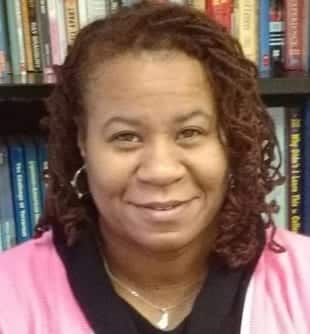 Karen Harris has been Director of English Language Arts & Testing for Orange Board of Education, Orange, NJ since July 2017. Previously, she served as the Special Assistant of Language Art Literacy at
 The way many gifted services work across the nation is that if a school or district has gifted programming, it is focused in the younger grades. Very rarely is there gifted-specific programming at the high school level. Instead, we rely on nationally recognized programs such as Advanced Placement (AP) and College Credit Plus (CCP) to fill the need for rigor and challenge. While these courses are certainly more rigorous than your typical high school class, they are not specific to the needs of gifted students. Even if they were, they would only be meeting the academic needs of the students. What of their social/emotional needs?
 The other impediment for gifted learners in high schools is that many high school teachers have a traditional style in the classroom, standing in front of the students and talking at them. They are the disseminators of information, the sage from the stage, the content expert. If you don’t believe me, go into most any high school and see how the desks are situated in the classroom. I would bet a majority are lined up in symmetrical rows, all pointed toward the front of the classroom where the teacher’s desk sits. This drill and kill style of teaching has been proven to not be the most effective method of reaching students, especially gifted ones, and yet it continues.
  These methods of teaching allow students to learn for themselves rather than having it spoon-fed to them by the teacher. They also are engaging and challenging at the same time. They teach students not just the content, but how to find that content and use it best. This way, whether that student retains that content or forgets about it, they still possess the skill of knowing how to learn.
 The main advice for high school teachers is to remain open minded. To recognize that even though you might be the content expert of your subject, you are not necessarily the strategy expert. There is always room to learn. If we expect this of our students, we should expect it of ourselves. If there is anything I have learned after twenty years in education, it is that I still have a lot of learning to do.
 So when he is consulting with an education institution about how they can most effectively use technology in their classrooms and communities, he and his colleagues gather data in the form of surveys of the stakeholders to see their actual needs. They determine how technology is currently being used and predict how it will be used moving forward in the future.