“If you ever find yourself in the wrong story, leave.” -Mo Willems
On Facebook these past few weeks, there has been a posting going around that asks, “What is your word for 2018?” My word is ‘Agency.’ Being in charge of my own choices. Finding my voice. Speaking up. Being responsible for my life. This awareness of my agency started twenty years ago and it wasn’t a pretty lesson to learn.
In the mid-1990s, I found myself in a frustrating position. I didn’t like what was going on at my school. I was in my late 20s and I was mad. The principal, in my opinion, wasn’t effective. Don’t ask me for details on the actions that I interpreted as ‘ineffective’ as I don’t remember them, but I do remember making an appointment with the superintendent and driving down to the district office to make my feelings known. You called up the superintendent and drove to the D.O.? I must have been truly irritated.
I went in to talk to the superintendent in one of my best outfits. I kvetched, complained and shared my feelings. Dr. Don Phillips, the superintendent at the time, looked at me and said straight up, “It doesn’t sound like you are happy at the school. Maybe you should leave.”
I was shocked. Stupefied. Hurt. I could not absorb that Dr. P. was putting it back on ME. What?? I walked down to the HR assistant superintendent’s office and sobbed. And the then assistant superintendent, Candace Simpson, let me. I cried a lot. I blew my nose from all the crying. I was devastated. My principal was bad and I should leave? It made no sense.
Fast forward with gratitude. Dr. Phillips response to my complaint put me on a path that I have been grateful to have been ‘put on’ ever since. I realized I was in charge of my life. That is heavy stuff. Deep end of the pool stuff.
Collaborating with the Enemy: How to Work with People You Don’t Agree with or Like or Trust by Adam Kahane is a good and deep read. It actually has a title of a chapter that states, “Collaboration Is Not the Only Option.” Kahane talks about four ways to manage situations of discomfort. Collaboration is but one of them. The others include Force, Adaptation and Exiting. All of them are actions; they are decisions that require engagement. You can also choose to not engage and exit – and that, too, is a choice.
I spend a lot of time talking to educators who share that they are at their wit’s end. They have put up with too much adaptation. They have felt forced. They don’t feel they are living lives of integrity. It is painful to hear the stories. And, in a humane way, I tell them they might choose to leave. Like Mo Willems says, “If you ever find yourself in the wrong story, leave.” It will take psychic energy and strength. It might cost you financially and be painful. But, you can, in most situations, leave. That, right there, is a hard conversation.
I cannot thank Dr. Phillips enough for kick-starting me on this path of agency, voice and living a life of integrity. It wasn’t a journey I expected to be on. (He was supposed to fire the principal, darn it.) Yet, it was the greatest gift I could have been given. So my word this year is Agency. Living with a sense of ownership for my choices, trusting my gut, being responsible for my actions and being an agent in my development.
Subscribe to edCircuit to stay up to date on all of our shows, podcasts, news, and thought leadership articles.


 We all know the power of field trips, to open up students to the world outside the classroom, to make connections to curriculum goals, and to spark students curiosity. As you bring learning goals to life for students through interactive experiences, there is room to be strategic, to make sure each excursion includes opportunities for responses and reflections. Although there is often time spent before a field trip to prepare students for a new experience, the days that follow a special event are ripe for responses and reflections.
 Share on social
 Tell a story


 Hadi Partovi and his twin brother Ali were born in Tehran, Iran, and grew up during the Iran-Iraq war. With no one at that time or place offering any computer science classes, Hadi took matters into his own hands. His father acquired an old Commodore 64 for him, and Hadi taught himself to code. He says, “There was this alternate reality where I could make whatever I wanted and create my own world.”
 Code.org’s adoption rate into classrooms across the nation and world in just a four-year period is amazing. The integration into the school systems by a curriculum is practically
  While the conversation about the American educational system usually revolves around America’s slipping global ranks in math, science, and basic curriculum compared to the rest of the world, Hadi has plenty of hope and faith in America’s educational future. “When it comes to computer science and technology, other than a handful of countries such as Iran, we actually are doing quite well,” Hadi says. “And the reason why is that America invented the computer. We invented the Internet. We invented the Smartphone. We invented social media. We invented e-commerce.”

 The opioid epidemic is a serious national problem that is affecting the health and welfare of nearly every community across America. In 2016, approximately 12.5 million people indicated misusing prescription painkillers and nearly one in six teens said they had used prescription medicine at least once in their lifetimes to get high. With approximately 144 drug overdose deaths per day in the United States and 63 percent of those deaths related to misuse of prescription opioids, or some combination of heroin and fentanyl, there is a dire need to reverse this trend in a nationwide effort.
  Opioid use may start with a legitimate medical need for treatment of pain, but it can soon lead to physical dependency. Long-term misuse of opioids can lead the body to produce less dopamine over time, causing cravings for more in greater doses. Due to the highly addictive nature of opioids, prevention and education are two vital keys to reducing misuse and addiction. According to
  Operation Prevention
 While
While  Robin Porter has been in the field of education for more than 30 years. She began her career as a middle school teacher in Pennsylvania and Maryland. She then moved to USA Today where she directed content development for the newspaper’s education division.
 Eric Scheninger was going to be a Connecticut high school principal for the rest of his life, and he was completely satisfied with that career path. He began his career in education as a science teacher, teaching biology, chemistry, marine biology, and ecology while he coached ice hockey, football, and lacrosse.
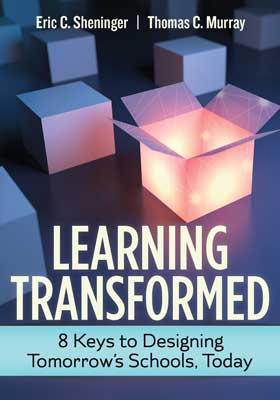
 “I thought I was going to be a principal for thirty plus years at New Milford High School, and this was not the role that I saw for me,” he says. “I think that having my own thinking pushed after we took a critical lens to our work really opened my eyes to what was possible in our school that was very diverse where we were able to accomplish things and get results when people said we couldn’t.” In his latest book
  But when it comes to transformation in schools, Eric is blunt. “If it’s important to you, you’ll find a way,” he says. “If not, you will make an excuse. Excuses hold us back and I think it really comes down to mindset. We teach the way we were taught. We lead the way we were led. For the longest time, the business world was frowned upon in terms of ‘Oh, they’re going to influence us, pollute us, in a negative way.’”
 Eric is a Senior Fellow and Thought Leader on Digital Leadership with the