
https://vimeo.com/233534272
A dedicated performer discovers a love for teaching
 Terry Eberhardt is a music teacher at Howard County Public Schools in Maryland. Terry had his sights set on being a performer coming out of the Peabody Conservatory of Music, but an influential teacher convinced him to work on and receive a parallel degree in education while simultaneously obtaining his degree in performance. The competitive world of auditions and performing live or in the studio turned out to be less than satisfying, so lucky for his students Terry fell back on his education degree and discovered a love for teaching. He is the classic example of the “accidental educator.”
Terry believes artists who are focused on performance are natural communicators, which, in most cases, makes them natural teachers. The inherent extroverted nature of a performer lends itself to the interactive skills necessary to sharing musical and artistic knowledge with students.
Terry believes music education is vitally important to education as a whole, as well as a general tool to engage students. After all, it was his personal experience of participating in musical activities that motivated him to keep his grades up in all areas of education. He now has the pleasure of sharing his knowledge with his students, and it has been highly successful. In fact, his efforts led to a 2014 semi-finalist nomination for the Music Educator of the Year GRAMMY award – a fitting tribute to such a fine educator.
Interview Transcript:
Dr. Berger: Terry, it’s really nice to be spending some time with you today. I’m always fascinated in all the interviews that I’m lucky enough to do to hear the background story of what brings all of us to education.
Tell us a little bit about your personal path and how your path in education steered you towards music education as a profession.
Terry Eberhardt: I think I have a pretty interesting story! The fact is that I’ve always loved music and I’ve always fancied myself being a performer. I ended up going to a private high school and played percussion. I had a teacher who really steered me into education but I was like, “There’s no way I’m going to teach. I want to be a performer!”
 But based on my interaction with him, I did a double degree in education and performance at Peabody Conservatory of Johns Hopkins. The whole time I was taking the education courses I was thinking, this is a fallback. It’s only a fallback. I’m going to be a performer. I’m going to be a performer.
I got out of school in four and a half years and did a whole bunch of auditions, and wasn’t really landing a ton of work so I was like, alright. Good thing I’ve got this teaching degree!
I taught for six months at an elementary school and I fell hard in love with it. And then I got a middle school job and I did that for four years.
While I was teaching middle school, I got asked to do a lot of performing. Crazily enough, I performed while teaching and decided, okay, I’ve got to try the performance thing again.
So I went back to school and got a masters in performance. Almost immediately in that Masters program, I realized that I really wanted to be a teacher.
I finished the masters in performance, and then I was fortunate enough to land a high school job where I got to open that school. I taught high school for nine years, and while I was doing that, I taught college for six years at Towson University.
That’s kind of how I got around to being an educator. I grew up with music in my life and I wanted to be able to share it and give it back to people like it was given to me.
DB: Terry, if we were to call you the “accidental educator” in the best possible way based on the path of how you got to where you are, how can we do a better job of identifying the next Terry Eberhardt? That young person, who is out there ─ whether it’s the arts or not ─ who has passions that if honed in a thoughtful, methodical, and organized way could help open their eyes to an opportunity within education?
To backup a little, I don’t think we do a very good job of saying to young people, “There are some incredible opportunities in education and lots of different roles that you can play.” Sadly, we rely on accidental sequences of events ─ look at your story for a perfect example ─ for young people to benefit.
So how do we do a better job of identifying the next Terry Eberhardt?
 TE: I think it’s educating students and parents in terms of what things are possible. A kid who wants to go into performance, be it acting or performing an instrument or singing or dance, is going to be typically very outgoing as I was. They’re going to be almost a master of communication because you’re communicating through your art form. And that makes it an easier shift than I ever knew to delivering instruction to youngsters or adults. It’s that simple communication piece that makes it really accessible.
Actually, what made it fun for me was that I was really using my performance training to engage students and to get them motivated and excited.
Yeah, I think it’s education ─ educating parents and students at young age that “Hey, if you’re really passionate about anything, you can use that ‘anything’ to do lots of different things like teaching.”
That would be my number one, for sure.
DB: Terry, how can we apply what you’ve experienced within your educational path to the notion that arts should not be just sort of an outlier, an afterthought to a young person’s educational experience? It’s not just a cherry on top or something that we add; it is essential to one’s learning path, to outcomes that we hope that they get to experience.
How do we take your experience and translate it into meaningful conversation and a movement where it is a critical part of education and it’s not something that we should have to continue to battle for?
We hear constant stories around the country where arts programs are marginalized and often the first to go. How do we have a more powerful conversation about their importance where we utilize a story like yours?
TE: It’s not to say that I’m the poster child for why music education or arts education is important but I was definitely that kid who wasn’t excited about anything else. It was the one thing that brought me to school every day. It was the thing that got me excited to be in the school building, and it was the thing that kept me well beyond the school day to be there and engage with instructors.
I had to have the right grades to be able to do the things that I wanted to do with my music. So it was very important to me.
And it wasn’t until I got to college that I realized that music isn’t just about increasing the other aspects of education. There is merit in it by itself; and music and art for the sake of art and music is really very important as well.
Yes, I think it’s just making sure that we look at data around students who have access to music and look at what it’s really doing for communities. Sometimes, students who are struggling in every other class excel in the arts classes. And that is really very compelling.
You can look at studies all over the world of arts programs being added to areas that are distressed or struggling in their academics, and you see that infusing them with music or an arts education really allows them to establish themselves to be stronger human beings at the end of the day. I mean, what we’re all trying to do is to create better humans.
About Terry Eberhardt:
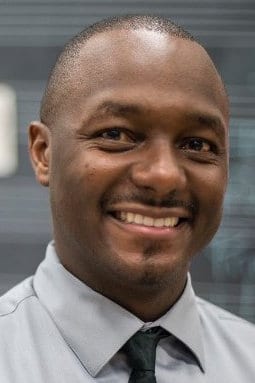 Terry Eberhardt’s love of music began with his church choir and public school chorus. Terry was recruited to a prestigious local private high school on a music scholarship. It was there at DeMatha High School, performing in the chorus, where his love of singing blossomed. It was through the transformative experiences as a music student that he was inspired to share the gift of music with young people.
Upon completing his Bachelor’s of Music in Vocal Performance and Music Education from the Peabody Conservatory of Music and his Masters Degree in Opera Performance at The University of Maryland Opera Studio, Terry began his teaching career at the newly opened Shady Grove Middle School in Montgomery County where he taught general music, choir and developed the theater program. Terry quickly gained a regional reputation for excellence in choral education. In 2005 Terry established the choral program at Howard County’s newest high school, Marriotts Ridge. He has also served as President of the Maryland Choral Directors Association.
During his ten-year tenure at MRHS, his students earned numerous awards and accolades for their performances throughout the eastern United States. In 2008 he was recognized as the district wide Howard County Teacher of the Year. Terry continues to serve the professional music community through his work at local universities as a voice coach, as an adjudicator for numerous choral competitions, and as a performer and director in the religious community.
Follow Terry Eberhardt on Twitter.
This article was originally posted in the Huffington Post
Author
Dr. Berger of MindRocket Media Group is an education correspondent and personality with articles in The Huffington Post, Scholastic, and Forbes.
Twitter.

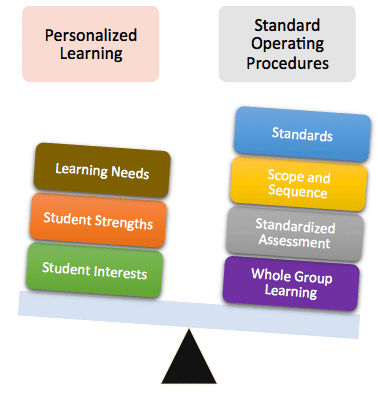 If personalized learning is the direction in which we want to move, how do we “tip the scale” in favor of it, to help us as educators to facilitate the academic success of each student through their learning needs, strengths, and interests? After all, whole group learning, standards, the scope and sequence, and, especially, the standardized assessment we typically use and teach to tend to drive our curriculum.
 It sounds simple enough, but how do we, as educators, go about setting the stage for all of this to happen? Some of the answers rely on technology, but even without a great deal of technology at educators’ fingertips, it is possible to deliver personalized learning. Here are some tips from many people who manage this on a daily basis:
 Automate what you can, and allow students to make choices whenever possible:
 If all or most of the above is put into place and practiced in classrooms, the balance can indeed be tipped in favor of personalized learning. This would mean students are likely to learn more content, learn more about themselves, and take more control of their own learning. What a wonderful scenario for our 21
 Welda Simousek is the author of several books (mentioned above), an experienced educational consultant, and owner of Welda Consults, LLC, which is a customized professional development company,
 If you walk into nearly any public high school in the United States you will see the influence that sports have on the school environment. This may be in the trophy case that sits at the front of the school. It might be the posters encouraging athletes to achieve great things against a rival. It could be the pep rally the school holds to encourage and inspire the athletes. Or the press showing up to document the signing of an athlete to a college commitment. Just listening to the announcements, the content is rife with the accomplishments of the sports teams and the athletes that participate.
 Just go to any high school football game on a Friday night. There is always a crowd, not all which are parents and students but community members as well, a lot of enthusiasm as evidenced through the noise level, and cheerleading squads and bands which support the teams. Now go into a classroom and measure the level of enthusiasm of those in attendance. It is almost passive. Where is the pep rally for the academic bowl team? Where are the posters supporting the chess members? Do community members turn out to watch the robotics crew compete?
  Imagine a school system where 100 percent of the focus is on the education of children. All resources would funnel toward this goal and all of the parent involvement would have to do with academics. Where every hire is to find the best person to teach that content area, not who can perform double duty as teacher and coach. How much movement would occur at that school in regard to achievement?
 One could easily make the argument that sports teach our children very valuable skills. Leadership, teamwork, and problem-solving are just a few of many benefits of participating in a sport. There is certainly value in sports. The problem comes when sports becomes more valued than the academics – when the focus of schools becomes more about sports than education.
 It is because there is too much opportunity in sports. Sports can lead to college scholarships. That is all fine and dandy if the student were using this chance to get a degree to lead to bigger and better things. The problem is that colleges are just as guilty if not more so in perpetuating the sports racket. When college football has become the minor leagues of the NFL and hot basketball players rarely last longer than two years in school before going into the NBA draft, college sports is big business. It brings in billions of dollars a year to universities as their sports are nationally televised and have corporate sponsors.
 other entity. Take it off of the school’s plate and onto someone else’s. The schools have enough to worry about educating the masses of their community. As a gifted coordinator who fosters the academic potentials of young children, I would like to see more emphasis put on academic success so that the students who are not athletically inclined are recognized for their achievements.
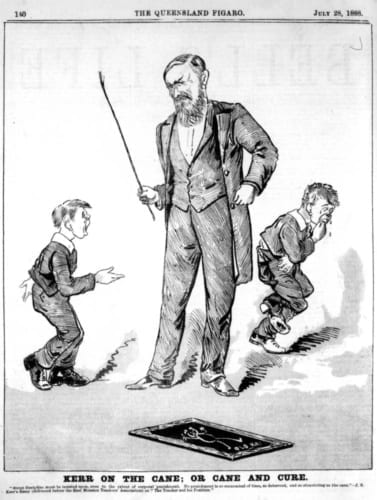 Schools around the country began implementing zero-tolerance policies in the mid-1990s to curb drug use and the possession of weapons on school grounds. Now zero-tolerance policies have spread to other student safety areas, including alcohol use, fighting, bullying and more. If a student is caught committing such an act, they often are immediately suspended or expelled – no questions asked.
 What makes zero-tolerance policies so destructive for students is they do not take into consideration the situation that caused the behavior. For example, should a student be suspended for biting a pastry into the shape of a gun? No, but it has happened. The discipline approach also does not take into account the student’s past indiscretions, or any mental health issues or special needs the student has that may have led the student to misbehave. For example, should a student on the autism spectrum who gets overstimulated and acts-out by hitting another student get suspended? No, but it has happened.
  So what does a PBIS system look like at the school level? Administrators and teachers need to define a set of student behavior expectations, and then share them with the student body. These expectations should be easy for all students to understand and should be promoted by all faculty and staff consistently and frequently.
  Data:
Data:
 Tip 1 – First and foremost, a quality teacher begins by selecting the most appropriate instructional strategies for the lesson being taught and the specific group of kids in the class. Just as “one size fits all” really doesn’t fit everyone, a good instructional strategy will work well for some students, but not for all. Combining quality instructional strategies with appropriate technology that enhance instruction is the key. Technology will not replace a good teacher, but a good teacher who uses technology to enhance her instruction will replace one who doesn’t.
 Tip 3 – Technology is only a tool, not an end in itself. While technology-based activities can be engaging and fun, begin your lesson planning by identifying the learning intentions/objectives you are planning on teaching. I like stating my learning objectives as what you expect students to
  Tip 5 – Be sure your students know the “why” of the activity you have designed to support the learning objective. While you might have a great reason for students to create a presentation for example, sometimes students get wrapped up in the technology and lose sight of the objective. When creating a PowerPoint, Keynote, or Prezi on a topic, be sure the focus is on the topic. Students shouldn’t spend more time working on the cute factor of a presentation than on the content itself.
  Tip 7 – Don’t wait to use technology until you are an expert. Some teachers avoid using technology because they are afraid that either the technology will crash on them during instruction or because they don’t feel expert enough and their students might see them mess up. First, the technology
  Howard Pitler is a dynamic facilitator, speaker, technologist, and instructional coach with a proven record of success spanning more than four decades. Pitler is an ASCD Faculty member and the author of several ASCD publications including