Being an educator is not for the faint of heart
By Matthew S. Howell
The profession of education can be frustrating. It can also be daunting, and it is full of challenges, both seen and unseen. The turnover rate for people entering the profession is among the highest of any field, not without logical reason. Between mandates, pressures, and a daily pace that can only be described as breakneck, being an educator is not for the faint of heart.
 So I was not surprised to find myself speaking with a teacher recently who was experiencing a crisis of confidence. She confided in me, saying, “I am so worn out, and the year has just started. I don’t know if I can keep up.”
I assured her that she was doing an excellent job, but my encouragement fell on deaf ears. She went on to detail the trials she was experiencing – negative parent emails, disaffected students, struggling learners, a new curriculum, etc… “The list” she said, “is never ending.”
At a loss for what to say, I asked her, “So what parts of your work bring you joy?”
She paused, became reflective, and then shared a set of positive moments she had recently with her learners. I suggested that she focus on the areas where she is feeling success and let the other aspects of her work take a back seat for the time being.
I know that her experience is not unique, and in fact, it can be more the rule than the exception. With this in mind, I will share three ways to find joy amidst the trials of your work:
Stick with the Winners
 Every school has them; those who are able to find positivity in every situation. These teachers find ways to make the mundane miraculous for their students and their colleagues. It starts with a mindset, one which refuses to allow the difficulties of teaching to outweigh the positive things going on around them. If you want to rise above the disconnected din of discord, develop relationships with these people. Making time for collaborative planning and informal discussions can be energizing. Sharing words of encouragement and cheering one another on can be exhilarating.
Conversely, every organization has people who seem to thrive on negativity. They lurk around corners, in hallways, standing sentinel at the copier; exasperated and proud of it, waiting to find a willing participant to join them in their griping. Of course, all of us need to vent from time to time, but these personality types have often developed habitual patterns of negativity and may be unaware of their own demeanor. While collegiality is important, do not value it over the heart of your work – making impactful decisions for your students.
Start a List
 I am not talking about an Amazon wish list, rather a list of positive moments that take place throughout your day. Most educators leave a day of teaching exhausted. It is natural human inclination to recall moments of struggle more readily than moments of success, leading to the further depletion of valuable energy. As well actualized caring human beings, it is normal to focus on things that do not go according to plan in an effort to find ways to improve.
Unfortunately, the tendency to focus accordingly can set negative neural-pathways in motion. These habitual ways of thinking will continually yield similar results. To offset this tendency, begin to track the “wow” moments from your day. Write these moments down before leaving your classroom for home. This can be an ongoing list kept in a notebook or journal. Writing moments down is proven to reinforce them in our memories.
Keep in mind, these do not have to be monumental happenings. Look for joy amidst the ordinary. Maybe a struggling student finally solved an equation she had previously struggled with. You may witness a young person help a peer open their locker or pick up a dropped pencil off of the floor. There are good things happening all around you, it could simply be a matter of drawing these moments out into clear focus.
Consider the Long Game
 We live in a world where instant gratification is treasured. Unfortunately, education is rarely about immediate outcomes. Behavioral changes, transference of understanding, synthesis of skills into application are all things that take form over extended periods of time. Growth points may need to be visited numerous times for the fruits of labor to form. Even then, it will likely be the bud and not the whole piece of fruit on display.
Educators have chosen to enter a profession that requires vast amounts of patience and care. It is important to keep in mind that your efforts may not ever come to light for you to see. This is not meant as note of despair, rather it is a thought that should bring solace and hope. Be mindful that the students you serve are helped greatly by your efforts, and this may never be acknowledged. Teaching is a selfless and courageous act. Take heart in knowing that you are helping those whose ultimate success you have aided but may never see.
With such a swirling rush of activity in education it can be difficult to avoid getting swept up in the changing tides. It is bound to happen in the best of circumstances, so go with the flow – just do so joyfully. Ultimately your students will benefit, and you will stay vital and energetic in the profession that you know, deep down inside, you love so well.
Author
 Mr. Matthew Howell has earned a Bachelor of Arts degree from Montclair State University. He has also earned his Master of Arts Degree from Seton Hall University in Educational Leadership and Supervision. Mr. Howell is certified in English education and as a principal and school administrator.
Mr. Howell has served in the Oceanport School District since September of 2012. In addition to Oceanport School District, his 14 years in education include positions in Somerset, Ocean Township, Millstone and Hazlet. Mr. Howell’s professional experiences include classroom teaching, coaching, supervision, and administration. He has held positions at a number of age levels. Mr. Howell is passionate about education and he firmly believes that every child can succeed.
Further Reading
- Education Dive – Changes in school models can create challenges for students
- CT News Junkie – Through Challenging Times, Connecticut Teachers Teach – Always
- BBC News – Job stress is ‘overwhelming’ teachers across the UK

 For the purpose of this series on AI in education, let’s ask the million-dollar question: what if AI could scale personalized education?
  Suddenly, the teacher is able to spend her time most effectively. Rather than being bogged down with scoring tests and creating practice sets, teachers can focus on inspiring their students through dynamic lessons. Teachers are uniquely able to build strong relationships with their students, help them overcome challenges, build their curiosity, and engage them in an ongoing educational dialogue.
 None of these steps should interrupt the classroom, nor should they require additional work on the part of the teacher. Instead, the teacher should always have all the information she needs at her fingertips to run the most effective class possible, both in terms of individual student learning, and class-wide learning.
  Edan Shahar is the founder and CEO of
 Shawn Patrick Higgins combines his enthusiasm for computer science with the creative arts to help his students learn and thrive as the Computer Science and Technology Teacher at
  SPH:
SPH: SPH:
SPH: SPH:
SPH: SPH:
SPH: Shawn Patrick Higgins has many years of experience teaching youth about video and creative technology, with more than 5 years experience teaching middle school computer science and managing educational technology. He specializes in project-based, collaborative learning in new media and fostering
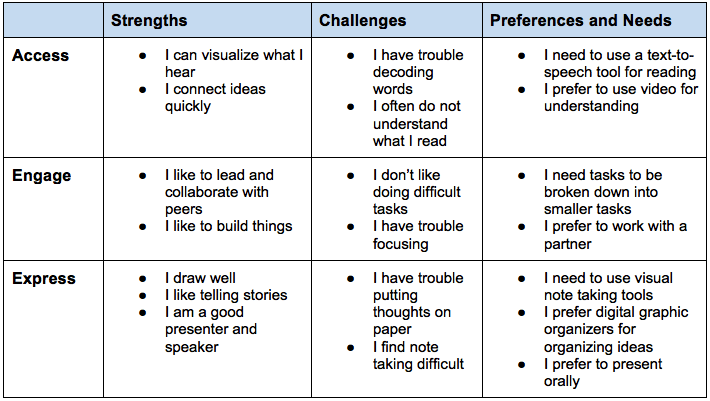 Words about me:

 PH:
PH: PH:
PH: PH:
PH: Dr. Polly Haldeman currently serves on the Executive team at
 For change to occur, teachers must be able to engage in critical self-evaluation of their own efficacy related to technology integration and determine how to make effective connections between teaching knowledge, content knowledge, and technical knowledge. Also, leaders must support teachers in the use of technology by establishing and building a culture for change.
  learning difficulties, classroom management, and differentiated instruction. Survey questions related to content knowledge focus on key concepts in teaching areas, class activities, and inclusion of relevant resources. The intersection of the three domains (technological – how devices work and enhance learning; pedagogical knowledge – how students learn; and content knowledge – what students learn and why) of how teachers rate themselves is at the heart of where to begin expanding personalized professional learning.
  Barriers to Pedagogical Change Incorporating Technology
 These barriers must be addressed in order to support changing practice and building a culture of trust, and an openness for risk-taking related to innovation, technology, and student-centered learning.
  Flipped learning, sometimes referred to as inverted learning, is often a teaching method which uses video lectures and other resources stored in online environments where students can access the materials from home or other locations. Then, the face-to-face classroom instruction includes engaging learning activities such as labs, case studies, games, simulations or experiments.
  Peer-to-Peer Learning
 For example, teachers use Twitter for international collaboration with educators to explore topics related to innovation and inquiries into what works for students. It helps to develop greater instructional capacity by hearing how others are using innovative instructional techniques to target student improvement. Other effective communication tools such as Google-Hangouts, Skype, Whatsapp, and Facebook engage individuals in on-going dialogue for personal and collective learning and professional growth.
  Dr. Diane Mason