Educators use a large portion of class time to prove homework was meaningful
By Joshua Sneideman
In my seventh year teaching middle school science I stumbled upon a homework assignment that would forever change my approach to homework. Many teachers struggle with assigning meaningful homework night after night. Educators use a  significant portion of class time to check for completion, review answers, think pair share or any of 100 strategies to prove that the homework was meaningful. This, as we all know, can become its own vicious cycle, as the dreaded pile of ungraded assignments just gets bigger. Neither new teachers nor expert educators can escape this yearly homework grading dilemma.
It was at just such a moment when I realized I could not collect another piece of paper to assess that creativity struck. The day’s lesson involved asking students to put to memory C6H12O6 as the formula for a simple sugar molecule and NaCl as the formula for salt. Students then used stereoscopic microscopes to compare sugar and salt crystals. (Sugar crystals are asymmetrical-looking hexagonal forms and salt crystals are cubic.)
As the lesson came to a close, I jokingly said tonight at dinner I would like you to ask your parents to please pass the NaCl or the C6H12O6. I will give you five points of extra credit, I said, if you can record the conversation and put it on YouTube. The videos I got the next morning were hilarious. I knew something was different at morning drop off when parents came up to me and said “thank you” for last night’s homework. One parent went so far as to give me a hug, saying she had a great conversation with her son at dinner. “Normally,” she said, “when I ask what did you learn at school today,” my son would reply “nothing.” This evening was different. Over time as I developed these parent/student engagements, students began to have similar positive experiences where they had “actually had a cool conversation with my dad” as one seventh grade student put it.
This serendipitous first step on my journey to including parents in my homework assignments was a raging success. I immediately began thinking about a next step. How did I want parents to engage with students around science content? I  chose a balancing act where parents need not feel like a science expert to actively participate in the homework and where, at times, students would feel like an expert. Parent engagement homework assignments could be simply conversational in style. I created the simplest of homework slips, asking for a parent signature that they had indeed had a conversation with their student.
As a science teacher, the goal to increase parent/student interaction around STEM content emerged. The conversational prompt simple yet open ended enough so that there was room for conversation worked avoiding the yes/no answers.
A study in the Proceedings of the National Academy of Science by Christopher S. Rozek, a postdoctoral scholar at the University of Chicago, finds parents who talk with their high schoolers about the relevance of science and math can increase competency and career interest in the fields, in addition to raising math and science assessment scores (https://phys.org/news/2017-01-children-stem-fields-boosts-scores.html).
“Parents are potentially an untapped resource for helping to improve the STEM motivation and preparation of students,” said Rozek.
Any teacher can take steps in almost any class to encourage parents to engage in directed conversation around educational themes. Dinner time seems like the best time to do this. Choosing this for me was more intuitive than research driven, only to  later find out that according to multiple studies, students who eat dinner with their families often are 40 percent more likely to earn As and Bs in school. Similarly, family dinners also have an impact on reading and vocabulary skills for the obvious reason that you are more likely to be exposed to new and complex vocabulary.
Dinner time is not the only approach to encouraging conversations. A Temple University study used grocery stores in low income communities to encourage increased parent/student interactions. They used conversational prompts in the form of signs around local grocery stores. The outcome was a dramatic increase in parent/student engagement.
Long story short, my classroom anecdotal evidence is that parents and student alike will enjoy homework assignments that ask them to engage with each other. Additionally, research indicates this to be an effective strategy. As the 2017-2018 school year gets started, try it for yourself. You will not be disappointed!
Author

Joshua Sneideman is Vice President at Learning Blade, focusing on district and school-wide implementation strategies. The Learning Blade team’s newest resource is called #STEM4Parents to stimulate more student-parent engagement.
As the 2013 -2015 Albert Einstein Distinguished Educator Fellow at the Department of Energy’s Office of Energy Efficiency and Renewable Energy, Sneideman received recognition from the Secretary of Energy Ernest Moniz for his efforts to increase minority participation in STEM education.
- Norfolk Daily News – New homework policy for Norfolk Public
- The Mercury News – San Jose students receive free mobile tech to help with homework
- Tallahassee Democrat – Revisiting homework: What is a good model?

 Jonathan Cassie has been a teacher and education leader for 20 years and is currently Director of Innovation at TVT Community Day School in Irvine, CA in the heart of Orange County. Cassie is the author of
  Jon Cassie:
 JC:
JC: JC:
JC: JC:
JC: JC:
JC: JC:
JC: JC:
JC:
 My son was about eight years old, and he was in second grade. I found him one day upstairs in his room
  According to
  Second, as in my son’s case, bullying often hurts us most when it targets areas in which we feel weak. Therefore, it behooves us to increase our own
  From a
 The Myth of Final Attainment
  The Greek philosopher Heraclitus wrote that we must embrace a constant state of becoming to reach the optimal realization of our human potential. A reasonable implication of this philosophy implies that mastery is not a final destination but a lifelong process of continuous growth and development. The journey’s the thing. As we travel along the road towards mastery, it is critical that we receive meaningful feedback to help us determine if sufficient progress is being made towards our desired future state while simultaneously enacting course corrections as needed. In the case of the future of education, we would do well to have a road map with crystal clear goals and just enough mileposts to allow creativity to flourish over-prescriptive, lock-step compliance. This is perhaps the most valuable element of the T3 Framework for innovation in education; it is a tempered guide designed to stimulate the realization of the collective efficacy of whole learning systems.
 Shifting from PD to OD
 Evaluating OD Impact with the T3 Framework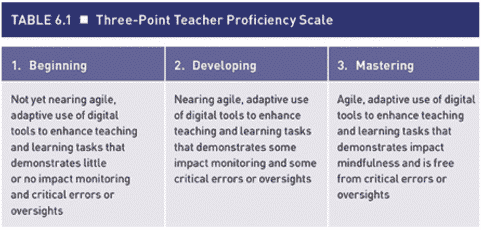
 Building collective efficacy with educational technologies will help guide our work at hand and move the needle of technology impact forward. Embracing a mastery mindset will help school systems realize their potential collective efficacy—and model that process for students. The T3 Framework and proficiency scales were designed to aid in mastering digital tools in a modern teaching and learning context. We will only transcend the status quo of low-impact technology by disrupting the current trajectory. Arguably, that matters most of all.
 The amount of time and energy that could potentially be lost in the first week of class is horrifyingly staggering. Which is why, when a contributor to eSchool News recently wrote “
 Not only did automation and streamlining service desk management help save time, but communication became much better for the district between IT and other departments, including admin, which often relies heavily on technology for streamlining their day-to-day tasks of billing, digital communications, answering calls and requests, et cetera.
 Funnily enough, trying to understand the vast challenges faced by school and district IT helped me examine my company’s dependence on IT. As it turns out, our “IT department” is pretty much just one guy who helps the rest of us with everything from Blue Screens of Death to coding our customized publishing platform. If Vince Carlson, eSchool Media IT Wizard, left—or even missed a day of work—we’d be devastated.
 The Differences Between a Teacher and a Tutor
 My Tutoring Philosophy
 Tutoring Math for Standardized Tests
 It’s always a good idea to challenge students along the way to think a little bit more deeply than they need to. This can have the effect of increasing the student’s level of