https://vimeo.com/219758783
How Advertisers Can Help School Districts
Andrew Swinand’s career in marketing, advertising and media has been extensive. He’s a global leader in bringing marketing analytics and brand consultancy to companies whose desire is to improve the human condition. In 2011, Andrew co- founded the purpose based incubator Abundant Venture Partners (AVP), and in January 2017 he accepted the position of CEO for Leo Burnett North America.
Andrew is presently the Chairman of the Board at Education Funding Partners (EFP), a company that partners major brands with public school districts to supplement educational funding and improve student outcomes. Andrew points to similarities between education and advertising, acknowledging how both use creative storytelling to educate and change human behavior.
We live in an on-demand world where answers to questions can be obtained instantaneously. Global connectivity creates evolving opportunities for granular personalization in both advertising and education. Memorization is no longer king and Andrew points to a growing need to reassess our interaction with information.
It’s refreshing to see a global business leader ready to roll up his sleeves and use his knowledge to improve education.
Interview
 Dr. Berger: Andrew, I think that there’s great value in reaching out to experts in verticals that touch the communities of education around the world in ways that we experience every day.
You are known at Leo Burnett as North American CEO and you’ve been a noted trailblazer in both media and advertising. I think we can learn a lot from the space that you occupy, and that there’s a moral to the story about a world where we are more connected every day, and about how we want to consume information and opportunity.
Let’s use that as a backdrop. Tell me about the power that you see in advertising and how it can help communicate messages that can make a difference.
Andrew Swinand: One of the exciting things about advertising is that, at its core, it’s using creative storytelling to change human behavior. It’s a medium that is being applied towards informing people of products and services, an idea that goes back to the beginning of human history.
The idea of creative stories well told to change behavior, to spark imagination, and to inform, is, to a great degree, the basis of great education.
DB: How have the consumers changed from your seat? We want information in different ways these days. Now, especially in the industry that I serve, we’re actively trying to find ways to communicate when, in the past, we didn’t want to rattle the cage, we didn’t want to feel like we did something wrong.
Now, we’re actually taking a very progressive stance in communicating in education, with the consumer being both the parent and the student.
How has consumer behavior changed now that we’re living in a world where people aren’t working nine to five? They’re working all over the place with multiple jobs. They need different skill sets that are much more forward-facing and public- or consumer-facing.
 AS: It’s less about people changing; it’s more of how they interact with information that has changed. From both an advertising and education standpoint, people are now able to interact with content information in so many more environments and forms.
You think about the idea of sight, sound, and motion or video or television being able to be consumed on mobile, tablets, and computers. The opportunity from both a business and education standpoint is ─ one, think about utilizing location as a way to share and send information. Where people are and how they interact with the information matters.
Two, the opportunity of information on demand, where you have an environment of sharing of information as education so people have a base level of knowledge. The ubiquity and the assets of information on mobile devices means that you can get the answer to any question or fact anywhere. It increases the onus on the ability to help teach people how to think and how to access information.
And, three, because of the ability to have sight, sound, and motion in any medium, I think that both in advertising and education the idea of interactivity in conversation can and should be reconsidered. If I have the ability to see the world’s best lecture, to see the world’s best film, to research products and services, what’s the role of human interaction ─ which is still critical in any brand experience as well as in education ─ and what role does searching for information or consuming a video play? How do we think wholistically about people’s journey of discovery?
DB: Speaking of that interactivity, we’re in a world now where advertising can come in many forms including sponsored content and content marketing. The producers of the content and the stories are getting very creative. We are finding that the consumer or the audience is becoming much more accepting and understanding of the ways in which they experience brands and opportunities.
And we’ve seen that now bleed over into education media as well. I’ve heard people say, “Everything that we consume is sponsored in some form or fashion.” It just means that the originators of the content have gotten much more intelligent in the way in which they have packaged things together.
 AS: I don’t see an inherent tension or disconnect between communications and point of view. If you look at the idea of perspective, history is written with perspective: Winning side, losing side, country of origin. With the Internet, people have the ability to see and experience different perspectives. Within that brand marketing, business products, there’s a perspective. And the example I would give is that the perspective of the Wall Street Journal on world events is going to be different than the perspective of the New York Times versus the Straits Times in Singapore.
We need to be aware of inherent bias and perspectives in terms of where we consume information. But that’s not to say that it’s wrong to have perspective in terms of the information we consume.
DB: We came together and we were introduced through a mutual friend at Education Funding Partners, so I know that you’ve played a role in that space. I’m starting to see more of where we’re seeing schools and districts be much more understanding ─ more intentional and savvy ─ about the ways in which they can maximize opportunity in a thoughtful and meaningful way.
What can schools, districts and the education industry learn from professionals like you who have seen the positive role advertising can play in providing opportunity for brands to establish ongoing and meaningful relationships with parents, teachers, and students?
AS: The core vision for Education Funding Partners is to find sustainable responsible ways for schools to increase their revenue base. The idea behind it is that brand and brand exposure are ubiquitous. It’s the shoes you wear, the shirt, your jacket. So how do we actually, in responsible and respectable ways, invite and explore ways for marketers to help offset funds for a better education for students and families, but in ways that don’t interfere with the actual education process?
The lesson learned is that businesses today are much more networked. There’s much more interactivity. Media digital communications are intertwined with so much of what we do. The opportunity is for schools and school districts to think about creative ways to offset costs to improve the quality of education and to think about who are marketers or businesses that basically are interested in helping in sustainable and responsible ways that don’t interfere with learning.
 DB: One of the most interesting things that should not be exclusive to education is the concept of personalization. If any industry has been the most successful, it’s been the advertising industry ─ personalizing a message in the way in which we purchase products online and personalizing it we give recommendations. The Holy Grail has been solved from an advertising perspective, and yet we’re trying to do this in so many other experiences in our lives.
What is the next evolution of that personalized experience with brands that we should be looking out for and/or that are exciting to you?
AS: The advances in the last 24 months in marketing technology ─ looking at and understanding people’s passions and interests based off of their digital behavior, the content they consume, the things they read ─ has reached new heights.
The future in learning is, based off of past behaviors, based off of things you opt in to receive. People are going to be able to experience much more relevant and engaging communications from brands and marketers. I think we’re moving towards the future where technology will allow people to much more customize and edit their content and experience.
The pros are greater relevancy, greater engagement, and greater information. The risk is that we live in our own echo chamber. I think the balance is ─ from a brand standpoint, from a human standpoint ─ how do we make sure that people are getting relevant, engaging content information? Also, how do we ensure that people are still open to and being exposed to new ideas and new things?
DB: It is really interesting and I love that you talked about our ability to edit as consumers and to provide our own commentary on what we would like to see in that regard.
This has been a real treat to speak with you today, Andrew. I hope that the education audience has learned a little more about messaging and the power of that and understanding the behavior of those that we are trying to support in our local communities.
About Andrew Swinand
Andrew Swinand is CEO of Leo Burnett North America. He was previously the founder and CEO of marketing startup The Abundancy, and co-founded its holding company Abundant Venture Partners (AVP), an incubator focused on building media and healthcare companies. Prior to that, Andrew was president of Starcom MediaVest Group, the world’s largest media agency.
Andrew has also worked for Procter & Gamble as a Brand Manager in their beauty care group and a Marketing Director for Reflect.com LLC. He started his career at BBDO as an Account Supervisor. He has been recognized by Advertising Age as a Media Maven, Mediaweek magazine as one of the Industry’s “Power 50” and Media Magazine’s “Rising Star”, appeared on the Crain’s Chicago Business “40 under 40” list, and was inducted into the American Advertising Federation Hall of Achievement in 2008. Andrew currently serves as Chairman of the Board at Education Funding Partners
Andrew served as an officer in the platoon leader in the 3rd Infantry Division, in the U.S. Army. He holds a degree from the Wharton School of Business at the University of Pennsylvania.
Follow Andrew Swinand on Twitter.
This article was originally published in the Huffington Post .
AuthorDr. Berger is one of many industry education correspondents for the Mind Rocket Media Group, An educator and former school administrator. His video interview work and conversational podcasts have been featured in various media outlets. He often hosts education panel discussions and develops strategic content. As an academic Dr. Berger is a guest lecturer at Vanderbilt University’s Owen Graduate School of Management. A former assistant principal, he has been an adjunct undergraduate professor and developer of online college courses. He is a passionate Detroit sports fan who has also adopted Nashville sports teams as his own.
Contact the Mind Rocket Media Group if you are interested in an industry interview and a placement on EdCircuit.
Further Reading
- Advertising Age – Leo Burnett Taps Andrew Swinand as North America CEO
- Crain’s Chicago Business – New Burnett CEO sees a future of data, meditation and ‘radical self-care’
- Ft. Wayne News-Sentinel – Michael Hicks: Some hard truths on school funding in Indiana


 Those are just a few of the considerations you might be thinking about before an interaction… and unfortunately, it still might not go well.
 Growing up, Abdulraham was an athlete, never imagining that he would enter the world of technology. But when he entered university at the
  The project uses machine learning techniques to identify recycled items, and then sorts the items by the use of basic mechanical motors. Green Jam encourages recycling by using a rewards system which is implemented in the cloud. Users can store their points until they are redeemed for simple utilities such as mobile phone credit, or topping up public transportation cards. The system also provides smart data analytics for companies to enhance their marketing strategies.
 “These two young fish are swimming along, and they happen to meet an older fish swimming the other way, who nods at them and says, “Morning, boys, how’s the water?” And the two young fish swim on for a bit, and then eventually one of them looks over at the other and goes, “What the hell is water?” —David Foster Wallace, commencement address at Kenyon College, 2005
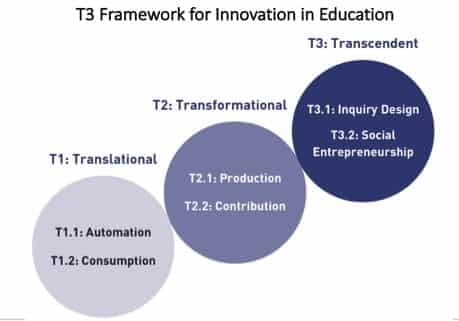
 In addition to enacting substantive growth in student cognizance, transcendent technology uses to push past the boundaries of prior experiences and expectations for education. The strategies in the domain of transcendent technology use include students identifying, investigating, hypothesizing, and iteratively generating more robust digital solutions to wicked problems that matter to them. This represents an entirely new domain of strategies that is only possible when students mindfully wield digital and cloud-based production technologies. We are just beginning to scratch the surface of what’s possible when students’ limitless passion and purpose are catalyzed in an educational setting.
 To realize the desirable future articulated in Part III of this article series, we must follow the guidance and direction provided by the highest quality educational research. The signal provided by such research will help us cut through all the confounding noise and help to identify strategies that amplify collective efficacy in our schools. If we disregard the research evidence, we risk ending up like the fish in David Foster Wallace’s allegory, wondering, “What the hell is water?”
 Now that schools are at long last taking inventories of all that their teachers are using and establishing strategies to get full-coverage models of digital curriculum and content, they are doing short work of saturating the school landscape with all things digital learning. In addition, the paid professional digital resources industry is gaining some minor efficiencies now reaching whole districts, resulting in lower marketing costs overall.
 1.) Discreet digital learning objects – video, apps, eBooks, documents, sites, games, and courseware (iTunes, Teacher Created Materials, YouTube, Overdrive, Scholastic, Waggle, Amplify, Tenmarks, Macmillan, Disney Interactive, Lumosity, ABCmouse, ReadingKingdom, Rocket Group, HMH, Discovery Education, and thousands, if not millions, of others)
 Jeff McCoy is the Associate Superintendent for Academics at Greenville County Schools in Greenville, South Carolina. Jeff started his career in Greenville County Schools at