
Will your students be greeted by rules or by questions that set the stage for thinking and risking?
by Howard Pitler, Ed.D.
 The school year is beginning in places in the Midwest in late July and soon after that throughout the country, it’s time to think about that very first day you meet your class. How will you begin to create an environment for risk and creativity? Will your students be greeted by rules and “thou shalt nots” or by questions that set the stage for thinking and risking? Here are six questions you should think about asking on day one.
1. What are you passionate about?
Ask students to think about their true passion. It is very possible their passion is something outside of the classroom. Knowing what they are passionate about will help you better relate to them as people and learners. It might also just give you a key to unlocking their learning. How will you relate what they need to learn in school to what they are passionate about? That’s a real key to engaging learners.
2. How do you want to be recognized?
Not all learners want to be recognized in the same manner. In fact, recognizing a student publicly might actually serve as a demotivator. While some students really want that big gold star on their forehead, others will be embarrassed by the attention. Culturally, calling attention to a single student for great performance might violate their norms of family and tribe first. How do you know what works for each individual student? Ask them to tell you!
 3. What do you see as your greatest strength?
 3. What do you see as your greatest strength?
Every student has a strength, but too often what they hear most about are their shortcomings. If you want to support and encourage a growth mindset, change the focus from the negative to the positive. Also, knowing what students see as their strengths will help you as you build cooperative or small group work groups.
4. What name do you want me to call you in class?
The name on your official role might not be the name the student prefers. If a boy is called Scooter by his family and friends and wants to be called Scooter in class, make that happen. Of course, nicknames have limits and classroom appropriateness has to be maintained.
5. What will a successful school year look and feel like at the end of the year?
Asking students to focus on the future helps them establish learning goals and priorities for the year. When teachers set clear learning intentions for unit and lesson plans it helps students gain a clear understanding of what they are expected to know, understand, and be able to do. Asking students to focus on their personal learning goals for the year provides a similar personal focus. Just as a teacher should review learning goals during and at the end of a lesson, have your students review their progress to their personal learning goals at the end of each quarter and the end of the school year.
 6. What are the characteristics or attributes you want in a teacher?
 6. What are the characteristics or attributes you want in a teacher?
Use the various descriptions of your students’ ideal teacher as a personal reflective tool. What are their top five to seven attributes and how do you see yourself as related to those attributes. Are there some areas you might want to work on to be the best teacher for this specific class?
Add these questions to the normal suggestions of learning every student’s name on day one, or at least week one (yes, I know some of you will have 150± students you see every day), greeting students at the classroom door with a smile and maybe a high five, and smile whenever possible. As a teacher, remember that students don’t care what you know until they know that you care and have a fantastic school year.
Author
Howard Pitler, Ed.D. is an author of Classroom Instruction that Works, 2nd edition., Using Technology with Classroom Instruction that Works, and A Handbook for Classroom Instruction that Works, 2nd edition. He has worked with teachers and administrators internationally for over a decade to improve outcomes for kids.
He was named a National Distinguished Principal be NAESP and is an Apple Distinguished Educator. He can be reached at hpitler@gmail.com, on Twitter, or on his website Dr. Howard Pitler.
- Education Week – Calming Those Back-to-School Jitters
- News-Press – 5 tips for a great first day of school
- Omaha dot com – First day of school is a challenge for teachers, too


 As of July 1, 2017, Dr. Jodi Marshall took over as
 When Connie Crigger, Principal at Shirley Mann Elementary School in Boone County, Kentucky wanted to enhance her school’s culture by incorporating more positivity into the educational experience — a growing trend connected to social/emotional learning and a focus on the overall well-being of students beyond performance measures — she faced the challenges of how to do it, how to sustain it and how to communicate it effectively to impact not only her school, but also parents, the district and the entire community.
  in the university’s most popular class, she was equally impressed that his parents were both educators and before attending Harvard on an ROTC scholarship, he was a volunteer firefighter in his hometown of Waco, Texas. “I could relate to Shawn’s message beyond all the research and studies,” she says.
 Notably, it was Principal Crigger who first gave Superintendent Poe
  To carry the practice of positive habits beyond 21 days and to include people who had not yet participated in the workshop, Principal Crigger targeted regularly scheduled faculty meetings to embed these new habits.
  She also found that
  Engaging and Communicating with Parents
 For Crigger, rewriting the formula for success by capitalizing on a happy, healthy, and engaging environment for educators and students connects with her highest purpose. “Learning what behaviors influence our ability to scan the world for positive and create higher levels of happiness in our lives is important,” she concludes.
 In the past few years, I have had the opportunity to provide professional development for many English as a Second Language (ESL) teachers. These specialists are now expected to take on more and more roles and be skilled in areas well beyond the classroom. As one principal told me when he began hiring for an ESL teacher, “The new ESL teacher can no longer just teach small groups of students in a pullout classroom. I need someone who can reach out to the community, collaborate with the rest of the staff, and provide on-going professional development.” Another school director in a similar situation told me, “ESL teachers are a dime a dozen, but I need an ESL leader. They are few and far between.” The seven scenarios in this article provide strategies for how school leaders can capitalize on ESL specialists’ strengths and transform these educators into school leaders.
 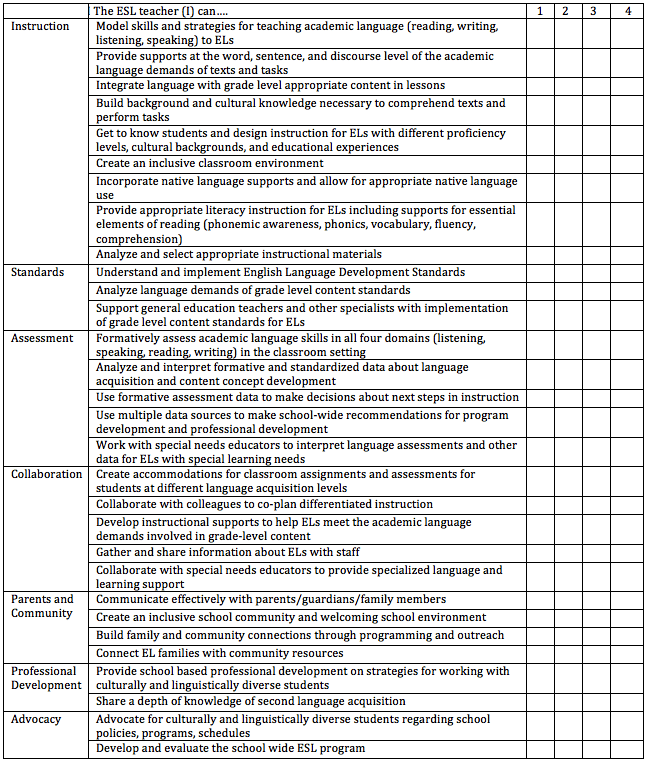 Scenario 1: Instruction
 team leader who supported her colleagues with lesson planning and instructional strategies. When the ESL teacher retired, the principal recruited Jane to lead the ESL program that supported over sixty percent of the student body. He recognized Jane’s strengths as an instructional leader and asked me to teach her to be an instructional coach. Over the past two years, Jane has become a skilled coach helping her colleagues at all grade levels to implement strategies for working with ELs. When the ESL teacher becomes an instructional leader, she can impact all students and teachers.
 Formative, summative, and standardized assessments can all contribute information that help ESL teachers make effective instructional and programmatic decisions. For years, Lisa, a secondary ESL specialist at a middle school with high numbers of newcomers, maintained efficient longitudinal language acquisition data on her students and reviewed the data for trends regularly, but she had no formal position in the school’s leadership or data team. Unfortunately, much of her information was not shared with her colleagues. During one meeting with the school’s leadership team, I asked Lisa to share her data about a student being considered for special education. The principal quickly realized that Lisa’s careful documentation and detailed analyses were essential for decision making. Lisa is now included on the school’s data team and all ELs and teachers benefit from her insights. ESL teachers who are skilled at data analysis can help school leaders and their colleagues meet the special needs of ELs.
  Later we developed a parent-child reading program on those mornings. After participating in the morning language classes, native Spanish speaking parents felt more comfortable at school and attended school functions at a higher rate. When ESL specialists offer adult language classes, conduct home visits, and provide information about community resources, parent engagement increases and the entire school community benefits.
 Advocating for ELs comes naturally to many ESL specialists, but others feel intimidated or overwhelmed with the prospect of speaking out to school and district leaders about the needs of their students. In one district with low graduation rates for ELs, the high school ESL specialist, Sherry, first addressed the issue within her circle of influence. With support from the administration, she created a peer-tutoring program and worked closely with the school’s guidance counselor to create schedules for the ELs that would put them on the path to graduation. In just two years, Sherry’s efforts paid off—the EL graduation rate increased significantly. She now serves on a district-wide committee dedicated to ensuring that ELs graduate. ESL teachers who advocate for their students can make a significant, positive impact on their education and futures.
 Most teachers are now more than halfway through the summer and hopefully, most of us have had some peaceful rest and relaxation with our families. For my family, the last six weeks of school were some of the busiest, most stressful weeks we had all year. There were birthdays, graduations, graduation parties, college deadlines, and the usual end of year responsibilities as well. This past winter, we decided we would leave as soon as school was out for a graduation celebration trip, so add “prepare for a 10-day trip out of the country” to the above list of stressors, as well!
 1.) No matter where you’re headed, whether for a month or a weekend, pack light. Having fewer things simplifies your life. When you think about how many decisions you have to make each day, even every minute of every school day, having fewer decisions to make will cut your stress in half. Testing this tactic over the summer will pay off once the school year resumes. Have small kids? Pre-plan their outfits and roll each of them together. Allow them to decide which one to wear each day and you can rest easy knowing they will match.
 4.) Trade Facebook for FACETime ― and I don’t mean the calling feature on your iPhone. Everyone wants to preserve their memories; just don’t spend so much time preserving that you forget to live it with your family. Take the photos you want, check in where you want, but save the posting for later when everyone is having down time. No one ever regrets not spending time on their phones, but many people regret not being present with their family. You will want your kids’ memories of you to be of you fully engaged with them and not fully engaged with a phone.
  During our last vacation, I sat outside on the patio reading one of the books I bought on the trip. Below me in the ocean, I could see my two guys playing in the turquoise water that was still sparkling as the sun started to dip below the horizon. There was a light and steady breeze blowing across my skin and among the background sound of the crashing waves, I heard my daughter on the balcony above me begin to play a slow, mellow song on the ukulele. Time seemed to stand still and all I could do was sit, smile, and soak it all in.