


edCircuit
  • Start Here
    • Login
    • Register
    • Subscribe
    • Submit a Press release
    • Advertise or Sponsor
    • Contribute
    • Get Interviewed
  • On the Wire
  • EdTech
    • All EdTech
    • Online Learning
    • Hybrid and Remote Learning
    • Augmented and Virtual Reality
    • ESports
    • Gamification and Game-Based Learning
    • Digital Citizenship
    • EdTech Entrepreneurs
    • Market Trends
    • Future of Education
  • Artificial Intelligence
  • K-12 Education
    • All K-12
    • K-12 Teachers
    • Teaching Strategies
    • Special Education and IEPs
    • Dyslexia
    • Gifted and Advanced Learning
    • Early Childhood, Pre-K and Kindergarten
    • School Calendar
    • Tutoring and Homework Help
    • Attendance and Absenteeism
    • After-School Programs
    • School Counselors
    • Homeschooling
    • School Models
    • Teacher Retention
    • Parents
    • Students
    • STEM and STEAM Education
  • Teaching and Learning
    • Literacy and Reading
    • Math Education
    • Civics and History Education
    • Financial Literacy
    • Assessment and Testing
    • Curriculum and Instruction
    • Personalized Learning
    • Project-Based Learning
    • Social-Emotional Learning
    • Executive Function
    • Creativity
    • Diversity, Equity, Inclusion
  • Professional Development
    • All Professional Development
    • Educators
    • Administrators
    • edLeaders
  • Higher Education
    • All Higher Education
    • College Admissions
    • Career and Technical Education (CTE)
    • Graduation
    • FAFSA and Financial Aid
    • Student Loans
  • Cybersecurity
  • School Safety
    • All School Safety
    • Science and Lab Safety
    • School Design and Facilities
    • Bullying
    • Duty of Care and School Liability
  • Continuing Education
    • All Continuing Education
    • Online Certificate Programs
    • Teaching Jobs and Careers
    • Teacher Appreciation
  • Education Policy and Government
    • All Education Policy
    • Department of Education
    • School Choice
    • Global
    • Advocates
  • EDU Shows
    • All EDU Shows
    • Safer Ed
    • Mind the Gap
    • Education Industry Questions
    • CoffeEd
    • InFocus
    • InformED Report
  • EDU Podcasts
    • All EDU Podcasts
    • Author Chats
    • CoSN The Podcast
    • Education Today
    • Building the Bridge
    • Students Speak
  • Education Industry Guides and Reports
  • Archived Media
    • Future of School: The Podcast
    • Equity Everywhere
  • About edCircuit
  • Subscribe
edCircuit
  • LOGIN
Home Tags Posts tagged with "Headline"
Tag:

Headline

This if for posts to be in the featured/top section of site
Business meeting in an office with laptops displaying AI in K–12 Procurement graphics, as participants discuss data and charts shown on large screens and papers.
Market TrendsHot Topics - controversialArtificial IntelligenceK-12

AI in K-12 Procurement: The Vendor Shift Ahead

by EdCircuit Staff March 23, 2026
written by EdCircuit Staff 4 minutes read

AI in K-12 procurement is not replacing sales teams, but it is changing how vendors compete, respond, and win in district markets.

As procurement has become more structured and compliance-driven, vendors have had to adapt. Artificial intelligence is accelerating that shift.

For VP-level sales leaders, CROs, revenue teams, and EdTech executives, the question is no longer whether AI will impact district sales. It already has. The real question is how to use it without undermining trust or long-term relationships.

Here’s where AI is reshaping vendor strategy.

AI Is Changing the RFP Game

K–12 Request for Proposal (RFP) requirements are more detailed and compliance-driven than they wereĀ even five years ago. Scoring rubrics are specific. Legal review is deliberate. Documentation must align precisely with district requirements.

AI is now being used to:

  • Draft structured first-pass responses

  • Mirror rubric language automatically

  • Pull from prior proposal libraries

  • Flag missing compliance elements

That reduces turnaround time dramatically.

But faster does not mean better.

District reviewers are already seeing proposals that look polished at first glance but lack depth when pressed. The structure is strong. The language is clean. Yet when follow-up questions surface around implementation, integration, or measurable outcomes, the response weakens.

That’s where credibility erodes.

AI can organize information and accelerate drafting. It cannot demonstrate a lived understanding of a district’s instructional priorities, board dynamics, or operational constraints.

The vendors who win will use AI to remove friction in preparation, then invest real time in tailoring their response.

Efficiency gets you to submission.
Relevance gets you shortlisted.
Specificity gets you awarded.

Predictive Targeting Is Getting Smarter

AI is also reshaping how vendors identify and prioritize districts.

Instead of relying solely on territory assignments or informal signals, vendors can now analyze:

  • Budget trends

  • Public board minutes

  • Technology adoption patterns

  • Staffing changes

  • Funding announcements

AI tools can surface districts entering purchasing cycles or expanding strategic initiatives.

That shifts sales from reactive to proactive.

But predictive insight only works if paired with disciplined relationship development. A data signal may tell you where to look. It does not build trust for you.

Pricing Strategy Is Becoming Data-Driven

AI models are increasingly being used to evaluate:

  • Historical win-loss outcomes

  • Competitive pricing patterns

  • Regional budget norms

  • Renewal retention rates

This allows vendors to simulate pricing strategies before submitting proposals.

In subscription-heavy K–12 markets, that matters. AI can reveal whether aggressive first-year discounts correlate with renewal churn. It can highlight pricing structures that support multi-year retention.

But districts are also becoming more sophisticated buyers. Transparent pricing and predictable renewal terms are often valued more than short-term incentives.

AI should clarify, not complicate, the pricing strategy.

Contract Review and Risk Screening

Legal review is now one of the most time-intensive stages of K–12 procurement.

AI-assisted contract tools help vendors:

  • Flag data privacy conflicts

  • Identify insurance compliance gaps

  • Compare district terms to standard language

  • Predict negotiation friction points

Used well, this shortens cycles and prevents late-stage surprises.

But sensitive negotiations still require human judgment. District legal teams expect accountability, not automation.

AI can surface issues quickly. It cannot assume responsibility for resolving them.

The Hidden Risk: Proposal Saturation

As AI lowers the effort required to respond to RFPs, districts may see an increase in submissions.

More proposals do not automatically mean stronger competition.

If responses begin to sound templated or overly polished without clear local alignment, procurement teams will adjust. Evaluation criteria may shift toward demonstrated implementation credibility, reference strength, and operational proof.

Automation does not lower the bar. It often raises it.

Vendors who rely entirely on AI-generated narratives risk blending into a field of well-written but indistinguishable competitors.

What Sales Leaders Should Be Doing Now

The opportunity is not to replace teams. It is to strengthen them.

Use AI for Preparation, Not Performance

Let AI accelerate drafting and organization. Let humans refine strategy and alignment.

District buyers can quickly identify when a response lacks an authentic connection to their goals.

Build AI Literacy Across Revenue Teams

Sales, proposal, and legal teams should understand:

  • Where AI creates efficiency

  • Where human oversight is essential

  • How to preserve voice and clarity

Disciplined adoption creates leverage. Unstructured adoption creates exposure.

Protect Brand Authenticity

In K–12 markets, long-term contracts depend on trust.

If AI use leads to vague claims, inconsistent messaging, or inflated outcomes, relationships suffer.

AI should strengthen clarity, not dilute credibility.

Anticipate Procurement Response

As vendors adopt AI, districts will respond with tighter expectations, deeper follow-up questioning, and greater scrutiny of implementation claims.

Vendors should expect that sophistication on one side drives sophistication on the other.

The Strategic Shift

AI in K–12 procurement is compressing timelines and increasing analytical capacity across the vendor landscape.

But efficiency alone does not win in education.

Districts still evaluate alignment with instructional priorities, long-term partnership value, renewal stability, and implementation support.

AI can sharpen preparation. It can strengthen internal strategy. It can improve precision.

It cannot replace understanding how districts actually operate.

The vendors who succeed in the next phase of K–12 procurement will not be those who automate the most.

They will be those who automate intelligently, then engage intentionally.

And districts will notice the difference.

Subscribe to edCircuit to stay up to date on all of our shows, podcasts, news, and thought leadership articles.


March 23, 2026 0 comments
0 FacebookTwitterPinterestLinkedinWhatsappCopy LinkEmail
A group of students walk from an old, abandoned school bearing a For Sale sign—a nod to Higher Education Closures—to a modern tech and healthcare institute, symbolizing educational transformation.
Hot Topics - controversialHigher Education

Higher Education Closures Reshape the Sector

by EdCircuit Staff March 20, 2026
written by EdCircuit Staff 6 minutes read

Higher education closures rarely begin with a headline. They begin with small, quiet signals — a hiring freeze that isn’t lifted, residence halls that no longer fill, emergency fundraising emails that grow more urgent, a commencement ceremony where faculty and families realize it may be the last.

When Bacone College ended its 145-year run, when Limestone University’s final campaign fell short, when Trinity Christian College and others announced their teach-outs, the immediate story was institutional. But taken together, these closures — along with mergers in New Jersey, North Carolina, and Missouri and acquisition talks in California — reveal something far larger.

This is not a cycle.

This is a structural redesign of American higher education.

A Pattern That Can No Longer Be Dismissed

Over the past two years, closures, pauses, and consolidations have touched nearly every institutional category: private liberal arts colleges, faith-based campuses, minority-serving institutions, regional publics, and specialized professional schools.

Martin University’s short-lived operational pause turned into a permanent closure.
Sterling College in Vermont is shutting down despite a distinctive environmental mission.
Lourdes University in Ohio is announcing its closure in a region already facing demographic contraction.
LabourƩ College of Healthcare is being absorbed to preserve its nursing pipeline.
Washington University is acquiring a pharmacy school to expand strategically rather than build from scratch.

Individually, each decision has its own financial and governance story.

Collectively, they point to a system realigning capacity with reality.

The Demographic Clock Has Run Out

For more than a decade, higher-ed leaders spoke about the ā€œenrollment cliffā€ as a future problem. It is now a present-day constraint.

The number of traditional college-age students is shrinking — most sharply in the Midwest and Northeast, where many tuition-dependent private institutions are located. Those regions built dense ecosystems of small colleges for a population that no longer exists in the same numbers.

You cannot out-recruit a demographic decline.

At the same time, fewer high school graduates are moving directly into four-year institutions. Alternative pathways — workforce entry, short-term credentials, employer-funded education, and community college transfers — are no longer secondary options. For many students, they are the first choice.

The Tuition-Driven Model Is Under Maximum Stress

Most of the institutions closing share a common profile:

High tuition dependence
Small endowments
Limited pricing flexibility
Deferred maintenance
Rising discount rates

When enrollment drops, the financial model does not bend. It breaks.

Emergency fundraising campaigns can delay the outcome, but they rarely change the trajectory. Limestone’s final appeal demonstrated how difficult it is to close a structural gap with one-time philanthropy.

The result is a growing number of boards facing the same question:
Is closure more responsible than slow institutional erosion?

Mergers Are No Longer a Last Resort

If closures represent one side of the transformation, mergers and acquisitions represent the other.

The definitive agreement between New Jersey City University and Kean University is not just a rescue — it is a prototype for public-sector stabilization. Catholic college consolidations are being driven not only by finances but by demographic strategy. Large research universities are acquiring specialized schools to accelerate program growth in healthcare, pharmacy, and applied fields.

The stigma around mergers is disappearing.

In its place is a new reality: survival through scale, shared services, and system integration.

Why This Matters to K-12 Leaders

This is not a higher-ed story alone.

It is a K-12 pipeline story.

When regional colleges close:

Dual-enrollment partnerships disappear
Teacher preparation pipelines shrink
Local scholarship pathways are disrupted
Students lose nearby transfer options
Workforce alignment fractures

In many communities, the closest and most accessible four-year institution is also the primary destination for first-generation students.

When that campus closes, postsecondary access changes overnight.

For superintendents and district leaders, this means postsecondary planning can no longer be based on historical assumptions. The map is being redrawn in real time.

The Human and Community Impact

A college closure is not just an academic event.

It is an economic shock to a town.
It is a cultural loss for a region.
It is a professional displacement for faculty and staff.

In some communities, the institution is the largest employer, the primary arts venue, the healthcare partner, and the identity anchor.

When it closes, the question becomes: what does the campus become next?

Across the country, former college properties are being redeveloped into housing, innovation hubs, healthcare facilities, and mixed-use spaces. The afterlife of these campuses will shape local economies for decades.

Is This a Trend? Yes — and It Will Accelerate

Even moderate declines in enrollment are projected to significantly increase closure rates.

The next decade will not bring a return to the old equilibrium. It will bring:

Fewer but larger institutions
System-level governance models
Expanded adult-learner enrollment strategies
Workforce-aligned academic portfolios
Year-round and hybrid delivery structures

The four-year residential experience will remain powerful — but it will no longer be the dominant model for most students.

What Surviving Institutions Are Doing Differently

The campuses most likely to thrive are not simply cutting costs.

They are:

Redefining their mission for a specific population
Aligning programs with regional workforce demand in healthcare, advanced manufacturing, AI, and applied technologies
Building deep employer partnerships
Designing stackable credential pathways
Collaborating instead of competing with neighboring institutions

They are becoming ecosystem institutions, not standalone campuses.

The Leadership Question That Matters Now

The most important shift is not financial.

It is strategic.

For decades, higher education operated on an assumption of perpetual growth. Planning models, facilities, staffing, and program expansion were built around that expectation.

That era is over.

The central question for presidents, boards, and system leaders is no longer:

How do we avoid becoming the next closure?

It is:

What role must our institution play in a smaller, more competitive, more interconnected postsecondary landscape?

Because the institutions that will define the next generation of higher education are not the ones that simply survive.

They are the ones that redesign themselves — in partnership with K-12 systems, workforce leaders, and their communities — for a different future.

The Signal for the Entire Education Sector

For K-12, higher education, and edtech leaders alike, these closures are not warnings from the edge of the system.

They are indicators from its center.

They tell us that:

Demographics now drive strategy
Access must be redesigned regionally
Partnerships are the new infrastructure
Institutional identity must be clear and defensible

The campuses going dark are not just endings.

They are the clearest possible signal that the education continuum — from middle school career exploration to lifelong learning — is being rebuilt.

And the leaders who recognize that shift early will shape what comes next.

Play video: The Enrollment Cliff (3 minutes 38 seconds)3:38
The Enrollment Cliff3 min 38 sFuture U. Podcast on YouTube

Future U. Podcast –Ā The Enrollment Cliff (Play video)

Subscribe to edCircuit to stay up to date on all of our shows, podcasts, news, and thought leadership articles.

March 20, 2026 0 comments
0 FacebookTwitterPinterestLinkedinWhatsappCopy LinkEmail
A business meeting with six professionals discusses data on a screen showing a robot, charts, and profiles, suggesting a presentation on AI and Governance or automation.
Artificial IntelligenceK-12Hot Topics - controversial

AI and Governance in School Districts

by EdCircuit Staff March 19, 2026
written by EdCircuit Staff 5 minutes read

AI and governance in school districts are no longer parallel conversations. They are inseparable. As artificial intelligence becomes embedded in assessment systems, intervention dashboards, predictive analytics, and operational platforms, district leaders are discovering that AI adoption is not a technology upgrade—it is a governance mandate.

The districts that benefit from AI will not be the ones that adopt fastest. They will be the ones that govern best.

For superintendents, school boards, CIOs, CTOs, and cabinet leaders, the stakes are structural: public trust, legal exposure, equity outcomes, and long-term data architecture.

AI Is Infrastructure, Not a Pilot Program

In previous waves of edtech adoption, districts could pilot a platform at a grade level or in a single department. AI does not operate in isolation.

Modern AI-enabled systems draw from:

  • Student information systems

  • Assessment archives

  • Attendance records

  • Behavioral data

  • Intervention logs

  • Longitudinal academic histories

When an AI system pulls from multiple data streams, it becomes embedded in district infrastructure. It shapes recommendations, flags students, influences placement decisions, and informs resource allocation.

That means governance cannot be reactive.

District leaders must determine in advance:

  • What data streams AI tools may access

  • What decisions AI may inform

  • What decisions AI may never influence

  • How outputs are reviewed and validated

Without clear guardrails, AI drifts from assistance to authority.

A District Scenario: When Governance Lags Adoption

Consider a hypothetical example: a mid-sized suburban district implementing an AI-powered predictive analytics tool designed to identify students at risk of academic failure.

The vendor integrates with the district’s SIS, attendance records, and discipline data. Within weeks, the system generates risk scores for middle school students.

Administrators notice that a disproportionately high number of flagged students come from two specific neighborhoods. The tool weighs attendance patterns heavily. Those neighborhoods, however, experience transportation instability due to bus route shortages and seasonal housing mobility.

Without governance oversight, the system’s output could lead to unintended consequences:

  • Increased monitoring of specific students

  • Lowered academic expectations

  • Placement into intervention programs without contextual review

In response, district leadership convenes an AI oversight committee. They audit the algorithm’s weighting structure, adjust attendance thresholds, and require human review before any placement decision is made.

The result: the tool shifts from labeling to informing.

This is the difference governance makes.

AI itself did not create inequity. A lack of structured oversight nearly did.

Data Privacy: Beyond Compliance

AI systems require volume. Volume requires protection.

FERPA compliance is the baseline—not the ceiling.

District leaders must ensure:

  • Data minimization practices are in place

  • Contracts prohibit secondary data usage

  • Encryption standards meet current cybersecurity benchmarks

  • Data retention timelines are explicit

  • Exit clauses require data deletion upon contract termination

Boards should ask vendors directly:
If our district ends this contract, how is student data purged and verified?

Governance requires specificity, not assumptions.

Algorithmic Bias and Equity Audits

AI models are trained on historical data. If that data reflects systemic inequities, outputs may replicate them.

Governance requires districts to:

  • Conduct regular bias audits

  • Analyze subgroup impact

  • Review predictive weighting variables

  • Require vendor transparency on model updates

Leaders must insist that AI outputs are explainable. If a model cannot clarify why a student was flagged, it should not influence placement decisions.

The strongest AI implementations treat data as insight—not verdict. They inform decisions; they do not make them.

Codifying that principle protects both students and institutions.

Procurement Must Evolve

Traditional procurement processes often focus on:

  • Cost

  • Compatibility

  • Feature set

AI procurement must add:

  • Model transparency

  • Bias testing documentation

  • Liability clarity

  • Vendor financial stability

  • Independent security certifications

AI contracts are not annual software subscriptions. They shape longitudinal student data ecosystems.

District leaders should treat them accordingly.

Professional Capacity Is Governance

Even the most responsible AI framework fails without educator readiness.

If teachers interpret risk scores as definitive rather than advisory, governance breaks down at the classroom level.

Strong districts invest in:

  • Ongoing AI literacy training

  • Clear decision protocols

  • Cross-department alignment between curriculum, IT, and equity teams

  • Feedback systems for frontline educators

Governance lives in practice, not policy binders.

Cybersecurity: Expanding the Risk Surface

Every AI integration expands a district’s attack surface.

Cloud-based processing, API integrations, and data transfers create additional entry points for malicious actors.

Governance must include:

  • Vendor security audits

  • Multi-factor authentication standards

  • Incident response simulations

  • Breach notification protocols

Cybersecurity oversight is not separate from AI governance. It is foundational to it.

Transparency and Public Trust

Communities are increasingly aware of AI’s influence in public institutions. Silence invites suspicion.

District leaders should proactively communicate:

  • Where AI tools are used

  • What data they access

  • How decisions are reviewed

  • What safeguards are in place

Board-level briefings and parent forums strengthen confidence.

Public trust is not a byproduct of AI success—it is the product of governance clarity.

Strategic Alignment: AI Must Serve the Mission

AI adoption should map directly to district priorities:

  • Closing achievement gaps

  • Improving early intervention

  • Increasing operational efficiency

  • Strengthening data-driven instruction

If AI does not clearly advance strategic goals, it becomes a distraction rather than an advancement.

The question for superintendents is not, ā€œIs this innovative?ā€
It is, ā€œDoes this advance our mission without compromising our values?ā€

Leadership Defines the Outcome

AI will influence assessment, intervention, scheduling, budgeting, and communication across school systems. That influence is inevitable.

What is not inevitable is how responsibly it will be governed.

Districts that:

  • Establish formal AI governance committees

  • Conduct ongoing bias audits

  • Maintain strict data oversight

  • Require human review of algorithmic outputs

  • Communicate transparently with stakeholders

…will harness AI as a force multiplier.

Those that adopt without structure risk scaling inequity, exposure, and distrust.

AI does not replace leadership.

It magnifies it.

In the era of artificial intelligence, governance is not an afterthought. It is the defining responsibility of district leadership.

Subscribe to edCircuit to stay up to date on all of our shows, podcasts, news, and thought leadership articles.
March 19, 2026 0 comments
0 FacebookTwitterPinterestLinkedinWhatsappCopy LinkEmail
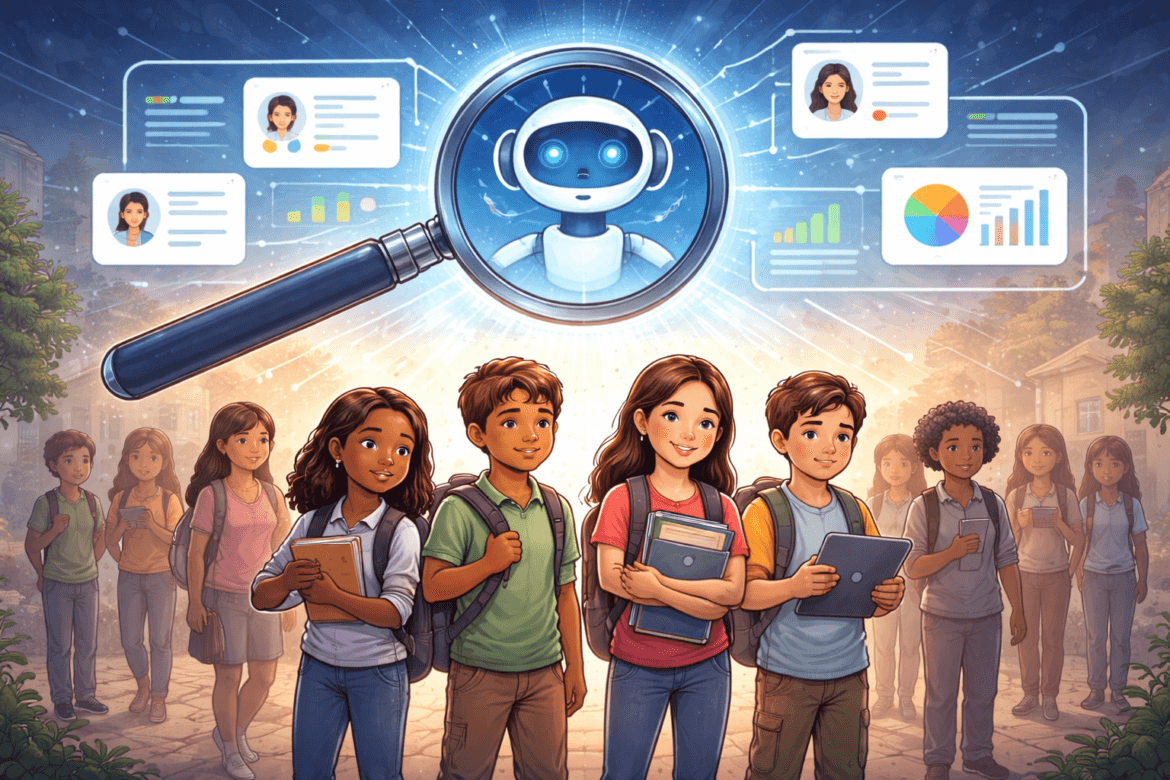
A group of students stand outdoors with books and tablets, while a digital interface above shows a magnifying glass highlighting how AI can help close achievement gaps in education through data charts, robot icons, and student profiles.
Hot Topics - controversialArtificial IntelligenceK-12Assessment and Testing

AI and Achievement Gaps in Education

by EdCircuit Staff March 18, 2026
written by EdCircuit Staff 6 minutes read

AI and achievement gaps in education are becoming central to conversations about how artificial intelligence will shape the future of schooling. As districts adopt AI-driven assessment tools, adaptive learning platforms, and predictive analytics, a critical question emerges: will these technologies narrow long-standing disparities, or risk reinforcing them?

The answer depends less on the technology itself and more on how schools implement it.

For educators, administrators, equity advocates, and school board members, the moment demands both optimism and caution.

The Promise: Earlier, More Precise Identification

One of the strongest arguments for AI as an equity accelerator lies in its ability to detect patterns that traditional systems may miss.

Historically, achievement gaps have been identified after students fall significantly behind. Standardized test cycles, semester report cards, and delayed referrals often meant that support arrived late. By then, academic gaps were wider, and confidence had eroded.

AI-enhanced systems shift that timeline.

Modern adaptive assessment platforms can analyze:

  • Skill-level weaknesses in reading and math

  • Response inconsistencies that suggest executive function challenges

  • Language acquisition patterns among English learners

  • Growth trends across demographic subgroups

Instead of waiting for a student to fail a high-stakes exam, AI tools can flag subtle warning signs in real time.

For example, an elementary literacy screener might detect that a student is decoding accurately but struggling with vocabulary-based comprehension. Without AI-level pattern recognition, that nuance may not be visible until much later.

In this way, AI can function as an early alert system—identifying disparities before they solidify.

The Risk: Bias Embedded in Algorithms

However, technology is not neutral.

AI systems are trained on data. If that data reflects historical inequities, the outputs can replicate or amplify them.

Consider predictive models that identify students ā€œat riskā€ of academic failure. If training data is disproportionately influenced by socioeconomic variables, attendance patterns, or disciplinary history, the system may inadvertently flag students from certain communities more frequently—even when individual growth patterns suggest resilience.

Similarly, language processing algorithms may misinterpret dialectal variation or emerging bilingual proficiency as an academic weakness.

For school leaders, this raises important questions:

  • Who designed the algorithm?

  • What data was used to train it?

  • How often is bias testing conducted?

  • Are educators trained to question outputs rather than accept them automatically?

AI and achievement gaps in education intersect most critically at this point: automation without oversight can entrench inequity.

The Human Layer: Professional Judgment Still Matters

The strongest AI implementations treat data as insight—not verdict.

A dashboard might highlight that a student’s performance fluctuates across testing sessions. The AI may interpret that as inconsistency or disengagement. A teacher, however, might recognize housing instability, caregiving responsibilities, or emotional stressors.

AI surfaces patterns. Humans interpret context.

For special education coordinators and intervention teams, this distinction is vital. Decisions about tiered intervention, RTI placement, or IEP evaluation must never be outsourced to algorithms.

Instead, AI should support earlier and more informed discussions—not replace professional expertise.

When educators are empowered to interrogate AI outputs, equity is strengthened.

Digital Access and Infrastructure Gaps

Equity challenges are not limited to algorithm design.

AI-driven platforms depend on reliable devices, connectivity, and consistent usage. Districts with uneven technology access may experience distorted data patterns.

If a student has limited internet access at home, adaptive practice tools may interpret reduced engagement as academic weakness. If devices are shared among siblings, usage patterns may not accurately reflect performance.

For administrators and board members, closing achievement gaps through AI requires infrastructure equity as well:

  • Device access

  • Broadband reliability

  • Technical support

  • Family digital literacy

Without these foundational elements, AI systems can generate misleading conclusions.

English Learners and Cultural Context

One of the most delicate intersections of AI and achievement gaps in education involves English learners.

Adaptive systems may struggle to distinguish between language acquisition challenges and conceptual misunderstandings. A student solving math problems incorrectly due to language interpretation may be flagged for math intervention rather than language support.

Culturally responsive implementation requires:

  • Assessments validated across diverse linguistic groups

  • Professional development for teachers interpreting AI data

  • Ongoing monitoring for subgroup performance disparities

When properly calibrated, AI can actually enhance support for multilingual learners by identifying growth trajectories more precisely. But calibration matters.

The Opportunity: Precision Over Generalization

Despite legitimate concerns, AI also offers something traditional systems rarely provide—precision.

Achievement gaps have historically been discussed in broad demographic terms. AI systems can analyze within-group variation, ensuring that students are not reduced to averages.

Rather than labeling entire subgroups as underperforming, AI can identify individual skill patterns within those groups.

This level of precision enables:

  • Targeted small-group instruction

  • Adaptive skill reinforcement

  • Early micro-interventions

  • Continuous progress monitoring

Instead of waiting for broad gap reports, educators can respond in weeks rather than years.

That responsiveness is where AI holds genuine equity potential.

Transparency and Governance: The Role of Leadership

District leaders must treat AI adoption as a governance decision, not merely a procurement decision.

Questions boards should be asking include:

  • What student data is being stored?

  • How long is it retained?

  • Who has access?

  • Are parents informed about AI usage?

  • Is there an audit process for bias review?

Transparency builds trust.

Parents deserve clarity about how AI tools influence instructional decisions. Educators deserve professional development that equips them to interpret outputs responsibly.

When governance structures are intentional, AI becomes a tool for equity rather than a source of risk.

Reframing the Goal

The ultimate question is not whether AI can eliminate achievement gaps entirely. No technology alone can overcome systemic inequities tied to funding, housing stability, healthcare access, or community resources.

The real opportunity lies in reducing delay.

If AI helps identify reading gaps in first grade rather than fourth, that is meaningful progress.
If it helps distinguish between language acquisition and conceptual misunderstanding, that matters.
If it empowers teachers with earlier insight rather than year-end surprises, that strengthens instruction.

AI and achievement gaps in education are intertwined because the stakes are high. The tools have power. So do the implementation decisions.

What Works Without Technology: Active Learning

Not every approach to the achievement gap depends on new technology. In 2017, edCircuit reported on a study in the journal CBE—Life Sciences Education, led by Cissy Ballen, then a postdoctoral associate in the University of Minnesota’s College of Biological Sciences. The study found that active learning, such as working in groups and taking part in class discussions, improved outcomes for underrepresented minority students in undergraduate biology and raised self-confidence among all students.

The same edCircuit coverage pointed to two other routes: studying the teaching practices of nations with high achievement, and improving professional learning for teachers. Both fit the argument above. A tool that flags a gap earlier still depends on what teachers do next in the classroom, and active learning is one option with research behind it.

Moving Forward with Intention

The future of equity in education will not be determined by algorithms alone. It will be shaped by the leaders who choose how those algorithms are used.

When districts commit to:

  • Rigorous bias review

  • Ongoing professional development

  • Infrastructure equity

  • Transparent communication

  • Human-centered decision-making

AI can become part of a broader strategy to narrow opportunity gaps.

When implementation is rushed or oversight is weak, disparities can widen.

The technology itself is neither savior nor villain. It is an amplifier.

The challenge—and the opportunity—for educators, administrators, advocates, and school board members is to ensure that AI amplifies opportunity, not inequity.

If schools approach AI with clarity, intentionality, and accountability, it may not solve achievement gaps alone—but it can help ensure that fewer students slip through the cracks before support arrives.

And that is a powerful place to begin.

Subscribe to edCircuit to stay up to date on all of our shows, podcasts, news, and thought leadership articles.

March 18, 2026 0 comments
0 FacebookTwitterPinterestLinkedinWhatsappCopy LinkEmail
A woman assists two children working on laptops at a desk with books and papers, embracing homeschooling while a virtual lesson with a teacher is displayed on a laptop screen.
K-12HomeschoolingEdTechHot Topics - controversialSchool Choice

Homeschooling Growth Fueled by Education Technology

by EdCircuit Staff March 17, 2026
written by EdCircuit Staff 6 minutes read

Homeschooling growth is no longer a temporary pandemic story. National survey estimates suggest roughly 6% of U.S. school-aged children are homeschooled, a sustained increase over pre-2019 levels. What began as an emergency response has, for many families, become a permanent shift.

The reasons vary. Some parents cite academic dissatisfaction. Others point to school safety, flexibility, special learning needs, or values alignment. But beneath those motivations lies a structural change that rarely gets enough attention: the infrastructure for homeschooling is radically different than it was even 10 to 15 years ago.

Technology did not invent homeschooling. But it has lowered the barrier to entry in ways that have made it viable for more families.

Before and After: What Changed

To understand the rise, it helps to look backward.

Fifteen years ago, homeschooling often meant purchasing boxed curriculum, teaching directly from printed manuals, managing lesson plans on paper, and manually assembling portfolios to document progress. Parents carried nearly the entire instructional load. If a student struggled with Algebra II or chemistry, the parent either mastered the material or hired a local tutor. Rural families had limited access to enrichment or advanced coursework. Documentation for state compliance could be time-consuming and inconsistent.

Today, families can build what looks remarkably like a digital school system at home.

Modern homeschooling frequently includes:

  • Standards-aligned online curriculum platforms

  • Adaptive practice tools that adjust difficulty automatically

  • Video-based direct instruction in advanced subjects

  • Auto-graded assessments with performance dashboards

  • Digital portfolios and transcript generators

  • Live online classes and virtual enrichment

Learning management systems, once primarily used by districts and universities, now sit at the center of many homeschool environments. An LMS allows parents to organize assignments, track pacing, monitor mastery, and generate progress reports in a structured way. The administrative burden that once deterred many families has been significantly reduced.

In short, homeschooling moved from analog and parent-dependent to digitally supported and systemized.

That shift matters.

Did Technology ā€œOpen Doorsā€?

It is difficult to establish a direct causal link between edtech growth and homeschooling expansion. Families choose homeschooling for personal, cultural, or educational reasons. Policy changes in some states, including education savings accounts and expanded school choice programs, also play a role.

However, several realities suggest technology has meaningfully expanded feasibility.

First, participation in homeschooling has remained elevated even after schools reopened fully. If growth were driven purely by temporary health concerns, we would expect a sharp reversion to pre-2019 norms. Instead, estimates have stabilized at higher levels.

Second, more states report record or near-record homeschool registrations in recent years. That persistence suggests infrastructure, not emergency reaction, is sustaining participation.

Third, the cost-benefit calculation for parents has shifted.

Technology has opened doors in four specific ways:

1. Academic Access

Parents no longer need subject-matter expertise in every discipline. High-quality video instruction, interactive simulations, and adaptive math platforms reduce dependence on parent-led lecture.

2. Geographic Equity

A rural student can take an advanced coding class or join an online live writing seminar. The zip code barrier has weakened.

3. Administrative Simplicity

Progress tracking, attendance logs, and portfolio documentation can now be generated automatically through digital systems.

4. Flexible Work Integration

Working parents can assign structured, self-paced modules while maintaining oversight through dashboards and scheduled check-ins.

This does not mean homeschooling is easy. It requires time, structure, and intentionality. But technology has reduced friction. And reducing friction expands participation.

That said, accessibility is not universal. Reliable internet, devices, and parent availability remain prerequisites. In that sense, edtech may expand opportunity most for families who already possess certain resources. The digital divide still matters.

The Unbundling of School

One of the most significant shifts enabled by technology is the unbundling of school itself.

In traditional public education, academics, extracurriculars, socialization, counseling, and services are bundled into a single enrollment structure.

Digital infrastructure now allows families to separate those components.

A student might:

  • Complete core academics at home through online curriculum

  • Participate in a homeschool co-op for labs

  • Hire a remote tutor for upper-level math

  • Join a community athletic league

  • Request access to public school extracurriculars

Technology makes coordination possible. Calendars sync. Assignments upload. Communication centralizes.

For districts, this unbundling creates a new reality: students who want to belong without fully enrolling.

What This Means for School Districts

As homeschooling grows, districts increasingly face requests from homeschool families to participate in athletics, the arts, clubs, or even part-time coursework.

Whether homeschool students may participate depends on state law, district policy, and activity association rules.

Many states have adopted what are commonly called ā€œTebow laws,ā€ named after former NFL quarterback Tim Tebow, who was homeschooled and played high school football through a public school. These laws generally allow homeschool students to participate in interscholastic extracurricular activities under certain conditions.

However, implementation varies widely.

Some states require participation only at the zoned public school. Others impose academic eligibility documentation, periodic grade checks, or standardized test benchmarks. Athletic associations may impose additional compliance rules.

Even where the law permits access, districts wrestle with practical concerns:

  • How do we verify academic eligibility?

  • Who monitors attendance equivalency?

  • How are disciplinary codes enforced?

  • Are roster spots guaranteed or competitive?

  • How do participation fees and insurance apply?

Consider a simple scenario.

A homeschooled sophomore wants to join the varsity soccer team. The district requires proof of residency, documentation demonstrating academic progress comparable to enrolled students, and a signed agreement to the student code of conduct. The student must try out; placement is not guaranteed. If selected, they must follow all team rules and meet all eligibility checkpoints.

This model attempts to balance access and fairness.

Districts that respond reactively often encounter friction. Districts that publish transparent policies reduce confusion. Clear timelines, documentation requirements, and enforcement standards protect both enrolled and homeschooled students.

Special Services and Part-Time Access

Beyond extracurriculars, districts also navigate requests related to evaluations, part-time enrollment, and special education services.

Legal obligations vary by state and federal interpretation. In many cases, homeschooled students do not automatically receive the full suite of services provided to enrolled students, but districts may have obligations related to evaluation or proportionate-share services.

This legal complexity underscores an important point: the growth of homeschooling is not just an instructional shift. It is a governance challenge.

A Structural Shift, Not a Trend

The sustained growth of homeschooling suggests this is not a short-lived reaction but part of a broader restructuring of education delivery.

Technology has not replaced schools. It has expanded the ecosystem.

Parents today can assemble an education using interoperable parts:

  • Digital curriculum platforms

  • Learning management systems

  • Remote instruction

  • Community-based enrichment

  • Public-school extracurricular participation

That flexibility changes expectations.

For some families, homeschooling is about autonomy. For others, it is about customization. For districts, it represents both competitive pressure and an opportunity for collaboration.

The deeper question may not be whether homeschooling will continue to grow. It may be whether public education systems adapt to a world in which enrollment is no longer the only way students engage with schools.

Technology did not create homeschooling. But it has undeniably lowered the structural barriers that once limited who could attempt it.

And when barriers fall, participation tends to rise.

Subscribe to edCircuit to stay up to date on all of our shows, podcasts, news, and thought leadership articles.

March 17, 2026 0 comments
0 FacebookTwitterPinterestLinkedinWhatsappCopy LinkEmail
Science classroom featuring STEM Lab Storage Safety, microscopes, shelves with plastic bins, boxes labeled supplies, and a central workspace with stools and various lab equipment.
STEM and STEAM EducationSafer EdScience and Lab SafetyK-12

STEM Lab Storage Safety: When Storage Becomes Risk

by EdCircuit Staff March 16, 2026
written by EdCircuit Staff 6 minutes read

Walk into almost any STEM lab, science classroom, or career and technical education space before students arrive, and the room typically looks organized and ready for learning. Cabinets are closed, materials appear neatly stored, and equipment sits exactly where it should be.

But stay in that room long enough and a different pattern begins to appear.

Microscopes stacked higher than intended. Robotics kits are placed on top of cabinets. Boxes of supplies are tucked into corners because there simply isn’t another place for them. None of these adjustments looks dangerous on its own. In fact, they often look like practical solutions created by teachers trying to make the most of the space they have.

Yet over time, those small decisions quietly change how the room functions.

Pathways narrow. Storage expands into workspaces. Equipment becomes harder to retrieve safely. What once felt like an open and flexible learning environment gradually begins operating closer to its limits.

That shift is why STEM lab storage safety deserves far more attention than it typically receives.

Safer Ed Podcast: When Storage Becomes Risk

This article accompanies the latest episode of the Safer Ed Podcast, where we examine how storage decisions quietly influence safety in STEM classrooms.

In the episode, we explore how equipment accumulation, vertical storage, and shrinking workspace capacity can affect supervision, movement, and emergency access in ways schools rarely recognize until a near miss occurs.

Listen to the full conversation below.

Safer EdWhen Storage Becomes Risk: The Hidden Safety System in STEM SpacesMarch 16, 2026 Ā· 8 min 37 sPlay episode: When Storage Becomes Risk: The Hidden Safety System in STEM Spaces (8 minutes 37 seconds)0:00-8:37Follow on SpotifyApple

The Hidden Safety System in STEM Spaces

When schools think about safety in science labs or technical classrooms, the focus usually lands on the obvious elements—chemicals, tools, safety procedures, and personal protective equipment.

Those elements are critical, but they represent only part of the safety system.

The physical environment itself also plays a powerful role in determining whether a space operates safely. Storage decisions influence how people move through a room, how teachers supervise activities, and whether emergency equipment remains accessible when needed.

The challenge is that storage pressure rarely appears overnight. Instead, it develops gradually as programs evolve.

A school adds robotics. A new engineering course introduces additional equipment. A biotechnology unit requires specialized materials. Each addition supports meaningful learning opportunities for students.

But every new tool or device also needs a place to live.

When the program grows faster than the space designed to support it, classrooms begin adapting in subtle ways.

Cabinets fill beyond their intended capacity. Shelves hold more materials than originally planned. Equipment begins stacking vertically because horizontal space has disappeared.

At first, these changes feel temporary.

Eventually, they become permanent.

When Organization Becomes Capacity

Many educators understandably treat storage as an organizational issue—something that can be solved with better shelving, labeling, or rearranging.

But in many STEM classrooms, the deeper issue is capacity.

Every learning environment has a limit not only for students but also for materials, equipment, and movement. When that capacity is exceeded, the room compensates.

Teachers move carts closer to the walls. Materials occupy surfaces meant for experiments. Equipment is stacked higher to create room below.

None of these solutions is careless.

They are adaptations made by educators committed to providing students with hands-on learning experiences.

But collectively, they alter how the room functions.

The Movement Problem

One of the first places storage pressure appears is in the way people move through a classroom.

Active STEM learning environments depend on movement. Students gather supplies, share equipment, and collaborate across workstations. Teachers move continuously between groups, supervising activities and answering questions.

Clear pathways make this movement predictable and safe.

When storage expands into those pathways—even slightly—movement patterns change.

Students begin stepping around objects. Teachers reposition themselves to maintain visibility. Congestion forms around areas where materials are concentrated.

Those subtle shifts can influence everything from supervision to emergency response.

Vertical Storage and Near Misses

Another common signal of storage pressure is vertical stacking.

When cabinets and shelves reach capacity, the easiest solution is to place materials above them. Microscopes, robotics kits, engineering components, and other equipment often end up on the tops of cabinets.

While these stacks may appear stable, retrieving items from elevated positions introduces new risks.

Students stretch higher than intended. Equipment shifts when something beneath it is removed. Teachers lift heavier items from overhead storage.

These situations often produce what safety professionals call near misses—moments when something almost goes wrong but doesn’t.

Near misses are valuable signals.

They reveal when systems are operating closer to their limits than anyone realizes.

Emergency Access Must Remain Clear

Storage pressure can also influence emergency preparedness.

Safety showers, eyewash stations, fire extinguishers, and exit pathways must remain immediately accessible. However, when classrooms feel crowded, these areas sometimes become convenient temporary storage spots.

A cart may sit near a doorway. A box may be placed beside a safety station while materials are reorganized.

Individually, these adjustments may appear harmless.

But when multiple small decisions accumulate, the environment slowly changes.

What once was a clear emergency access point may become partially obstructed.

What School Leaders Should Notice

For administrators and district leaders, evaluating STEM lab storage safety requires a slightly different perspective during classroom visits.

In addition to observing instruction and engagement, leaders should also look at how space is being used.

Questions worth asking include:

  • Are cabinets operating within their intended capacity?

  • Are materials stacked above safe reach levels?

  • Are pathways wide enough for students carrying equipment?

  • Is emergency safety equipment fully accessible?

  • Does the room appear to be storing more materials than it was designed to support?

These observations often reveal whether a classroom is functioning comfortably within its limits—or quietly compensating for storage pressures.

Understanding Classroom Capacity

One of the most effective ways schools can address this issue is by understanding the true capacity of their learning spaces.

Tools like the Science Safety Occupancy Load Calculator help schools evaluate how room layout, class size, and equipment interact.

When leaders understand how much space is truly available for movement and supervision, they can make better decisions about scheduling, storage planning, and equipment placement.

Recognizing capacity limits early prevents small issues from growing into larger safety concerns.

Small Adjustments, Big Impact

The good news is that storage challenges are often easier to address than major infrastructure issues.

Small changes—redistributing equipment, adjusting shelving height, relocating storage areas, or rotating materials between classrooms—can dramatically improve how a room functions.

When storage systems are aligned with the program’s actual needs, movement improves, supervision becomes easier, and emergency access remains clear.

In other words, the entire safety system becomes stronger.

A Conversation Worth Sharing

Safer STEM programs continue to expand as schools embrace hands-on, project-based learning. That growth brings incredible opportunities for students, but it also requires thoughtful planning around the physical environments where learning happens.

Because in Safer STEM and Safer CTE classrooms, safety isn’t determined only by rules or equipment.

It is also shaped by the quiet decisions about where things are placed, how much space remains, and whether the room still functions as intended.

That is why Safer STEM lab storage safety deserves attention—not just from teachers, but from school leaders, facilities teams, and safety professionals across the education community.

Subscribe to edCircuit to stay up to date on all of our shows, podcasts, news, and thought leadership articles.
March 16, 2026 0 comments
0 FacebookTwitterPinterestLinkedinWhatsappCopy LinkEmail
Newer Posts
Older Posts

Participate

  • Contribute
  • Sponsor
  • Submit Release
  • Subscribe
  • Get Interviewed

We value your privacy

We use cookies to enhance your browsing experience, serve personalized ads or content, and analyze our traffic. By clicking "Accept All", you consent to our use of cookies.

Customize
  • Needed for the site to work: signing in, the cart, your consent choice. Always on.

    8 cookies
    • ss_consent 1 yearYour cookie choice on this site, so you are not asked again.
    • wordpress_logged_in_* 2 days, or 14 days with "remember me"Keeps you signed in as you move between pages.
    • wordpress_sec_* 2 days, or 14 days with "remember me"The secure half of your sign-in.
    • wordpress_test_cookie SessionChecks that your browser accepts cookies when you sign in.
    • wp-settings-* 1 yearYour display settings when signed in.
    • wp_woocommerce_session_* 2 daysYour shopping session: the cart and the checkout.
    • woocommerce_cart_hash SessionTells the site whether your cart has changed.
    • woocommerce_items_in_cart SessionWhether your cart holds anything.
  • Remembers choices you make, such as a language or a region, and supports features like live chat.

    1 cookie
    • woocommerce_recently_viewed SessionThe products you looked at, so the site can show them again.
  • Helps us understand how visitors use the site: which pages are read, and for how long.

    2 cookies
    • _ga 2 yearsGoogle Analytics: tells one visitor from another. Set only after you allow analytics.
    • _ga_* 2 yearsGoogle Analytics: keeps your session state. Set only after you allow analytics.
  • Measures how fast pages load so we can make them faster.

  • Used to show you content and offers that match your interests, on this site and elsewhere.

    1 cookie
    • sbjs_* SessionWooCommerce order attribution: where you came from, so a purchase can be credited to the campaign or site that sent you.

Your browser asks us not to sell or share your information (Global Privacy Control), so advertising cookies stay off.

Do not sell or share my personal information

Some cookies from other companies help show you offers on other sites. Tick the box and save your preference to opt out of that sharing; untick it to opt back in at any time.

Your browser sends Global Privacy Control, so this preference is set for you and cannot be changed here.

Sign In

Keep me signed in until I sign out

Forgot your password?

Password Recovery

A new password will be emailed to you.

Have received a new password? Login here

Shopping Cart

Close

No products in the cart.

Close
-
00:00
00:00

Queue

Update Required Flash plugin
-
00:00
00:00

Your cart (items: 0)

Products in cart

Product Details Total
Subtotal $0.00
Shipping and discounts calculated at checkout.
View cart
Go to checkout

Your shopping cart is empty

Return to shop

Notifications