




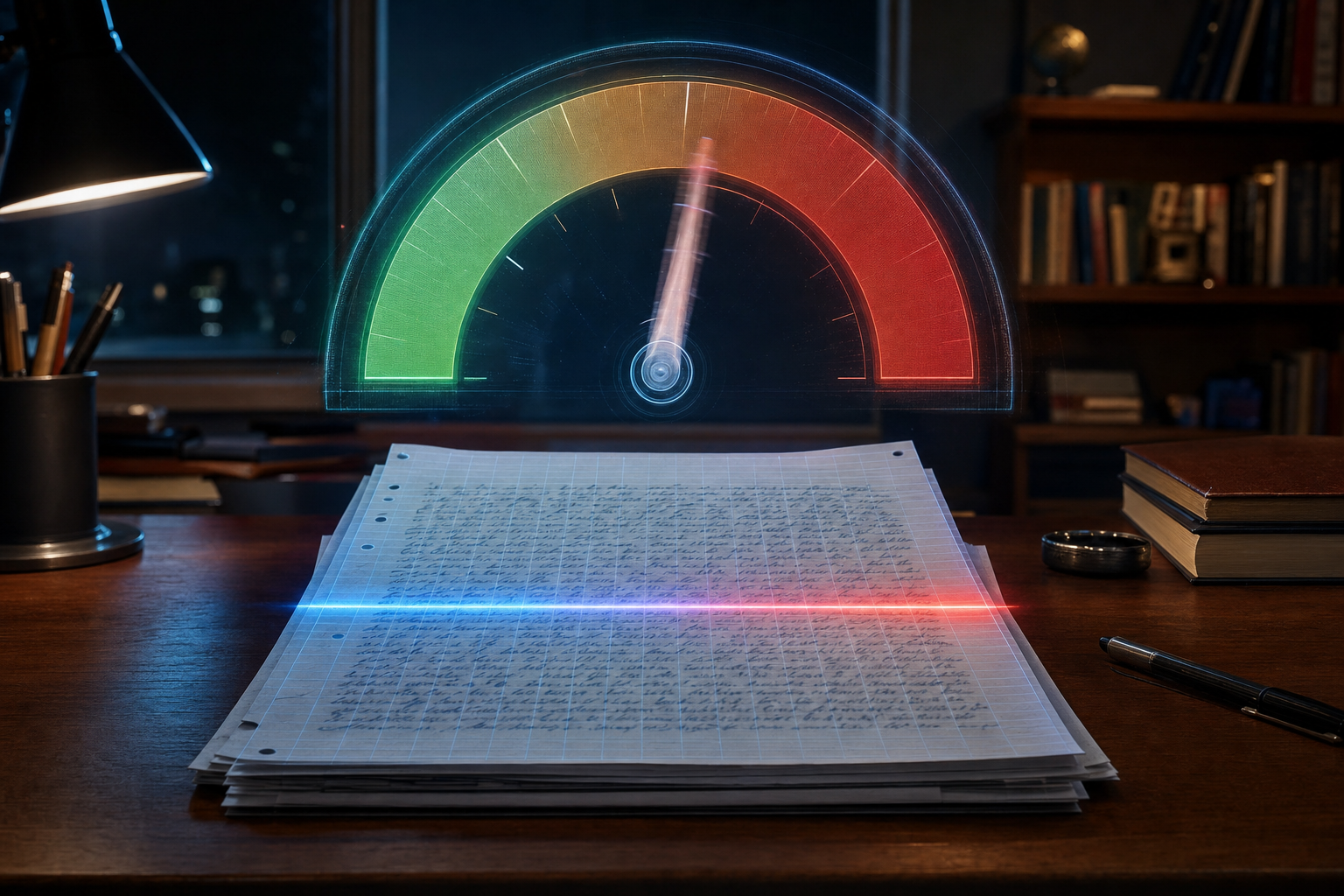
AI detection in schools is being asked to solve a problem it cannot reliably solve: determine with certainty who or what produced a student’s work.
A teacher reads an essay that feels different from the student’s previous writing. The vocabulary is more advanced. The sentences are polished. The argument is unusually organized.
The teacher runs the essay through an AI-detection tool. The report indicates that a large portion may have been generated by artificial intelligence.
The student insists the work is original.
Now what?
A percentage on a screen can feel decisive, particularly when a teacher already has concerns. But the score is still a prediction based on patterns in the writing. It does not show the student’s notes, drafts, research, revisions, or conversations. It cannot recreate how the assignment was actually completed.
That does not mean schools should ignore AI-assisted cheating. Students who use a chatbot to complete work they were expected to do independently bypass the learning and misrepresent their abilities. Teachers then lose the information they need to provide useful feedback and plan instruction.
Academic integrity matters. So does a fair process for determining whether it has been violated.
A Detection Score Is a Clue, Not Proof
AI detectors examine language and estimate whether portions of a document resemble text produced by a generative AI system.
Products use different models, training data, thresholds, and methods. Some analyze how predictable the language appears. Others look for patterns in vocabulary, sentence structure, repetition, phrasing, or organization.
The result is a probability or percentage. It is not direct proof of authorship.
Human writing can contain the predictable language or formal structure that a detector associates with AI. Generated text can be revised, paraphrased, translated, or combined with student writing until it becomes harder to identify. A student may also use AI for brainstorming or feedback without placing generated sentences into the assignment.
Those situations are not the same, but a detector may struggle to distinguish among them.
The tool is trying to identify a writing process by looking only at the finished product. That is a difficult task, particularly when human and machine contributions may be mixed together.
This is where schools can get into trouble. A report that was designed to flag a possibility can quickly become the central evidence in a disciplinary decision.
Why AI Detection Is Different From Plagiarism Detection
Schools have years of experience using plagiarism reports. When a report identifies language that matches an article, website, book, or previously submitted paper, the teacher can open the source and compare it with the student’s work.
The educator can then decide whether the student quoted the source, paraphrased it, cited it incorrectly, or copied it without acknowledgment.
AI detection does not provide that same trail of evidence.
Generative AI creates a new sequence of words, so there may be no original passage to find. A detector instead identifies language patterns that it considers more likely to have been produced by a machine.
The report cannot reveal what the student typed into an AI tool, what response the tool produced, or how much of that response was used. It also cannot reliably determine whether the student generated an entire essay, requested organizational feedback, used a grammar feature with generative capabilities, or wrote independently.
Treating an AI score like a traditional plagiarism match gives it a level of certainty it does not possess.
The Technology Is Improving, but the Limits Remain
The discussion about AI detectors is often reduced to two positions: They work, or they do not.
The research is more complicated.
A 2026 study published in the International Journal for Educational Integrity tested four popular detectors on fully human, fully AI-generated, hybrid, and humanized AI texts. One tool performed better than the others, and researchers found fewer false positives than several earlier studies had reported.
That is meaningful progress. It also does not resolve the larger problem.
Performance differed across products and declined when the writing combined human and AI contributions or was altered to sound more human. The researchers concluded that detection tools may provide useful initial flags but should not serve as the sole evidence in high-stakes decisions.
Even Turnitin’s guidance states that an AI-writing score should not be used by itself as the basis for adverse action against a student.
Newer models may improve accuracy. They will also be chasing generative systems that continue to change. A detector validated against one model, language, writing style, or type of assignment may perform differently when those conditions change.
Schools need to understand that context before turning a score into a consequence.
The Fairness Problem
A false accusation can do real damage.
A student may lose credit, face disciplinary action, miss an academic opportunity, or have their honesty questioned by teachers and family members. Even when the allegation is eventually dismissed, rebuilding trust can take time.
Multilingual learners face particular concerns.
A Stanford-led study found that several AI detectors frequently misclassified writing by non-native English writers. More than 61% of the tested TOEFL essays were falsely classified as AI-generated by the detectors examined. According to Stanford’s summary of the research, systems that rely on predictable language patterns may penalize writers who use a more limited range of English vocabulary or sentence structures.
Detector technology has changed since that study, and newer research suggests that some products have reduced false positives. Schools still cannot assume that every student, language background, writing style, subject, or grade level will be evaluated equally.
Teachers also need to consider legitimate reasons why a student’s work may suddenly look different. The student may have received tutoring, used an approved editing tool, followed detailed feedback, worked with a family member, or spent far more time on the assignment than usual.
Improvement should not automatically become evidence of misconduct.
Ask a Better Question
When a submission raises concerns, “Did AI write this?” may not be the most useful starting point.
Teachers need to determine whether the student understands the material, can explain the reasoning, and followed the assignment’s expectations.
Suppose a ninth-grade student submits a literary analysis that is much more sophisticated than the outline completed in class. The teacher could ask the student to explain the thesis, locate supporting evidence in the text, and describe how the argument developed.
If the student can discuss the ideas, produce notes, and explain key revisions, the teacher has meaningful evidence of learning. If the student cannot explain basic claims or identify the sources used, that also matters.
Neither outcome should be decided by the detector alone.
The student is not required to prove innocence simply because the writing improved. Teachers are looking at the full body of evidence, just as they would with any other academic-integrity concern.
The strongest evidence comes from an assessment process that allows the teacher to see how the work develops.
Make Student Thinking Easier to See
Schools will not protect academic integrity by trying to make every assignment impossible for AI to complete. As the technology improves, that becomes an exhausting contest.
A more durable response is to design important assessments around visible thinking.
Some work can begin in class. Students might develop a thesis, solve the first problem, select evidence, outline an argument, interpret a source, or write an opening paragraph while the teacher is present. This provides an authentic sample without turning the entire assignment into a supervised examination.
Larger projects can include a few meaningful checkpoints: a topic proposal, source list, outline, early draft, peer review, or final reflection. These steps already support better teaching. They also provide context if questions arise later.
Version histories can help, but they require careful interpretation. A document that appears all at once may raise a question, yet students sometimes draft in another program, work offline, or paste material from their own notes. It is one piece of evidence, not a complete account.
Brief student explanations are particularly valuable. A teacher might ask why a source was selected, why a paragraph was moved, how a conclusion was reached, or what changed after feedback. A two-minute conference, written reflection, or short recorded explanation can reveal whether the student understands the work.
Assignments can also draw on classroom experiences that a generic chatbot would not know: a laboratory observation, local issue, specific class discussion, field experience, assigned data set, or decision made during the learning process.
None of these approaches makes an assignment “AI-proof.” They make genuine participation harder to fake and student thinking easier to recognize.
Clarify AI Expectations Before Students Begin
Many disputes arise because the teacher and student never had the same understanding of what was allowed.
One teacher may permit AI for brainstorming. Another may allow grammar feedback but prohibit rewriting. A third may require students to complete the assignment without generative AI.
Those expectations can all be reasonable. They must also be visible.
Assignments can use three simple labels:
- AI-Free: Students complete the work without generative AI.
- AI-Assisted: AI may support specified parts of the process, but students remain responsible for the ideas and final response.
- AI-Integrated: Using, analyzing, or evaluating AI is part of the assignment.
Teachers may also need to clarify whether students can use translation support, predictive text, grammar assistants, citation tools, or tutoring platforms. Many familiar programs now contain generative features, and students may not recognize when they have crossed from basic editing into content generation.
Clear directions at the beginning prevent confusion at the end.
When AI is permitted, a short disclosure can document its role:
I used an AI tool to generate possible counterarguments and identify areas where my explanation was unclear. I selected the evidence, wrote the final response, and verified the cited information.
For a larger project, students might also retain relevant prompts or briefly describe what they accepted, changed, and rejected.
The requirement should remain reasonable. A student does not need to create pages of documentation for minor assistance. The amount of disclosure can match the importance of the assessment and the extent of AI involvement.
Build a Fair Review Process
Concerns will still arise, even with clear expectations and stronger assessment design. Schools need a consistent response that protects academic integrity without assuming guilt.
A teacher can begin by reviewing the assignment’s stated AI rules and comparing the submission with other classroom evidence. Notes, drafts, source lists, feedback, and version histories may provide helpful context.
The student should then have an opportunity to explain the content and describe how the work was completed. Teachers can ask specific questions rather than beginning with an accusation.
Language background, accommodations, legitimate editing assistance, tutoring, and changes in effort should also be considered. If a detector report is available, it can be included as one part of the review.
A serious consequence should require more than that report.
Schools also need a clear way for students and families to understand the evidence, respond to the concern, and appeal a decision when appropriate. Academic-integrity procedures built before generative AI may need updating, but the principles of notice, consistency, documentation, and fairness still apply.
Teachers should never ask a chatbot whether it produced a student’s paper. AI systems cannot reliably identify their own output, and their answer adds no dependable evidence.
When the available information remains uncertain, schools should be cautious about imposing a penalty that may be difficult to reverse.
Keep the Work Manageable for Teachers
Assessment redesign cannot become another large responsibility placed entirely on classroom teachers.
Requiring multiple drafts, individual conferences, oral defenses, and detailed documentation for every assignment would quickly become unmanageable.
School leaders and departments can identify which assessments deserve the strongest process evidence. A capstone, research paper, laboratory investigation, final project, or major writing assignment may justify several checkpoints. A daily practice activity probably does not.
Teachers need shared language, planning time, professional learning, and common procedures. Otherwise, each classroom develops a different enforcement system, and students encounter inconsistent expectations throughout the day.
A practical school-wide approach may begin with a small number of high-value assessments rather than trying to redesign everything at once.
Questions School Leaders Need to Ask
Before enabling an AI-detection product or changing academic-integrity procedures, leaders need more than a sales demonstration.
They should understand what the tool measures, what independent evidence supports it, and how performance changes across languages, subjects, grade levels, and writing styles.
They also need to decide:
- Whether students and families will know the tool is being used
- Who can view the reports
- What additional evidence is required before a consequence
- How students can respond or appeal
- How teachers will be trained to interpret results
- Whether student writing is retained or used to improve the vendor’s model
- How often the district will review the product’s performance
- Whether better assessment design could address the concern more effectively
Choosing a detection tool creates responsibilities that extend beyond purchasing software. It shapes how the school defines evidence, fairness, and student accountability.
Academic Integrity Requires More Than Detection
AI has made it easier for students to submit work that looks finished without completing the thinking behind it. Schools cannot pretend otherwise.
They also cannot rely on another algorithm to settle every question of authorship.
Academic integrity grows from clear expectations, worthwhile assignments, visible learning processes, honest disclosure, strong teacher-student relationships, and fair procedures when something does not add up.
A detection score may occasionally help a teacher identify work that deserves a closer look. The final judgment belongs to people who can examine the student, the assignment, the process, and the full context.
The future of assessment will not depend on whether schools can identify every sentence touched by AI. It will depend on whether educators can still determine what students understand, how they reached their conclusions, and whether the work reflects thinking they can genuinely call their own.
Subscribe to edCircuit to stay up to date on all of our shows, podcasts, news, and thought leadership articles.
Related reading
More on Artificial Intelligence