How the Coronavirus Shaped K-12 Decisions: Randy Ziegenfuss and Sean Slade
As Pennsylvania began closing schools, Randy Ziegenfuss explained how he made fast decisions without ego, and Sean Slade urged care for the whole child.

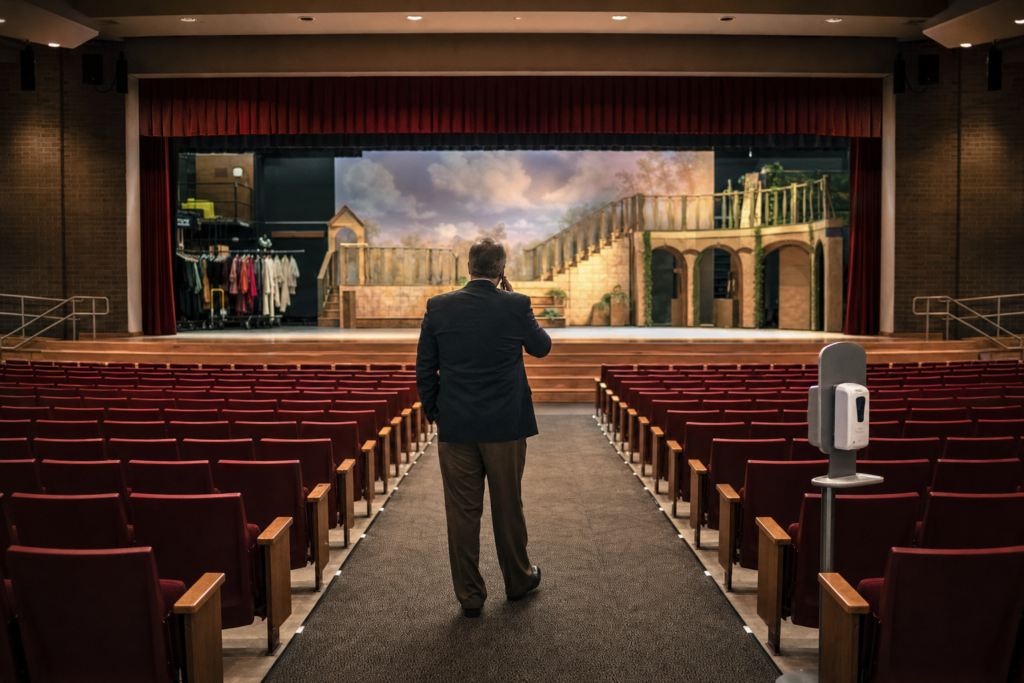
Superintendent Randy Ziegenfuss on crisis leadership as schools closed in March 2020, and ASCD's Sean Slade on why the whole child comes first.
This episode of edCircuit’s Education Today podcast, presented by Soundtrap for Education, was recorded in mid-March 2020, in the days when schools across the United States were deciding whether and how to close. Dr. Randy Ziegenfuss, then superintendent of the Salisbury Township School District in Pennsylvania, described how he and his team were making decisions with no playbook, a test of crisis leadership none of them had faced before. Sean Slade, senior director of global outreach at ASCD, then explained why the first priority in a crisis is the health, safety and sense of belonging of students and staff, and what schools could learn from the moment.
 Education TodayS1E2, How the Coronavirus is Influencing K-12 Decision-MakingPlay episode: S1E2, How the Coronavirus is Influencing K-12 Decision-Making (34 minutes 8 seconds)Follow on SpotifyApple
Crisis leadership: put your ego aside
Ziegenfuss began with how much school safety had changed during his career. When he started teaching, the front door was open and no one signed in or wore a badge. Safety and security had always mattered, but they now carried far more weight, whether a district was reviewing its plans after a school shooting elsewhere or preparing for a pandemic.
His central lesson for leaders was to put ego aside and tell the team plainly that this was not a one-person show. “I don’t have all the answers,” he said. None of his colleagues had been through anything like it, and neither had the country. For two weeks, he said, a principal had called him almost every day with an unusual situation no one had anticipated. His response was not to solve each problem alone but to ask who else should be part of the conversation, so the district could reach a plan that parents and staff could trust. The team kept its pandemic plan in a shared Google Doc and refined it daily.
Vulnerable inside, clear outside
Ziegenfuss described vulnerability as a double-edged sword. With his leadership team, built over years of working together, he invited people to poke holes in his thinking. In public, too much visible uncertainty could make families think the district did not know what it was doing. So the tone of a message to parents had to say: we thought this through, here is the plan, here is what we need from you, and we are in this together. If the district made a bad decision, he said, it would acknowledge and fix it publicly.
Ten minutes to decide about the musical
He offered an example from the afternoon of the recording. Pennsylvania’s governor had just announced school closures in one county and a limit of 250 people on large gatherings statewide, which went further than superintendents had expected in a state that values local control. Then a principal called: the high school musical was scheduled for that evening. What should they do?
Ziegenfuss and his team talked it through quickly. He asked for each person’s rationale and role-played a parent asking why school was still open but the musical was not. After about ten minutes he made the call. The musical was cancelled and could be rescheduled for late April. A professional development day and the weekend would give the district time to see where things stood. He had heard no pushback, he said, because people wanted to be safe.
Talking points for everyone who answers the phone
Communication, he said, is where crisis plans most easily “go sideways.” Parents heard from the superintendent’s automated messages and also from their children’s teachers, and every one of those messages represented the district. Salisbury Township’s answer was a set of talking points, updated as the plan changed and sent to supervisors and principals so that teachers, administrative assistants and anyone answering parents’ calls gave the same message: here is what we are doing, here is why, and here is what we do not yet know but can help with. “If you screw up,” he said, “you’re going to hear about it.”
A Data Insight on whole-group teaching
The episode’s Data Insight from The Learning Counsel found that whole-group instruction remained the predominant model at every level, and was most common in high schools despite efforts to diversify learning there. More than 70 percent of high school instruction was whole group, compared with around 60 percent in elementary schools and just over 50 percent in middle schools.
The whole child comes first
Slade, speaking from ASCD’s whole child perspective, said the first question in a crisis is not how much content students can keep learning. It is whether everyone, staff included, is healthy, safe and supported, and whether students and staff still feel they belong to their class and school community. Once immediate hygiene issues are handled, he said, the next step is attention to the social and emotional well-being of students and staff.
He called the pandemic “a clarion call” rather than a mere test. Education systems around the world, not only in the United States, had focused their energy on what can be measured and checked off, and had drawn attention away from schools’ role in developing the whole child. Students who are anxious, disconnected or unwell, or whose families are sick, find it very hard to learn.
Teachers do not have to be experts in everything
Slade’s own children’s school district, Arlington Public Schools near Washington, D.C., had just announced a four-week closure. Teachers were about to try teaching online with little warning. He hoped the moment would help teachers and the public accept that teachers are experts in pedagogy, child and youth development and their subjects, but do not need to be experts in everything. “Too many teachers still believe that they need to be the experts in everything,” he said. Trying new things, with some succeeding and some failing, is what an education system should be about.
Out of the silos
He also hoped the crisis would push education, health and community organizations to work together. Schools, health departments, after-school programs and community groups often serve the same children in the same places, each with its own policies and funding, and sometimes at cross purposes. “We’ve become experts in our each little silo,” he said. His practical advice was to bring local health leaders, school administrators and community organizations into the same room to agree on outcomes.
Testing was his example. Test scores show some things, he said, but not everything schools want children to develop, and students are measurably more anxious during state testing. A graduate who excels at multiple-choice tests but is anxious, unhealthy and without a support network may not be the most successful adult. He urged a broader conversation about what kind of people schools want their graduates to become.
Belonging online, and care for staff
Asked how schools could do better than sending home packets, Slade pointed to research on online and distance learning in higher education, much of which focuses on building community and a sense of belonging, not only on transferring information. Students learn and grow best through relationships, he said, and teachers teach better and enjoy it more when they know their students and build a positive learning community.
His final advice was for superintendents: make sure the plan also covers staff health and well-being, with real support and outlets for educators, even if the community they build is online.
Listen to the full conversation in the player above, or find every episode on the Education Today show page.
Subscribe to edCircuit to stay up to date on all of our shows, podcasts, news, and thought leadership articles.
Related reading
More on edLeaders