

Education Podcasting and SEL: Jeff Bradbury and Lori Jackson
TeacherCast founder Jeff Bradbury explains how audio helps students find their voice, and Lori Jackson describes why SEL became schools' top pressure point.


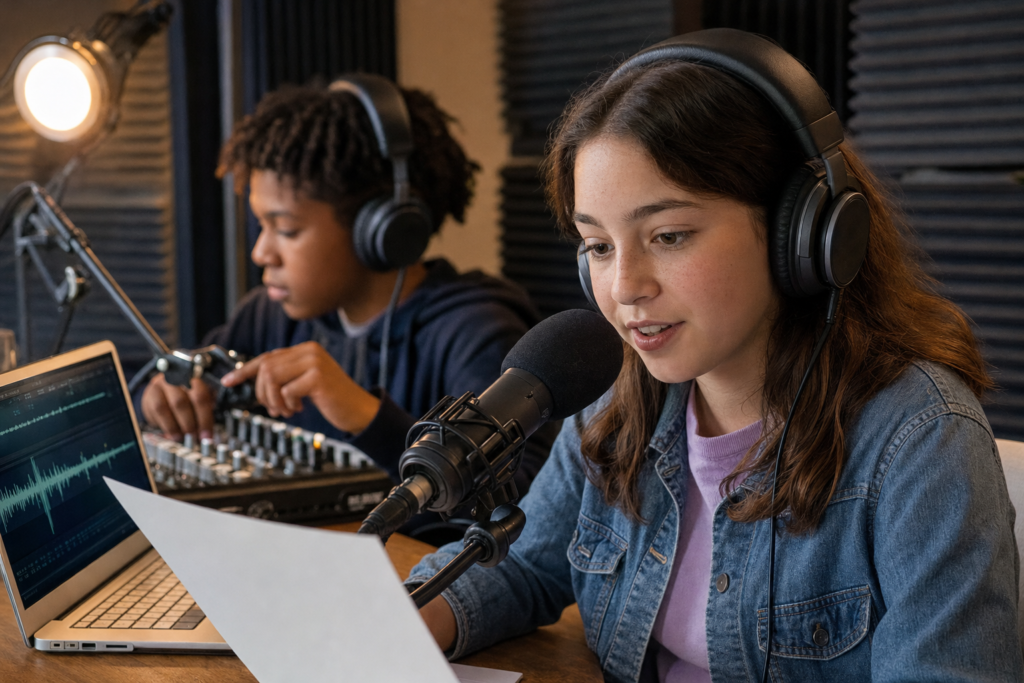
Jeff Bradbury on podcasting with students and finding your voice, and Lori Jackson on why social emotional learning became schools' top pressure point.
The premiere episode of edCircuit’s Education Today podcast, presented by Soundtrap for Education, paired two conversations that turned out to be closely linked. Jeff Bradbury, creator of the TeacherCast Educational Network and a middle school broadcasting teacher, talked about podcasting with students and what audio and video can do for them and for the educators who teach them. Lori Jackson, an educational psychologist and co-founder of The Connections Model, then responded to new survey data showing that students’ social and emotional needs had become the top pressure point for schools.
 Education TodayS1E1, Going Deep on Education Podcasting and SELPlay episode: S1E1, Going Deep on Education Podcasting and SEL (25 minutes 50 seconds)Follow on SpotifyApple
The equipment is no longer the hard part
When Bradbury started TeacherCast in 2011, podcasting took a lot of equipment. Now, he said, students can do it all on a phone. The question has shifted from what gear to buy to what a person actually wants to say.
His students know far more about what is possible than students did a decade earlier. In a lesson he calls “Why am I awesome?”, he asks each student to list ten things that make them special. Many still want to be musicians or athletes, but more than ever they also want to be YouTubers, online personalities and, in one case, shoe moguls, and they see audio and video as the way to get there. Bradbury sees his job as helping them do that safely and responsibly, in a way that will serve them later in life.
Teaching students to introduce themselves
His first lesson of the year is deliberately simple. Students pair up and introduce themselves. Fifteen minutes later, he asks each partner to introduce the other. The point is whether the first introduction was memorable enough to be repeated. From there the class moves into the power of voice: telling a story with a beginning, a middle and an end, explaining “your why,” and thinking about how people will remember you from what you say and do.
By the end of the course, every student has an “edu resume,” a Google Site that serves as a digital portfolio of audio and video projects explaining who they are and what value they bring. Bradbury argued that video in schools should not be reduced to the flipped classroom. It can be a learning platform, an entrepreneurial tool and a way for students to explain themselves.
Why many teachers still hold back from podcasting with students
Asked whether teachers had grown more comfortable with podcasting, Bradbury was candid. Some educators were doing remarkable work with student podcasts, but many teachers, in his experience, were “still scared of the potential,” worried that a student might record a math lesson to make a name for themselves. He built a website, podcastingwithstudents.com, to show teachers both the equipment and how to plan lessons around audio and video. Free tools such as Soundtrap, along with platforms such as Listenwise, have made it easier for professional development to cover this ground.
“Put down the wall and be vulnerable”
Bradbury’s own path ran through performance. He was pushed onto a stage at family reunions as a small child, became a musician and then a conductor, and learned that recording and editing his own work put him “in control of my destiny.” That led to filming orchestras, then to podcasting and a studio of his own. He believes everyone who records should understand the whole process, not just how to press a record button.
For educators who would like to share their expertise but fear they have nothing new to say, he offered two pieces of advice. The first was to keep creating content, because the first 50 episodes will not be as good as the next 50. The second, which he called the more important one, was to “put down the wall and be vulnerable.” It took him two years to put his own name on his website and more than 50 episodes to say it on air. When he finally launched a podcast under his own name, he said, the work changed. “It’s not listen to me,” he said. “It’s be with me on this journey.”
A data point that put SEL first
The episode’s Data Insight came from The Learning Counsel’s 2019 survey of school and district digital curriculum strategy. Respondents rated 14 issues on a scale of one to ten, and for the first time the social and emotional needs of students outranked every other issue facing schools.
Jackson said her reaction was twofold. It was good news that social-emotional learning was on people’s minds. But a pressure point also signals pain: schools, teachers and communities were struggling to meet the needs they saw. In her work with schools, teachers described mental health issues in children that they had not seen before and did not feel prepared to handle, along with concerns about behavior. Teachers themselves were stressed. “They’re not immune to what’s going on in society,” she said.
Teach SEL like any other skill
Jackson’s answer was to be proactive and specific. Her team breaks social-emotional learning down to foundational skills, particularly in early elementary school: can children name their emotions, and can they identify them in a moment of need? Teachers are asked to teach those skills like any academic skill, with time set aside for instruction and then chances for students to practice and apply them in class. Once those foundations are in place, schools can build the social skills and other parts of SEL on top of them. “It’s very doable when you don’t make it this giant amorphous topic,” she said.
Teachers, she noted, often worry about whether they are doing it right. The first step is reassurance, because good teachers already do much of this without noticing. The second is a clear, targeted set of skills. “You’re not telling them to be mental health counselors,” she said, which many teachers find uncomfortable. They are being asked to be the teachers they already are.
Technology was a deliberate choice for The Connections Model. Its app teaches children to identify, understand and manage their emotions, and Jackson said the children it was first designed for would not accept that teaching any other way. The app lets students drive their own learning instead of being talked at. Most schools, she added, already understand that SEL needs to run through the whole school day and year. The hard part is how, and that requires breaking the work into manageable pieces so that “the drumbeat of change” does not drown out practical approaches.
Listen to the full conversation in the player above, or find every episode on the Education Today show page.
Subscribe to edCircuit to stay up to date on all of our shows, podcasts, news, and thought leadership articles.
Related reading
More on Social-Emotional Learning