ESEA Explained: Why It Still Shapes Every School
A leading federal education expert explains why ESEA still matters, what’s at stake in the reauthorization debate, and how policy decisions shape every student’s future.

What is ESEA? The main federal K-12 law, now amended by ESSA. See what changed in 2015, what stayed, and what families and school leaders should know.
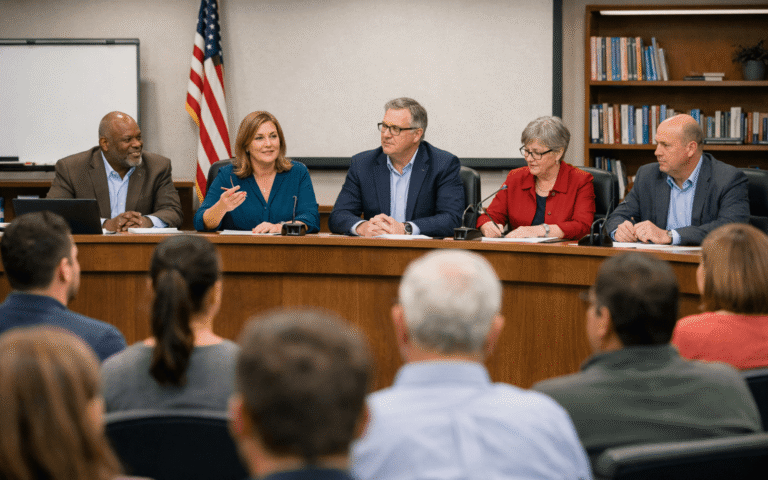
In this 2015 interview, Dr. Cheryl Sattler explains why the Elementary and Secondary Education Act matters to families, while Congress weighed an update. A new section below explains how ESEA became ESSA in 2015 and what the law looks like today.
Dr. Cheryl Sattler has 20 years’ experience in federal education policy and practice, specializing in Title I of the Elementary and Secondary Education Act (ESEA). Sattler penned Let’s Talk Title I: Everything You Need to Know and Do as an Administrator to assist school-based leadership navigate Title I.
Dr. Sattler and Dr. John H. Lockwood founded ETHICA, providing educational consulting services specializing in federal programs and evaluation. ETHICA specializes in educational consulting services that focus on the efficient running of federal educational programs, such as Title I, school improvement, and program evaluation.
Why ESEA Matters to Families
edCircuit: For the busy parent/community member that knows very little about ESEA why should they pay attention and why now?
Dr. Cheryl Sattler: The ESEA is the single biggest law for K-12 education, so it sets the stage for what is important in schools and how schools set their goals. For example, in 2002 (the last time Congress updated this law) schools became extremely focused on reading and math (in some cases, excluding other important areas such as the arts and even recess) because the ESEA focused on reading and math. If you think back to early 2002 – 13 years ago – our lives were very different, especially in terms of technology. Because Congress doesn’t update this law very often, the priorities that it sets are something our kids have to live with for a long time. It’s important to get those right.
Politics and the Timing of Reauthorization
edC: Is it good timing for ESEA to be on the national stage now or do we run the risk of it being further politicized given the start of the 2016 election cycle?
CS: There was a time when education was somewhat insulated from party politics, even at the national level. That’s no longer true, which means that work on education does become part of the election conversation. Politics is the reason ESEA hasn’t been updated for 13 years. But there are so many things in ESEA that need to be updated that we can’t afford to be picky about the timing.
Right now – in mid-2015 – is a small space where it is possible for Congress to focus on issues rather than politics before the presidential cycle really gets going. If Congress can finish by the early fall, we may see an updated law. Otherwise, presidential politics will take over and an update will have to wait at least until 2017, and probably longer.
Students With Disabilities and Federal Oversight
edC: If you had to wave the caution flag on the current state of ESEA, what areas would you be focused on further altering?
CS: I believe there’s a real missed opportunity in the fact that we have two big laws – ESEA and a separate law for students with disabilities. As you might guess, these laws often conflict, and even when they agree, the fact that students with special needs are seen as a separate group means that they often aren’t included in the conversation about “all” students. Congress should combine these two laws.
We don’t have a separate law for any other group of children! I’m also concerned with the current impulse in Congress to limit the federal government’s oversight role. Where things are going well, the federal government isn’t needed. But in places where large groups of students aren’t graduating, or where there are achievement gaps between student groups, if the federal government can’t intervene, often no one else steps up to address the problem.
Measuring Student Achievement and School Success
edC: Have we missed an opportunity to more thoughtfully frame student achievement data and student growth measures given the stories of misuse over the last couple of years?
CS: Issues of student data privacy (which aren’t really thoughtfully addressed in the current ESEA rewrite either) have clouded the debate about achievement – we’ve become more focused on the data itself and less on what the data mean. But I think the issue goes well beyond either data or technology.
The best-kept secret in education is that every state has very, very different ideas about what it means to achieve. Students who are considered gifted in one state could cross the border to the next state and be labeled underachieving. These definitions – which usually make our local kids look great! – might make us feel good about our local schools, but they don’t do our kids any favors when they go to college or try to get a job. If a student graduates but can’t read (and yes, this happens, more than you would think) – who are we kidding?
edC: Our conversations have expanded to national and now global rankings that often have us, both parent and practitioner, questioning what we are assessing and if we are assessing the right measures. With that as the backdrop, what data in your opinion is the most important when gauging both school and student success?
CS: That is a great question! I wish we would have this debate at a national level, one that truly involved parents, educators, and students. To me, the most important piece of data is this: Can a student leave school and go on to achieve his or her dream? If that’s true for all of our students – whether that dream is to colonize Mars or raise a healthy family or develop the next new technology, and whether those students are African-American, Caucasian, native English speakers or students with special needs – then our schools are working.
If on the other hand, when students leave school they stumble because they don’t have the right skills to compete for a job, or they can’t earn college credit because they need to do remedial work — our schools aren’t working well enough. This requires a longer view than K-12 – because after all, 12th grade is just the jumping off point to a child’s future. I hope that some of the new standards and new tests are getting to this kind of a measure – but there’s a long way to go.
What is ESEA? The Elementary and Secondary Education Act, ESSA and where the law stands now
What is ESEA? The Elementary and Secondary Education Act is the main federal law for K-12 schooling in the United States. Dr. Cheryl Sattler called it the single biggest law for K-12 education in the 2015 interview above, which was recorded while Congress was considering an update. That update arrived later in 2015 as the Every Student Succeeds Act, usually called ESSA. This section explains how the two names relate, what ESSA changed, and how the points Sattler raised look against the law as it now stands.
ESEA and ESSA: how the names fit together
ESEA was enacted in 1965 as Public Law 89-10, and the Congressional Research Service (CRS) describes it as the primary federal source of aid for elementary and secondary education, particularly through Title I, Part A, which funds the education of disadvantaged students. Congress amends and reauthorizes the law from time to time instead of replacing it. The 2002 update Sattler refers to was No Child Left Behind (Public Law 107-110). ESSA, Public Law 114-95, is the most recent reauthorization, so the accurate way to describe the law today is as ESEA as amended by ESSA. ESSA is the current text of ESEA and does not stand beside it as a second law.
The House passed the final agreement on December 2, 2015, by a vote of 359 to 64, according to a Senate Republican Policy Committee notice, and CRS reports the law was enacted in 2015. The sources differ on how long ESSA authorized funding: CRS says appropriations were authorized through fiscal year 2020 in its introduction and lists authorizations for fiscal years 2017 through 2021 in its appropriations section, and the Senate notice says the bill reauthorizes the law through fiscal year 2021. Congress has continued to fund the programs through annual appropriations since, according to CRS report R45977, last updated in 2026.
What ESSA changed and what it kept
According to CRS, ESSA gave states more room to design their own accountability systems. States must set long-term and interim goals, use several weighted indicators, and sort schools through an annual system of meaningful differentiation. They must also identify schools for comprehensive support, including the lowest-performing 5 percent of Title I schools, and schools for targeted support, and they must reserve at least 7 percent of Title I, Part A funds for school improvement. All states submitted consolidated state plans.
The law kept the testing structure. States must have academic standards and aligned assessments in reading or language arts, mathematics and science, with reading and math tests in grades 3 through 8 and once in high school. The Senate notice adds that states may let high schools use a nationally recognized test such as the SAT or ACT in place of the statewide test, and that the Secretary of Education may not prescribe specific standards, tests or accountability methods as a condition of approval. CRS says the same about the Secretary’s role with state standards.
Sattler’s concerns, read against the current law
Sattler raised three issues in 2015 that remain useful questions for families and school leaders.
- Federal oversight. Sattler worried that limiting the federal role would leave no one to act where large groups of students are not graduating or achievement gaps persist. ESSA limits what the Secretary can require but still obliges states to identify and support their lowest-performing schools. Both features are part of the law as it now stands.
- Different definitions of achievement. Sattler observed that each state has very different ideas about what it means to achieve. Because ESSA leaves standards to the states, that variation remains possible, which is a reason for families to read their own state’s standards and school reports closely and not rely on one state’s labels in another.
- Students with disabilities. Sattler argued for combining ESEA with the separate law for students with disabilities. The sources opened for this section do not describe such a change, and readers can find current information on both laws in edCircuit’s special education guide.
What a parent or leader can do with this
The most direct step is to find out whether a school receives Title I funds. CRS explains that Title I, Part A provides supplementary services to low-achieving students in schools with high concentrations of low-income students, and that a school is either a schoolwide program, with at least 40 percent low-income students, or a targeted assistance program. A state education agency can supply the state’s consolidated plan, and a district’s federal programs office can explain how its Title I funds are used. For measures of school and student success beyond test scores, which Sattler asked national debate to take up, edCircuit’s assessment guide is a good place to continue.
Subscribe to edCircuit to stay up to date on all of our shows, podcasts, news, and thought leadership articles.
Related reading
More on Education Policy and Government