



 EdCircuit Staff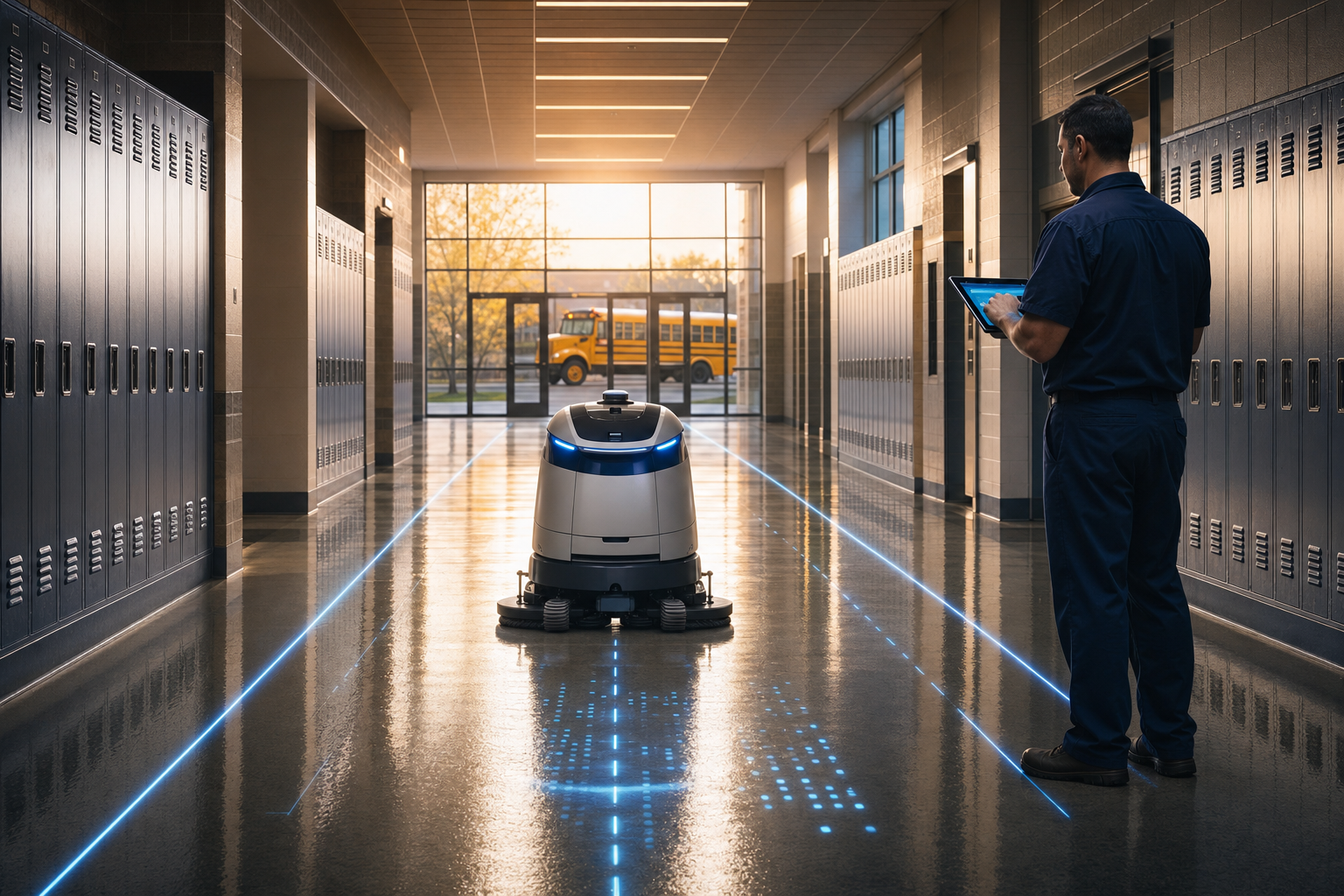
Most conversations about the future of AI in schools start in the classroom, with chatbots, tutors and lesson-planning tools. Yet some of the most practical uses so far sit outside it: in the software that plans bus routes, the machines that clean hallways overnight, the systems that run heating and air, and the tools that sort job applications in the central office. Some of these uses are delivering measurable savings. Others have failed in public, and a few raise questions about privacy and student safety that districts are still working through.
This is a look, area by area, at where autonomous and AI-driven technology is already in use in K–12 schools, what the evidence shows, and what district leaders should weigh before adopting it.
In the classroom: teachers are adopting AI faster than policy
Generative AI has reached classrooms quickly, often ahead of district guidance. CoSN’s 2025 State of EdTech District Leadership report found that 80 percent of districts have generative AI initiatives under way or planned, while 57 percent had written AI guidelines into board-approved policy. Training is catching up: an EdWeek Research Center survey found that half of teachers had received at least one AI training session by fall 2025, up from 13 percent in 2023.
Some districts are now adopting AI at scale. In August 2025, Miami-Dade County Public Schools, the third-largest district in the country, made Google’s Gemini for Education available to about 100,000 high school students and teachers, according to Google’s announcement.
Teachers remain divided on the value. A Pew Research Center survey of 2,531 public K–12 teachers in fall 2023 found that 25 percent believed AI tools do more harm than good in K–12 education and 6 percent more good than harm, while about a third saw an equal mix and another third were unsure. High school teachers were the most skeptical.
AI tutors: promising results, thin evidence so far
AI tutoring is the classroom use with the most attention and, so far, the least published evidence. Newark Public Schools in New Jersey began piloting Khan Academy’s Khanmigo in 2023-24 and has since expanded it districtwide with Gates Foundation support. District leaders say pilot students’ math scores improved, but no data had been published, and early pilot reports included basic math errors that Khan Academy says it has since fixed.
The strongest evidence so far comes from AI that supports human tutors rather than replacing them. In a randomized trial run by Stanford’s National Student Support Accelerator with more than 700 tutors and about 1,000 students from underserved communities, students whose tutors had an AI assistant were 4 percentage points more likely to master math topics, and up to 9 points more when their tutors were less experienced. The tool cost about $20 per tutor per year.
Students are not waiting for districts to decide. A Pew survey reported in February 2026 found that 54 percent of U.S. teens use AI chatbots for schoolwork, and 59 percent said AI cheating is a regular part of student life.
In the library: teaching AI literacy
School libraries are less a site of automation than a place where students learn to judge what AI produces. In Washington County Public Schools in Maryland, library media specialists teach AI literacy lessons in grades 6 through 12, adapted from Common Sense Media and taught alone or alongside English and social studies classes.
The library also offers a caution about letting AI make judgments. In 2023, Iowa’s Mason City Community School District asked ChatGPT whether books contained descriptions of sex acts to comply with a new state law, and removed 19 titles, including Beloved and The Handmaid’s Tale. The case is a reminder that decisions about what students may read call for human review.
Robots in schools: the overnight cleaning crew
Some of the clearest returns are in building operations. Spokane Public Schools in Washington bought 14 autonomous floor scrubbers, one for each middle and high school, for $1.08 million. The machines have run more than 1,500 hours across 16.5 million square feet, and floors that were cleaned once a week are now cleaned at least three times a week. Greenville County Schools in South Carolina has launched a $21.1 million robotic sweeper and scrubber program across 85 campuses, which it expects to save custodial crews four to six hours a day; that figure is a projection, not yet a measurement.
Heating and ventilation is a larger need. A federal Government Accountability Office report estimated that 41 percent of districts need to update or replace HVAC systems in at least half their schools, about 36,000 schools, and districts set aside an estimated $5.5 billion of federal pandemic relief funds for air filtration and HVAC. AI-controlled systems are one option for running that equipment more efficiently. The best-documented example is outside the United States: in Stockholm, the school-property company SISAB used AI-controlled HVAC across 87 education buildings from 2019 to 2023 and cut electricity use by 8.93 percent, according to a study by Schneider Electric.
In the cafeteria: early and mostly behind the scenes
Cafeteria automation is less developed than the hype suggests. edCircuit’s research found no U.S. district using computer-vision checkout lanes or AI waste cameras. The clearest use so far is in menu planning: Aramark Student Nutrition built its 2025-26 school menu, with more than 250 new recipes, using its own AI menu tool alongside 50,000 student surveys and dietitian input. For now, the cafeteria is a place to watch rather than a model to copy.
On the bus: routing software, cameras and electric fleets
Transportation shows both the payoff and the risk. Colorado Springs School District 11 used an AI routing tool from HopSkipDrive to cut its bus routes nearly in half, to about 55, saving more than $500,000 in a year; the superintendent said the savings protected at least 10 teaching positions. Denver Public Schools helped develop the same tool and used it to plan routes, model bell-time changes and prepare for school closures.
Routing software can also fail badly. In August 2023, Jefferson County Public Schools in Louisville, Kentucky, launched routes redesigned with AlphaRoute’s software that broke down on the first day; some students did not get home until nearly 10 p.m., and students missed more than a week of class while the district recovered. Columbus, Ohio, had dropped the same vendor the year before. Districts adopting routing tools need a tested fallback plan.
Other uses are spreading. Pittsburgh Public Schools’ AI stop-arm cameras on more than 200 buses recorded 10,989 illegal passes of stopped school buses between August 2024 and June 2025, more than 95 percent of them first-time offenses. Oakland Unified became the first major district with an all-electric bus fleet, 74 buses whose chargers can return power to the grid under AI-managed scheduling, and the EPA’s Clean School Bus Program has funded about 5,000 electric and clean buses nationwide.
Fully driverless school buses are not on U.S. roads. The one attempt to carry students in a driverless shuttle, at Babcock Ranch, Florida, was stopped by federal regulators in October 2018 because the vehicle did not meet school bus safety standards.
In the central office: hiring, paperwork and help desks
District offices are using AI for routine administrative work. Indianapolis Public Schools built internal tools that score principal applications against its hiring rubric and draft standardized salary-offer emails, keeps personal data out of them and leaves hiring decisions to people; it reports savings of more than $300,000 for 2026-27. In Texas, Katy ISD already uses AI for invoice processing, book policy reviews and Chromebook support, and plans to have AI handle about 30 percent of administrative inquiries over the next 12 to 18 months without cutting jobs, although one trustee raised concerns about relying on AI for building access.
The questions districts need to answer first
The most serious concerns involve student monitoring. An investigation by the Seattle Times and the Associated Press found that a records request at Vancouver Public Schools in Washington exposed nearly 3,500 unredacted student documents flagged by the monitoring service Gaggle, which about 2,200 students had triggered in one year; at least six students were potentially outed as LGBTQ+. The investigation found no independent research showing that such monitoring reduces suicide or violence. Earlier survey work by the Center for Democracy and Technology, reported by The 74, found that two-thirds of teachers knew of a student disciplined because of activity monitoring.
Classroom tools carry their own risks. Common Sense Media rated four popular AI teacher assistants, including Gemini in Classroom and MagicSchool, “Moderate Risk,” warning about content pushed to students without review and about bias in tools that generate behavior plans and individualized education program content.
What the future of AI in schools asks of district leaders
The evidence so far points to a practical approach. The strongest results come from narrow uses with clear measures: routes and fuel costs, cleaning frequency, energy use, staff hours recovered. Uses that make judgments about students, such as monitoring, discipline or which books stay on the shelves, need the most human oversight and the most caution.
For leaders weighing what comes next, a few questions help: what problem a tool solves and how its results will be measured; what data it collects and who can see it; how it fails and what the fallback plan is; and who stays accountable for decisions it informs. Districts that answer those questions before signing a contract are better placed to benefit from the next wave of autonomous technology, and to explain their choices to families.
Subscribe to edCircuit to stay up to date on all of our shows, podcasts, news, and thought leadership articles.
Related reading
More on Artificial Intelligence

