
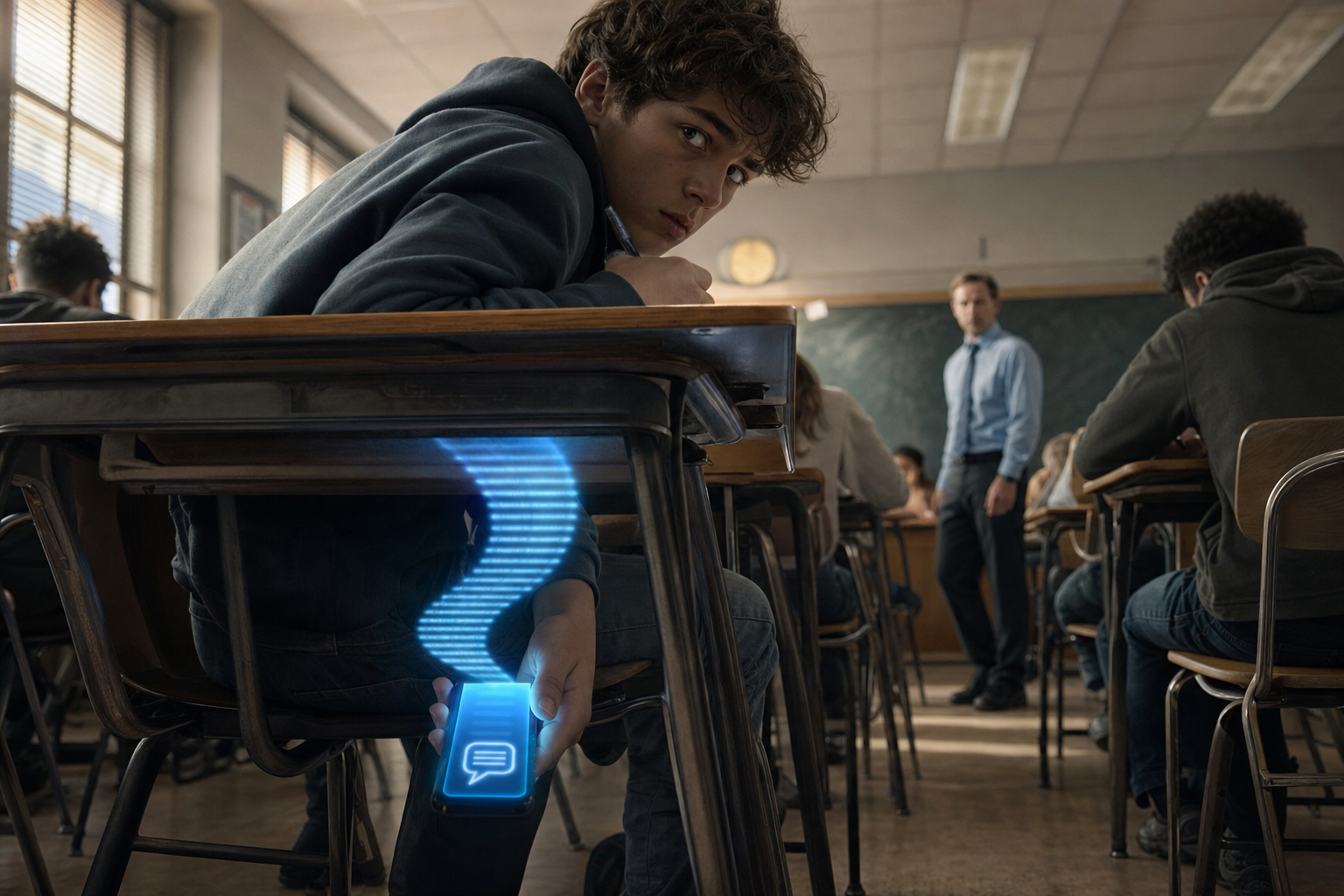
AI cheating is one of the most common worries in schools today. Students can ask a chatbot to write an essay, solve a math problem or answer a quiz, and teachers often cannot tell. In a Pew Research Center survey of U.S. teens released in February 2026, 59 percent said students at their school use AI to cheat at least somewhat often, and about a third said it happens very or extremely often. That figure reflects what teens believe about their classmates rather than what they admit doing themselves, but it shows how widespread the concern has become.
The picture is more complicated than the headlines suggest. Stanford researchers who have surveyed high school students for years found that 60 to 70 percent already reported cheating in some form each year before ChatGPT, and that share stayed about the same or fell slightly in 2023, after AI chatbots arrived. AI has changed how students cheat more clearly than it has changed how many do. For schools, the challenge is to prevent misuse while teaching students to use tools they will meet throughout their lives.
How students use AI to cheat
- Writing whole assignments. Essays, short answers and discussion posts generated in seconds.
- Solving problems without understanding. Math and science apps that show answers from a photo of the problem.
- Disguising copied work. Rewording text so plagiarism checkers do not flag it.
- Completing creative and coding work. Generated images for art assignments, or code for computer science tasks.
Use for schoolwork is now common: 54 percent of teens in the same Pew survey said they had used chatbots to help with schoolwork, which is why the line between help and cheating matters so much.
Not all AI use is cheating
The line between help and dishonesty is not always clear. Is it cheating if a student uses AI to brainstorm ideas and then writes the essay alone, or asks it to explain a passage they did not understand? Most schools now distinguish between uses that support learning and uses that replace it, and say so assignment by assignment.
Holly Clark, author of The AI Infused Classroom, argues that the reasons students cheat matter more than the tool. As she put it on the AVID Open Access podcast: “Kids cheat because they’re stuck. Kids cheat because they’re not interested. We can take both of those out of the situation, and they’re not going to be cheating.”
Why AI detectors are not the answer
Many schools turned to detection software. Turnitin reported that of more than 200 million papers its detector reviewed in its first year, about 11 percent contained at least 20 percent AI writing and about 3 percent at least 80 percent. Those are flags, not proof. Detectors make mistakes, and the cost falls on students wrongly accused. A Center for Democracy & Technology survey found 64 percent of teachers said students at their school had been disciplined for using, or being accused of using, generative AI in 2023–24, up from 48 percent the year before, while 68 percent of teachers used detection tools. In a later CDT survey, one in five students said they or someone they knew had been accused of cheating with AI without proof. edCircuit covers the problem in AI Detection in Schools: Why Educators Are Moving On.
What educators can do
1. Redesign assignments
Teachers are shifting some writing into class time, adding oral explanations and presentations, and grading drafts and process as well as final products. Others build AI into the assignment and ask students to show how they used it and what they changed. See Assessment in the AI Era: Rethinking How We Grade.
2. Set clear rules for each assignment
Students should know, for every task, whether AI is not allowed, allowed for specific steps, or expected, and how to disclose it. Clear rules prevent accidental violations and make real misconduct easier to address. New York City’s schools offer a lesson in how quickly thinking changed: the district blocked ChatGPT in January 2023 and reversed the ban that May, with the chancellor calling the first response “knee-jerk fear.”
3. Teach AI literacy
Students learn more from understanding how AI works, where it is wrong and why shortcuts undermine their own learning than from warnings alone. In July 2024, ISTE and ASCD revised the ISTE Standards so that existing indicators, especially in digital citizenship, cover the safe and responsible use of AI. See AI Literacy for Students: A Grade-by-Grade Guide.
4. Use AI to help teaching
Teachers who use AI themselves for feedback, question design and differentiation can model appropriate use and understand what students are doing.
Involving families
Many parents are unsure what tools their children use and where the line is. Schools can help by explaining the difference between support and substitution, for example a grammar suggestion versus a fully generated essay, sharing the school’s AI rules, and holding short information evenings. edCircuit’s parent’s guide to AI by age is a starting point.
Recommendations for schools and districts
- Clear AI-use policies in student handbooks, with examples of acceptable and unacceptable use.
- Updated honor codes that name AI explicitly.
- Fair processes that never rely on a detector score alone, and that let students explain their work.
- Professional development on assignment design and on using AI responsibly.
- Equal access, so that permitted AI use does not advantage students with paid tools at home.
AI cheating is a real problem, but it is better treated as a design and teaching challenge than as a policing one. Schools that redesign assessment, teach responsible use and set clear rules can protect academic integrity and prepare students for a world where AI is everywhere. For the wider picture, see edCircuit’s guide to AI in education.

Princeton University – Arvind Narayanan and Sayash Kapoor Cut Through the Confusion on Artificial Intelligence (Play video)
Related reading
Subscribe to edCircuit to stay up to date on all of our shows, podcasts, news, and thought leadership articles.
More on Artificial Intelligence