
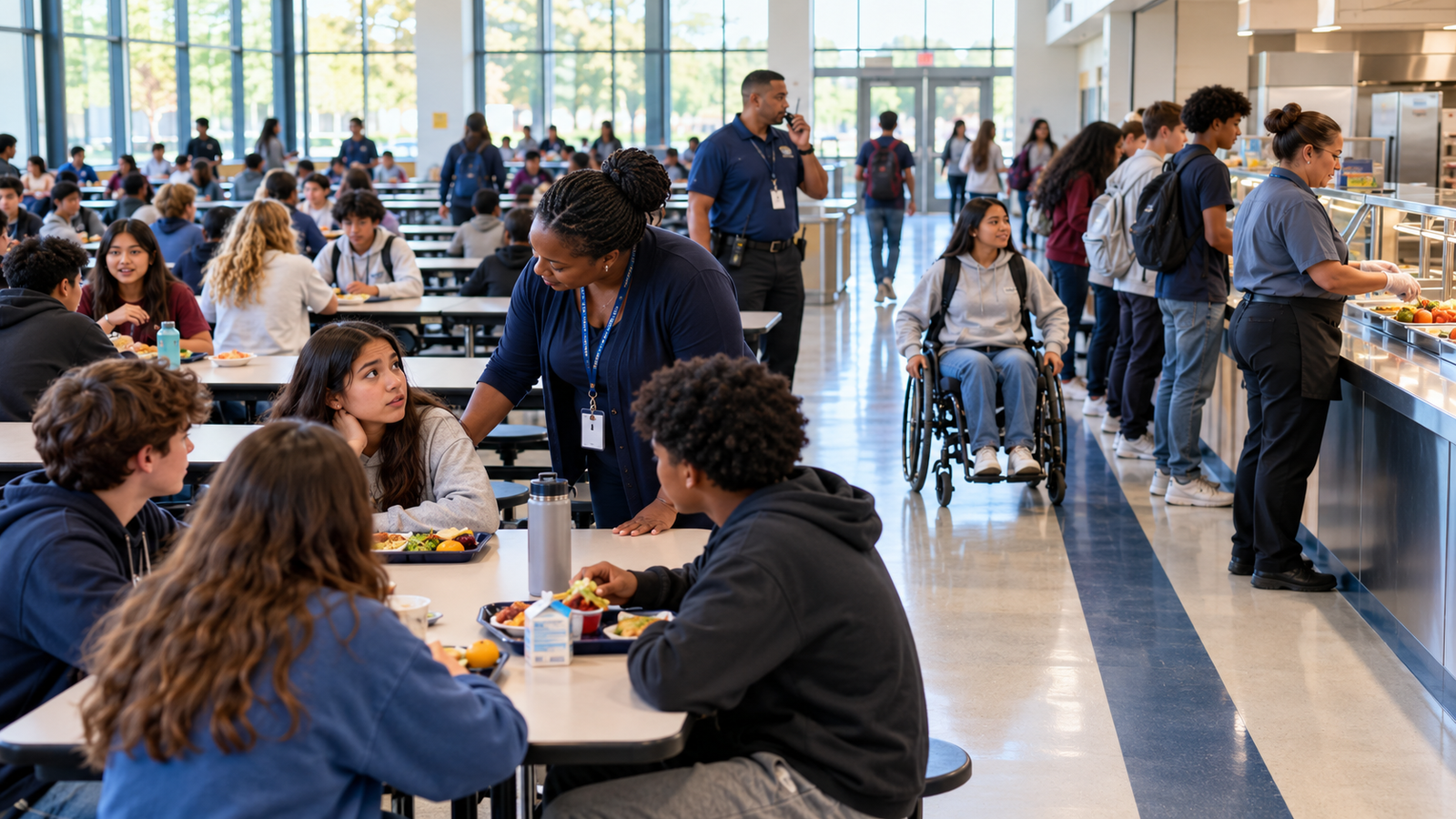
Cafeteria safety is tested when food, movement, noise, supervision, medical needs, and student behavior converge in one crowded space.
Lunch happens every day, which can make the cafeteria feel predictable. Students enter, move through the serving line, find their seats, and return to class. Staff know the schedule, and the room appears to run on routine.
Then a student says their throat feels tight.
One adult stays with the student while another reaches the nurse. Someone must locate the student’s emergency medication, create space for responders, and continue supervising everyone else.
In that moment, cafeteria safety is no longer a collection of separate policies. It becomes a test of whether people, information, equipment, and decisions can connect quickly enough to protect a student.
The challenge is not limited to food allergies. The same crowded environment must support clear supervision, accessible pathways, effective communication, student accountability, and a coordinated response to many different concerns.
 Safer EdThe Most Crowded Room in School: Is the Cafeteria Ready?Play episode: The Most Crowded Room in School: Is the Cafeteria Ready? (13 minutes)Follow on SpotifyApple
That is the focus of the latest episode of the Safer Ed Podcast, “The Most Crowded Room in School: Is the Cafeteria Ready?” The episode begins with a possible allergic reaction, but the conversation reaches much further. It examines the cafeteria as a complete safety environment—one shaped by supervision, communication, room design, accessibility, student relationships, and emergency readiness.
The Cafeteria Is Its Own Operating Environment
Schools devote considerable attention to classroom safety, but the cafeteria operates differently from a classroom.
Students arrive and leave in waves as noise levels rise. Food-service employees focus on meals while teachers, aides, administrators, or lunch monitors supervise students they may not know.
A cafeteria plan should answer basic operational questions before an emergency occurs:
Who leads during each lunch period?
Which adults supervise specific areas and respond to medical concerns?
Who summons trained help and manages the larger group if an adult must leave?
Who can redirect movement or clear an area for responders?
The answer cannot simply be “the adults in the room.” Shared responsibility works only when individual responsibilities are clear.
More Adults Do Not Automatically Mean Better Supervision
A cafeteria may have several adults present and still contain blind spots.
If everyone watches the room generally, no one may be consistently watching the tray-return area, a side exit, the far tables, or the hallway leading to the restrooms. An adult helping one student can unintentionally leave another area without coverage.
Defined supervision zones can improve visibility without locking adults into a single location. Each person should understand which part of the environment depends on them and who provides backup when they are pulled away.
This is especially important when one lunch period is leaving while another is arriving. Lines cross, chairs move, spills occur, and attention is divided. Those ordinary conditions—not an empty cafeteria—show whether the supervision plan works.
A Food-Allergy Plan Must Reach the Cafeteria
Food allergies are one of the most recognizable cafeteria risks, but having a policy does not guarantee a coordinated response.
The CDC’s guidance for managing food allergies in schools emphasizes daily management for individual students, preparation for emergencies, professional development for staff, education for students and families, and a safe, supportive school environment.
Nutrition professionals, lunch monitors, teachers, aides, administrators, and substitutes may all be present when a reaction begins. They should understand how to activate the student’s emergency care plan, summon trained assistance, and locate authorized emergency medication.
CDC materials also caution against sending a student experiencing a possible allergic reaction to the nurse alone. The response must come to the student.
Schools should follow applicable laws, medical orders, district policies, and individual emergency plans. The goal is not to encourage untrained employees to improvise. It is to eliminate uncertainty about who will act and how trained personnel and authorized medication will reach the student.
Available Is Not the Same as Accessible
A plan may state that emergency medication, a radio, or a first-aid kit is available. That does not answer the most practical question: Can the right person reach it quickly from the cafeteria?
Distance, locked doors, crowded hallways, the nurse’s availability, and the student’s location can all affect the response.
Schools can test access without creating a dramatic simulation. Start at the farthest cafeteria table and walk the actual response route. Determine how long it takes to contact the office, reach authorized supplies, and bring trained assistance to the student.
What happens if the nurse is assisting another student, the radio does not connect, or a substitute is supervising lunch? What if the usual entrance is blocked?
A plan becomes dependable when it accounts for the predictable ways its first option might fail.
An Empty Room Shows the Layout. A Full Room Shows the System.
Facility reviews often happen before students arrive or after they leave. That may reveal damaged furniture, blocked exits, or equipment concerns, but it cannot show how the cafeteria functions under normal pressure.
Observe the room during its busiest five minutes.
Where do lines intersect? Which tables are difficult for adults to see? Can students using mobility devices move through the room without navigating around backpacks, chairs, and crowded aisles? Can responders reach every area?
A spill, delivery cart, or backed-up tray-return line may seem minor. Together, they can restrict movement, reduce visibility, or complicate an evacuation.
The U.S. Department of Education’s school emergency-planning guidance emphasizes clarifying roles and preparing for emergencies across the school environment. Cafeteria employees and people who understand students’ access and functional needs should be part of that planning—not added after the plan is written.
Communication Must Compete With Noise
The cafeteria is often one of the loudest rooms in the building. That affects more than comfort.
Can students understand an emergency announcement? Can an adult summon help without leaving a student? Can staff provide a precise location without shouting across the room or sharing unnecessary personal information?
“We need help in the cafeteria” may not be specific enough. In a large space, responders may need to know which side of the room, which entrance offers the clearest route, and whether staff have already created space around the student.
Schools should test the intercom while the room is full and confirm that radios, phones, call buttons, or other communication tools work throughout the space. Every primary method should have a practical backup.
Cafeteria Safety Is Also Social Safety
The cafeteria is where students choose seats, navigate friendships, and experience school culture in public.
Bullying, exclusion, food-allergy stigma, conflict, and sensory overload may become more visible during lunch—or disappear into the activity of the room.
Effective supervision includes noticing patterns: who repeatedly eats alone, who avoids the serving line, which areas attract conflict, and whether a student leaves at the same time each day.
Those observations should not lead to quick conclusions, but they should reach the right people. A lunch monitor may see something that becomes meaningful when connected with observations from teachers, counselors, nurses, special education professionals, and families.
This connects with the previous Safer Ed episode about seeing the whole student. Safety improves when separate observations become coordinated support.
Accessibility Cannot Be Added After the Room Is Full
For some students, cafeteria noise, smells, crowding, and unpredictable movement can make lunch difficult. Others may require mobility assistance, visual directions, additional transition time, medical support, or individualized seating.
These considerations should be built into cafeteria operations and emergency planning from the beginning.
The goal is not simply to move students through lunch efficiently. It is to create an environment where students can participate safely and with dignity.
Practice the Connections, Not the Drama
Schools do not need a surprise simulation during lunch to evaluate readiness.
A short tabletop exercise can bring together the people responsible for the cafeteria. Give them a realistic situation: A student needs help at the far end of the room, the nurse is unavailable, the radio does not connect, and the next lunch group is waiting outside.
Ask one question: What happens first?
Then test the response. Can staff reach supplies and contact the office? Can responders enter without moving against the flow of students? Can one adult lead while another maintains supervision?
The exercise may reveal that substitutes cannot access the plan, medication is too far away, or no one is assigned to an important exit.
Those are not individual failures. They are system findings—and opportunities to improve before a real emergency.
Questions for School Leaders
Before the next lunch period, consider asking:
Does every adult understand their role?
Can trained help reach any student without preventable delay?
Can announcements be understood while the room is full?
Do supervision and emergency plans reflect how the cafeteria actually operates, including student needs and staff absences?
If one part of the plan fails, is there a workable backup?
The cafeteria may be the most crowded room in the school. That should also make it one of the most intentionally planned.
Listen to the Safer Ed Podcast
Listen to Safer Ed Season 4, Episode 7: “The Most Crowded Room in School: Is the Cafeteria Ready?” for a deeper discussion of cafeteria supervision, food-allergy readiness, communication, accessibility, student behavior, and emergency response.
To continue learning, explore the Science Safety Anaphylaxis and Duty of Care modules.
Subscribe to edCircuit to stay up to date on all of our shows, podcasts, news, and thought leadership articles.
Related reading
More on School Safety